








Charlie Woods’ Florida State Commitment: A Smart Choice That Breaks The Blueprint
I’ve spent 35 years around professional golf, and I’ve learned that the most interesting stories aren’t always about tournament victories or record-breaking rounds. Sometimes they’re about the paths not taken—the decisions that reveal something deeper about how the game is evolving, even at its grassroots level.
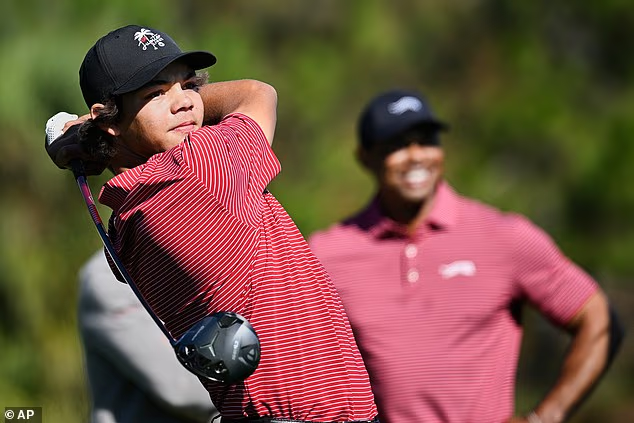
So when Tiger Woods’ 17-year-old son Charlie announced his commitment to Florida State University instead of following his legendary father’s footsteps to Stanford, my first instinct wasn’t surprise. It was recognition. I think what we’re seeing here is less about Charlie rejecting Tiger’s legacy and more about him writing his own story with his father’s blessing. And that’s actually a really healthy sign for junior golf.
The Stanford Shadow: Why Staying Home Made Sense
Look, there’s no understating what Tiger accomplished at Stanford. The resume is almost absurdly dominant: 1995 Male Freshman of the Year, 1996 NCAA individual champion and National Player of the Year, eight tournament victories in a single year. I covered some of those matches back in the day, and frankly, he was operating on a different planet than his peers. That kind of shadow is long—impossibly long for a kid trying to figure out who he is as a player and a person.
What strikes me most about Charlie’s decision is that it came with what sounds like genuine parental support. Tiger himself said last year:
“Our biggest thing that we’ve tried to teach him is that we want Charlie to be Charlie. We don’t want Charlie to be Tiger.”
In my three decades covering the tour, I’ve watched enough second-generation athletes struggle under the weight of inherited expectation. Some thrive with it. Others crumble. Charlie appears to have a parent wise enough to recognize the difference between legacy and burden.
The geography matters too. Tiger revealed previously that Charlie was keen to stay in the Southeast rather than head west to California. From a practical standpoint, that keeps him closer to home, closer to his support system, and perhaps most importantly, away from the relentless comparisons that would inevitably follow him to Palo Alto. That’s not running from anything—that’s making a mature choice about environment.
Florida State’s Growing Golf Dynasty
Now, here’s where I think casual fans might miss the real story. Florida State isn’t some consolation prize. The Seminoles have quietly become one of college golf’s premier programs, and Head Coach Trey Jones has built something genuinely special in Tallahassee.
The pedigree speaks for itself: Brooks Koepka came through the FSU program. So did Paul Azinger and Daniel Berger. That’s not just any school’s alumni list—those are major championship winners and PGA Tour stalwarts. Koepka alone has won four majors. When Charlie commits to FSU, he’s not joining some mid-tier program banking on his name recognition. He’s joining a pipeline.
The Class of 2027 they’re assembling is star-studded in its own right. Miles Russell, the No. 1 player in the American Junior Golf Association Rankings, is already committed. That’s the kind of peer competition that sharpens iron. In my experience, that competitive cauldron—training alongside elite amateurs every single day—often matters more than the coaching accolades or the facilities, though FSU has those in spades.
The Real Test Ahead
Let me be clear about what Charlie’s achievement actually is at this point: He’s a talented 17-year-old junior golfer who won a state title at The Benjamin School and has earned a scholarship to a top-tier college program. That’s genuinely impressive. But it’s also where the real work begins.
College golf is a furnace. The jump from high school dominance to competing against the country’s elite amateurs is significant. Having watched hundreds of junior phenoms over the decades, I can tell you that college is where we learn who’s truly built for this game and who was just the best player in their region. Some thrive. Others discover they want different lives. Both outcomes are perfectly fine.
What matters is that Charlie will have the space to find out which one applies to him. And that he’ll do it in an environment where excellence is expected but where he won’t constantly be measured against his father’s impossible standard.
A Different Kind of Legacy
Tiger said something else last year that I think captures the real genius of how he and Charlie are approaching this:
“It’s fun to be a part of the process with Charlie and go through it and see the opportunities that he has created for himself by playing better, places that he could play, wants to play and ultimately we’ll decide where he wants to go play.”
Notice the language there: “opportunities he has created for himself.” Not that Tiger created. Not through famous last names or connections. Through his own play. That’s parenting in the modern era of elite sport, and it’s refreshing to see.
Charlie Woods’ commitment to Florida State isn’t a rejection of his father’s brilliance. It’s actually a pretty shrewd endorsement of a different kind of success—one built on his own terms, in his own place, at his own pace. At 17, that’s wisdom most kids never find.
Whether he goes on to play professional golf or discovers a completely different path, he’s already shown something that matters far more than any single tournament victory: the ability to make his own choice.


