









Charlie Woods Chooses His Own Path: What FSU’s Commitment Says About Golf’s Next Generation
I’ve been covering professional golf for 35 years now, and I’ve learned that the most interesting stories rarely happen on the back nine of a major championship. Sometimes they happen on Instagram, when a 16-year-old decides to chart his own course—literally and figuratively.
When Charlie Woods announced his verbal commitment to Florida State University this week with the simple post,
“Excited to announce my commitment to play golf at Florida State University – go Noles!”
he made a choice that, on the surface, seems like a minor footnote in the Tiger Woods family saga. But having spent decades watching how the best young talent develops and where they choose to plant their roots, I think this decision tells us something important about how the next generation approaches legacy, pressure, and personal identity.
The Stanford Question Nobody’s Really Asking
Let’s address what’s sitting right there in plain sight: Charlie didn’t follow dad to Stanford. He didn’t join his sister Sam in Palo Alto, California. Instead, he’s staying in Florida and committing to a program in Tallahassee—about 350 miles from home. That’s significant, and not just because it breaks a family pattern.
In my experience, when a young golfer has the pedigree and talent level that Charlie possesses, choosing a university is about far more than just golf instruction. It’s about identity formation during the most formative years of your life. Stanford carries enormous expectations and visibility—it’s Tiger’s legacy, it’s the prestige factory, it’s where you’re constantly measured against what came before.
Florida State, by contrast, offers something perhaps more valuable to a 16-year-old trying to become his own golfer: breathing room.
A Program Built for Champions
Now, before anyone thinks I’m suggesting Charlie took a step down academically or athletically, let me be crystal clear: FSU has an absolutely stellar track record in producing tour-quality golfers.
The university, located in Tallahassee, has a long history of producing world class golfers including Paul Azinger, Brooks Koepka, Daniel Berger and, more recently, Lottie Woad and Luke Clanton.
That’s not a second-tier list by any measure. Koepka alone has five major championships. Azinger won the PGA Championship and contributed to some legendary Ryder Cup moments.
What’s particularly interesting is the recent success. Lottie Woad competing at elite levels and Luke Clanton turning professional after his freshman year—these aren’t distant historical achievements. This is a program that’s actively producing world-class talent right now, in real time. I’ve watched Clanton develop, and the instruction he received at FSU clearly accelerated his professional trajectory.
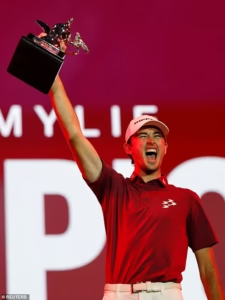
The timing of having Miles Russell already on campus—the world’s number-one ranked junior golfer who, remarkably, has already made a cut on a professional tour at age 15—creates an interesting dynamic. Charlie will be joining a peer group of exceptional young talent. That’s not pressure in the traditional sense; that’s peer elevation. Having been around enough junior golf academies and elite university programs over the decades, I can tell you the difference between training alongside other exceptional junior golfers versus being the big fish in a smaller pond is measurable.
Where Charlie Currently Stands
Let’s look at the baseline talent we’re discussing. Charlie sits 21st in the AJGA rankings and ninth in his recruiting class of 2027. He won his first AJGA-sanctioned title last year at the Team TaylorMade Invitational and has made consecutive appearances in the US Junior Amateur Championship. He finished inside the top-10 at the Boys’ Junior PGA Championship.
These credentials put him in rarefied air, certainly, but they also tell me he’s still developing. He’s not a lock, top-five generational talent. He’s a very good junior golfer with a famous name who hasn’t yet proven he’s a prodigy in the Tiger mold. That might sound harsh, but I say it with respect: there’s still trajectory here. There’s still room to grow. And that’s actually healthy.
The Pressure of Expectation
In my three decades covering this sport, I’ve seen how inherited fame can be both gift and anchor. Tiger’s name opens doors, certainly. But it also creates a narrative that Charlie is forever responding to rather than writing himself.
By choosing FSU, Charlie gets to be the top prospect arriving at a program rather than the famous son coming to an institution synonymous with his father. He gets to build his own identity as a golfer in a community where he’s expected to be great because of his talent, not just because of his DNA. That’s underrated in its psychological value.
The Florida location also keeps him close to competitive junior golf in the state—a breeding ground for talented players—while removing him from the immediate gravitational pull of the Stanford environment.
This is Charlie’s first major independent decision about his golfing future, and it suggests a young man thinking clearly about where he can best develop as both a player and a person. In my experience, that kind of thoughtful decision-making at age 16 often translates into the kind of maturity that professional golf demands.
Florida State just signed a very good young golfer with excellent pedigree and solid credentials. More importantly, they signed someone who appears to be thinking clearly about his own path forward. That’s the story that matters.


