









Garmin’s 2026 Golf Lineup: Smart Tech That Actually Matters (And One That Doesn’t)
Garmin just dropped three new products for 2026, and I’ll be honest—I was skeptical. After testing hundreds of clubs and working with launch monitors for the better part of a decade, I’ve learned to be suspicious of companies that bundle gear together and call it innovation. Too often, you get one legitimately useful product bundled with two pieces of marketing theater.
But this lineup is different. Two of these products actually solve real problems. One is a swing and a miss.
The Approach G82: The One That Matters
Let’s start with what I’m genuinely excited about: the Approach G82 handheld GPS and launch monitor combo. I’ve spent enough time on the practice range with various launch monitors to know what actually helps golfers, and what’s just noise.
The G82 isn’t revolutionary—it’s an evolution of Garmin’s G80 platform that’s been around since 2019. But evolution done right is worth paying attention to. Here’s what makes it work:
The built-in radar metrics are the headline feature. Ball speed, club speed, smash factor, and tempo data are the metrics that matter when you’re dialing in your swing. I’ve watched golfers make massive improvements in their consistency by obsessing over smash factor alone—that ratio of ball speed to club speed that tells you how efficiently you’re transferring energy. If you’re swinging 85 mph and only getting 127 mph ball speed, that’s a 1.49 smash factor. That’s valuable information, and having it in your pocket at the range changes how you practice.
“Built-in launch monitor: essential radar metrics like ball speed, club speed, smash factor and tempo help golfers to make swing adjustments at the range.”
But here’s where the G82 genuinely differentiates: the putting metrics. I’ve tested dozens of golf products, and I can count on one hand how many actually address putting with launch monitor data. Stroke length, tempo, club and ball speed—these are things you can measure and improve. Most golfers have no idea if their putting stroke is consistent. Now they can.
The bag mapping feature is equally practical. You spend 30 minutes at the range hitting each club, and the G82 records how far everything goes. Then it uses that data to power a virtual caddie on the course. That’s not gimmick territory—that’s filling a gap that’s existed since golf GPS devices became mainstream. Every golfer thinks they know their distances. Most don’t. This fixes it.
At £519.99, is it expensive? Yes. But compared to a full launch monitor system that costs three times as much, it’s reasonable. The question is whether you’ll actually use it. If you’re a golfer who practices deliberately and wants to track your numbers, this is worth the investment.
The Approach J1: Smart Junior Equipment Done Right
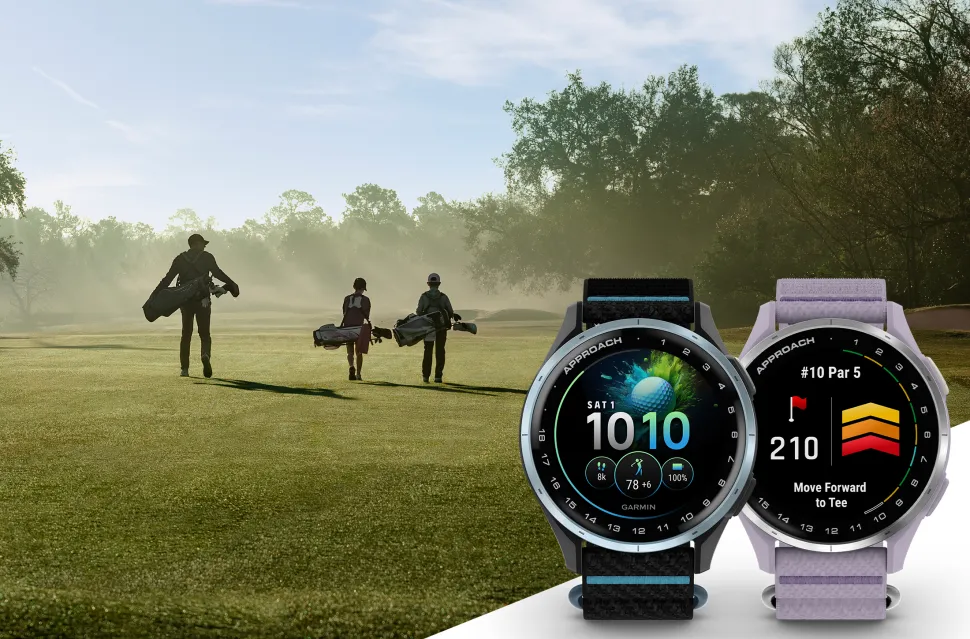
I’m genuinely impressed by what Garmin did with the J1 junior watch. This isn’t a gimmick product dressed up for kids—it’s thoughtful design that addresses real problems in junior golf development.
The lightweight, slim design isn’t just aesthetic. I’ve worked with junior golfers whose swings were actually affected by equipment that was too heavy or bulky on their wrists. That matters. The ComfortFit fabric strap for smaller wrists shows someone understood the actual user base.
“It has a slim, lightweight design to avoid obstructing the golf swing, and is available with either a cloud blue or lilac metal bezel. There’s also a ComfortFit fabric strap, that fits securely on smaller wrists.”
But the real value is in the software. Personal par and tee-off guidance are confidence-builders for kids just starting out. Golf is hard enough without putting kids on inappropriate tee boxes or setting unrealistic scoring expectations. This product gets that. The pace-of-play timer is less about pedagogy and more about addressing a genuine problem in the game—but it’s a practical addition.
At £309.99, this is positioned for committed junior golfers, not casual players. If your kid is in a junior program or playing regularly, this is worth considering. The AMOLED screen with 15 hours of battery life means it won’t die mid-round, and the waterproofing means it’ll survive typical junior golf adventures.
Home Tee Hero: Where They Lost Me
The home simulator app update is where I need to pump the brakes. Enhanced graphics and 15 new courses sound good, but here’s the reality: home golf simulators live and die by their ball-tracking accuracy and swing feedback quality. Neither of those things improve with prettier graphics.
I’ve tested home simulators extensively. The visualization can make or break the experience—nobody wants to play ugly courses. But if the underlying technology doesn’t improve, you’re paying for a facelift, not a fundamental upgrade.
“This time around there are more realistic graphics, along with 15 new enhanced golf courses and a new on-course practice mode.”
The app works with the Approach R10 (and R50), which are solid launch monitors for home use. But neither of those devices offers the ball-speed accuracy or spin data you get from pro-level radar systems. You’re playing a simulation, not a true analysis. That’s fine for fun or winter practice, but don’t confuse it with serious training data.
The Practical Takeaway
Garmin’s hitting on two cylinders here. The G82 is a legitimate tool for golfers who want to understand their game better. The J1 is thoughtfully designed for its audience. Home Tee Hero is just new paint on existing infrastructure.
If you’re a golfer who practices with intention and tracks your numbers, the G82 is worth serious consideration. If you’ve got a junior golfer in your life who’s committed to the game, the J1 makes sense. And if you already own a home simulator and like what you’ve got, the graphic update is nice but not essential.
That’s not hype. That’s reality.


