









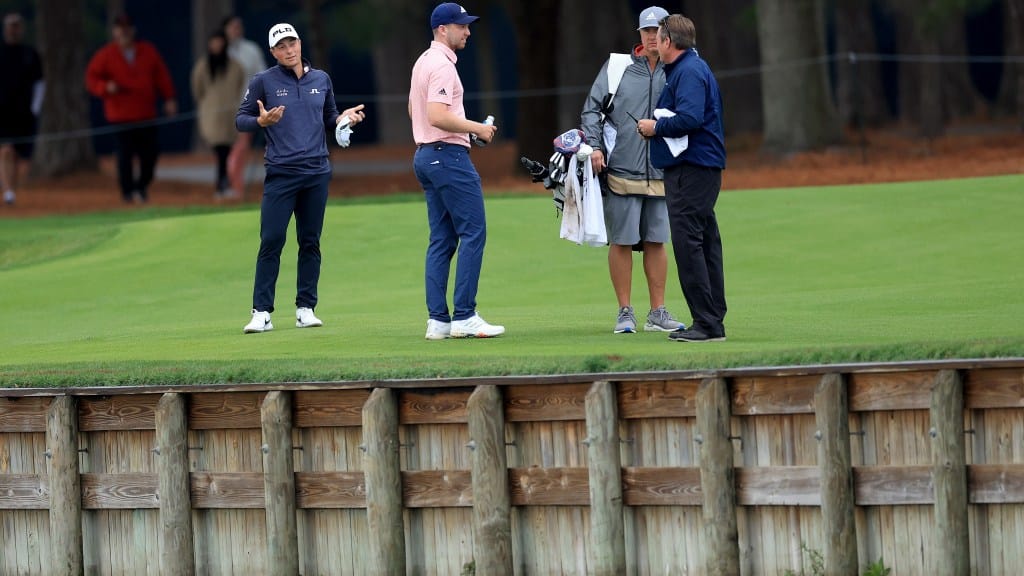
The PGA Tour recently announced changes to its pace-of-play penalties, including reducing fines for ‘Bad Times’ and ‘Excessive Shot Times’ from $50,000 to $10,000 and $10,000 to $5,000, respectively. Players will no longer be fined solely for ‘Timings’ during majors, and the definition of ‘Out Of Position’ has been amended to recognize good positioning on par-3 holes. The Rules Committee continues to evaluate pace of play data and has introduced an ‘Excessive Average Time Stroke Time’ penalty for players with an average stroke time 12 seconds above the field average.
While these changes may seem lenient, Gary Young, the Tour’s senior vice president of rules and competition, explains that fines can escalate for repeat offenders, with the possibility of special sanctions. The committee is also considering a pace of play subcommittee and potential public shaming as deterrents. The focus is on identifying and penalizing the slowest players, with an emphasis on average speed play. The Tour has its version of a shot clock using ShotLink data to monitor player times accurately.
Young acknowledges that the current system for penalty strokes for slow play is inequitable and rarely used due to its multiple warning stages. Players receive warnings before being penalized, and fines can escalate for repeat offenses. The Tour is open to revisiting the penalty stroke policy based on player feedback. The idea of public shaming for slow players is a topic for potential future discussion.
The Tour plans to implement further changes to address slow play, such as a pace of play subcommittee comprising players to provide peer reviews and oversight. Despite the focus on identifying slow players, decision-making on penalty strokes remains in the hands of the players’ organization. Any changes to the penalty stroke system would require player input and approval.
Overall, the PGA Tour’s pace-of-play policy aims to address slow play issues through fines, penalties, and potential future changes. The objective is to encourage all players to maintain an average speed of play, ensuring a smoother pace for all participants. By leveraging data and technology, the Tour can accurately monitor player times and identify those in need of improvement. The focus remains on creating a fair and consistent approach to promoting faster play on the course.
Players are subject to fines for exceeding time limits set by the Tour, with the possibility of escalating penalties for repeat offenses. The Tour’s rules officials use technology and communication to monitor pace of play and address issues as they arise. While the current penalty stroke system has limitations, potential modifications could be implemented based on player feedback and organizational decisions.
In conclusion, the PGA Tour’s approach to addressing slow play issues reflects a commitment to fairness, accountability, and continuous improvement. By considering feedback from players and exploring potential changes, the Tour aims to create a more effective pace-of-play policy that promotes faster and more efficient play on the course. Through a combination of fines, penalties, and peer oversight, the Tour can work towards a more streamlined and enjoyable playing experience for all participants.


