








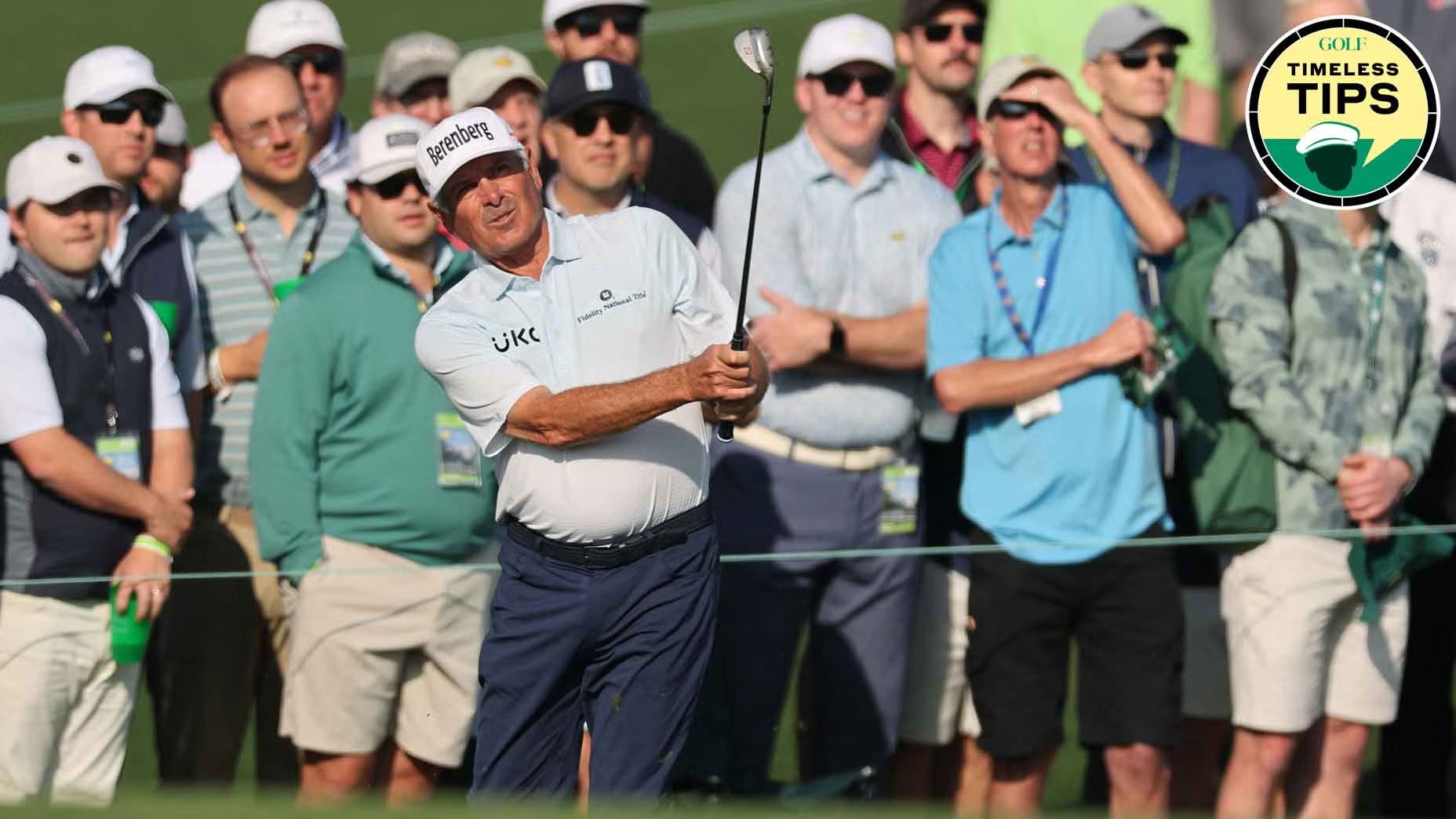
There’s a reason Fred Couples’ swing looks so effortless—and it’s not just genetics. It’s a philosophy about life that extends far beyond the fairway.
I’ve spent years watching golfers obsess over mechanics, grip pressure, and swing planes. But what I’ve really noticed is this: the ones who play their best golf are the ones who’ve figured out how to let go. They understand something that Fred Couples has mastered—that the pursuit of control often creates the opposite effect. It’s a lesson that applies to so much more than hitting a golf ball.
When GOLF Magazine sat down with Couples and his then-coach Paul Marchand back in 1998, they weren’t just documenting a technique. They were capturing a mindset. And more than two decades later, those five keys to iron accuracy read less like swing tips and more like a manifesto for how to approach golf—and maybe life—with less tension and more trust.
The Art of Letting Go
At the heart of Couples’ philosophy is something he calls “freedom of motion,” and it’s genuinely revolutionary stuff when you think about it. We live in an age of optimization, of tracking and measuring and controlling every variable. We’re told to be precise, deliberate, analytical. Golf culture can amplify this tendency to exhausting degrees.
“The great paradox of the swing is that the more you try to control the club through impact, the less control you have over the shot.”
That statement should be printed on every range mat in America. Because it’s not really about golf at all—it’s about the human condition. We are control-seeking creatures playing a game designed to humble us. The moment you accept this, something shifts.
What Couples understood, and what separates the smooth operators from the tense grinders, is that there’s a time for mechanics and a time for trust. The practice range is for building foundations—positions, feels, fundamentals. But the course? That’s where you let it go. That’s where you trust the thousands of repetitions and allow your body to do what you’ve trained it to do.
For everyday golfers, this is genuinely liberating. You don’t need to think your way through 18 holes. In fact, you shouldn’t. The best rounds often come when your mind quiets down and your body takes over.
Rhythm as a Life Skill
The second key Couples emphasized was “rhythmic transition”—that smooth acceleration from backswing to downswing that makes his swing look like one fluid motion rather than a series of mechanical positions. His hips and left leg move in sync. His right elbow drops smoothly. His torso unwinds powerfully. Everything happens in harmony.
But here’s what fascinates me: this isn’t just about biomechanics. This is about pacing. About understanding that good things don’t happen when you rush. Couples’ swing is long, but it’s never hurried. There’s a deliberate quality to it—a respect for the process.
“Most amateurs fall victim to ‘hitting from the top,’ swinging the club out and away from the body while trying to rush the club back to impact.”
Sound familiar? We do this in everything. We rush our mornings. We wolf down meals. We sprint through workouts without intention. And then we wonder why we feel frazzled and disconnected. Couples’ approach—this idea that rhythm and patience create better results—is actually a wellness principle masquerading as a golf tip.
The practical application: slow down. In your swing, yes, but also in your approach to the game itself. Walk the course with presence. Take your time over the ball. Build a pre-shot routine that grounds you. These aren’t just golf moves; they’re meditation in motion.
The Power of Feeling, Not Thinking
One of my favorite insights from the article involves Couples’ approach to developing feel. Rather than obsessing over positions, he’d hit shots of varying distances with the same club, slowing his body rotation and keeping everything in sync. He’d hit drivers to short par-threes. He’d rehearse key shots on the practice tee complete with his pre-shot routine.
This is how you build real confidence. Not through intellectual understanding, but through embodied knowledge. Your body learns what good feels like, and then it remembers.
“To best execute your swing on the course, you need to be confident that you can repeat the feeling of a good swing from memory. Then the mind is free to let the body go.”
This applies way beyond golf. Whether you’re an athlete, performer, or professional of any kind, the path to excellence runs through feel. Through repetition without judgment. Through building muscle memory so reliable that you can trust it under pressure.
Rituals Matter More Than You Think
Couples’ commitment to his pre-shot routine wasn’t obsessive-compulsive; it was liberating. Once he addressed the ball, his routine triggered everything he’d trained—target visualization, confident anticipation, freedom from mechanical thinking.
In our chaotic world, rituals are countercultural. But they’re also profoundly grounding. Whether it’s your morning coffee ceremony, your pre-round warm-up, or how you prepare mentally for an important meeting, rituals create containment. They tell your nervous system: “We’ve got this. We’ve prepared.”
The golfers I know who are happiest and most consistent aren’t the ones with the best swings—they’re the ones with the strongest routines. There’s comfort in knowing exactly what you’re going to do before you do it.
The Takeaway
Fred Couples’ five keys to accuracy offer something rare: advice that’s timeless because it’s really about human nature, not golf technique. These principles show us that performance—whether in golf or life—improves when we stop fighting ourselves. When we trust our preparation. When we move with rhythm and intention. When we build rituals that ground us.
The next time you’re on the range, don’t just work on positions. Work on freedom. Practice not thinking. Build the kind of feel-based confidence that lets you step onto the course and simply play. That’s not just better golf—that’s a better way to move through the world.


