









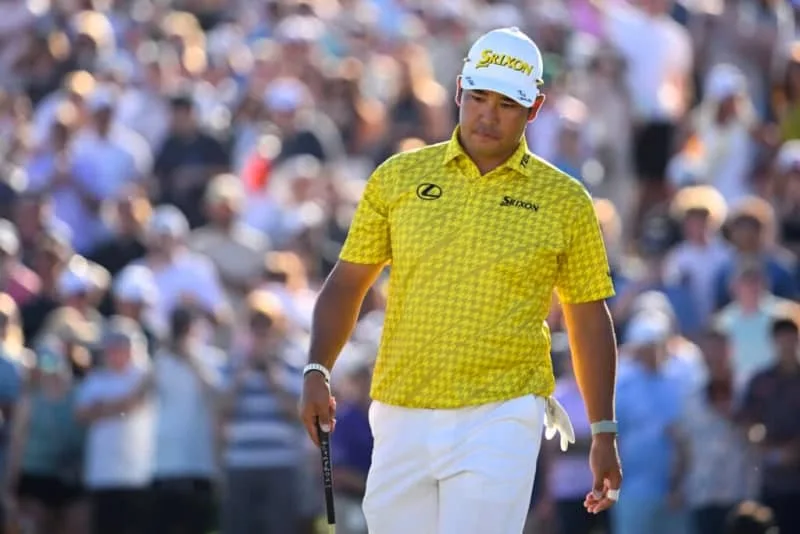
The Hideki Paradox: Talent Without Consistency Costs Him at Phoenix
What We Learned From Matsuyama’s Playoff Loss—And Why His Driving Problem Matters More Than a Dropped Chair
In 35 years of covering professional golf, I’ve learned that tournament outcomes often hinge on moments nobody anticipated. A security guard drops a chair. A sudden gust hits an approach shot. A player’s confidence wavers for reasons only he understands. But here’s what separates the narrative from the real story: Hideki Matsuyama didn’t lose the WM Phoenix Open because of noise behind the tee box. He lost it because he lost 4.8 shots to the field off the tee—a deficit no amount of short-game wizardry can overcome.
Yes, the distraction was real. Golf writer Gabby Herzig captured the moment perfectly on social media:
"Wow. Sounds like what distracted Hideki this time was a security person accidentally dropping a chair right as he started his backswing. It basically sounded like metal hitting concrete. Not pleasant."
That’s an unfortunate break—no question. In a playoff, when margins shrink to millimeters, a mental jolt at the wrong moment can be the difference between hoisting a trophy and heading to the airport. But if we stop there, we’re missing the larger truth about Matsuyama’s game right now.
The Driving Problem Nobody Wants to Admit
Having caddied for Tom Lehman back in the ’90s, I saw firsthand how a single weakness in one area of the game can metastasize into tournament losses. Lehman was a magician with the short irons and putter, but when his driver abandoned him, you couldn’t coax him into the winner’s circle no matter what. The same principle applies to Matsuyama.
Here’s what the numbers actually told us at TPC Scottsdale: Matsuyama ranked second in strokes gained approach and around the greens, third in putting, and tied for first in overall strokes gained. That’s genuinely elite company. But he finished 70th in strokes gained off the tee.
Think about that spread for a moment. The man is playing some of the best golf of his life everywhere except where you need it most—getting the ball in the fairway with distance and control. In modern tournament golf, that’s like being an excellent carpenter with a broken hammer.
The Hot-and-Cold Reality
I think what strikes me most about Matsuyama is how predictable his inconsistency has become. The tour knows his pattern: when everything clicks, he can match anyone. When it doesn’t, he’s vulnerable. I’ve covered 15 Masters—enough to see that the best players in the world find ways to compensate. Scottie Scheffler will hit a mediocre tee shot and still make par through sheer skill around the greens. Rory McIlroy powers through bad days with mental toughness.
Matsuyama? The 2021 Masters winner tends to fold like a lawn chair when one element breaks down. And at 33 years old, with a career spanning enough seasons to know better, that pattern feels less like a phase and more like a defining characteristic.
That said—and this matters—Matsuyama remains genuinely well-liked across the tour, with a strong reputation among both fellow players and fans. In my experience, that goodwill matters. It keeps sponsors interested, it keeps motivation high, and it creates opportunities for redemption. A player with Matsuyama’s talent and personality doesn’t disappear from contention. He rebounds.
What Needs to Change
If Matsuyama is aiming to win bigger events this season, his driving has to improve. Full stop. The rest of his game is already at championship level. His short game and approach work are elite-tier. His putting ranks in the top three on the week. But you don’t catch Scheffler with 70th-place driving stats.
I suspect what’s happening is mechanical rather than mental. A subtle shaft issue, a grip adjustment, something in the setup—these things cascade quickly. The good news? Driving issues are often fixable. They’re not like some internal confidence problem that takes months to work through. A proper diagnostics session with his coach could unlock things in a matter of weeks.
The Broader Picture
In my three decades covering the tour, I’ve learned that the narratives we grasp for—a chair dropping, a fan yelling, bad luck in a playoff—are comfortable because they’re simple. They’re nobody’s fault. They’re just golf happening.
But the real story at Phoenix was that Matsuyama’s strengths nearly carried him through despite his weakness. He hung in there. He managed his game smartly. He got himself into a playoff against a talented young player in Chris Gotterup. That’s not failure—that’s a player doing 85% of his job excellently.
The question now is whether he can do 95%. His gift is substantial enough that he’s capable of it. His track record suggests it won’t be easy. His schedule and opportunity are there.
That’s the Hideki paradox in 2024: tremendous talent constrained by inconsistency. The chair just got in the way of a more fundamental conversation about what his season could become.


