








As a golf architecture enthusiast who’s trekked across 200+ courses, from the windswept links of Scotland to the desert jewels of Arizona, I’ve come to appreciate the profound impact of environment on design. Yet, a persistent question has always lingered: how do we extend the joy of the game, the art of the course, into seasons when Mother Nature pulls her green cloak away?
For golfers like Bertrand Quentin in Montreal, the cold reality of winter turns verdant fairways into snowy canvases, shortening seasons and disrupting momentum. This isn’t unique to Quebec; countless regions face similar golf droughts. Solutions have ranged from the digital immersion of simulators to the seasonal pilgrimage south. But a recent development has sent a ripple of excitement through the architectural community, promising an entirely new category of golf destination: Megalodome.
A Desert Oasis Under Glass: Megalodome’s Vision
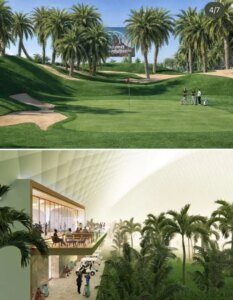
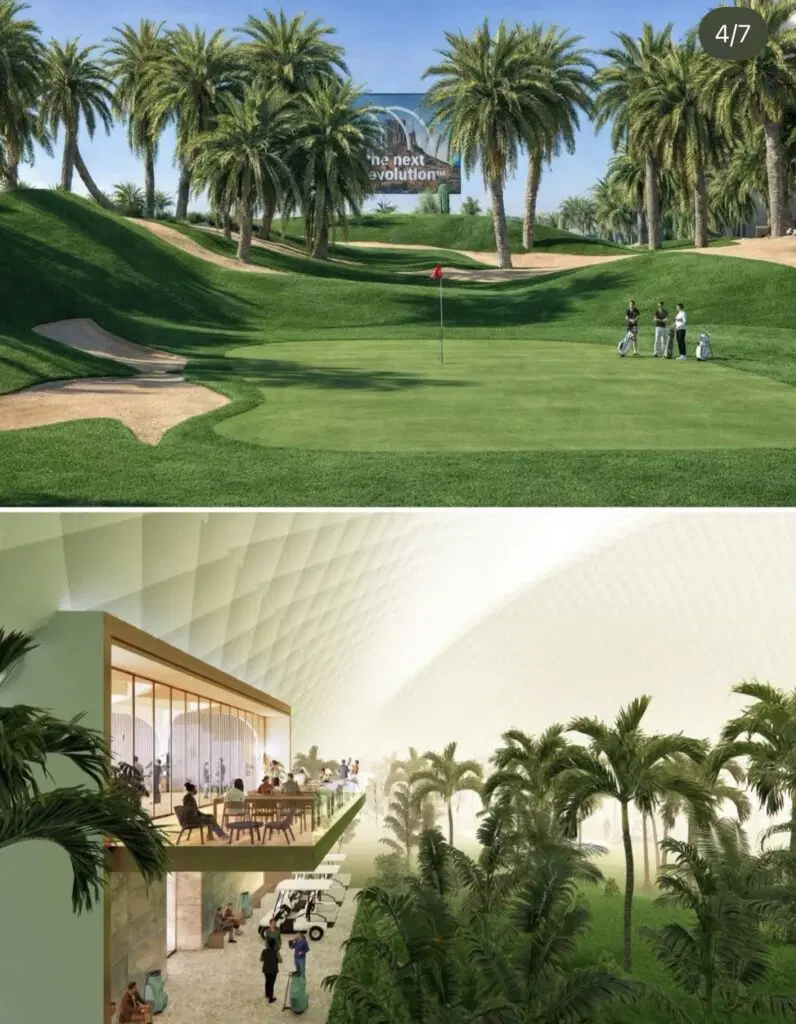
Imagine, if you will, stepping out of a frigid Midwestern winter, perhaps an hour west of Chicago near Oswego, and into a vibrant, sun-drenched Arizona landscape. This isn’t a flight of fancy, nor is it a simulator experience. This is the audacious vision of Megalodome Golf: an indoor oasis, cocooned within massive interconnected domes, offering a genuine golf course experience, complete with artificial turf meticulously engineered to mimic the bounce and roll of real grass.
The renderings I’ve seen are nothing short of spectacular. We’re talking an Arizona-style design, a vista punctuated by swaying palm trees, sculptural cacti, gleaming water hazards, and sprawling sandy wastes. It paints a picture that immediately evoked thoughts of pristine desert golf, where strategic bunkering and desert washes define the lines of play. It’s a bold departure from traditional indoor golf, presenting an entire course, not just a series of hitting bays.
“Word of the project went viral on social media this week, complete with renderings and details that seemed plucked from a sci-fi future: an Arizona-style design, ornamented with palm trees, cacti, water hazards and sandy wastes, nestled in the village of Oswego, roughly an hour west of downtown Chicago…”
While industry behemoths like TGL offer cutting-edge simulator experiences, Megalodome promises something fundamentally different. Quentin differentiates it sharply from its digital counterparts:
“Put simply, there is nothing else like this in the world.”
Deconstructing the Design: Huxham’s Indoor Canvas
The architectural genius behind this groundbreaking project is Montreal-based Huxham Golf Design. Their brief, I imagine, was uniquely challenging: translate the vastness and variability of outdoor golf into a controlled, yet expansive, indoor environment. The design calls for four massive interconnected domes. Three of these will house a nine-hole executive course, a strategic ensemble of six par-3s and three par-4s, culminating in a par of 30. The fourth dome is dedicated to an expansive practice facility.
Designing a course, even an executive one, within a dome presents fascinating architectural considerations. How do you create variation, risk-reward, and strategic depth when the overarching environment is fixed? I’m particularly interested in seeing how Huxham Golf Design leverages elevation changes, green complexes, and the interplay between the artificial features (water, sand, cacti) to craft memorable holes. Pete Dye, with his penchant for creating dramatic landscapes out of flat ground, often used mounding and water to define his courses; I suspect similar principles, albeit on a different scale, will be at play here. The material choice of artificial turf that bounces and rolls like real grass is critical; it’s not enough to merely look the part, the ball must react authentically.
The practice facility, too, is designed with a keen eye for detail. It will boast a short-game area and 50 hitting stalls, with a truly impressive range extending over 275 yards — a testament to the sheer scale of this enclosed world. Imagine dialling in your wedges or unleashing a driver from the comfort of a climate-controlled environment, staring down a simulated Arizona sunset regardless of the blizzard outside.
“The scale is truly unprecedented,” Quentin said.
The Visionary and the Horizon
Bertrand Quentin, a 65-year-old forest engineer, embodies the passion that drives such ambitious projects. His dream, sparked seven years ago, is now on an accelerated timeline, with plans for a late 2027 opening. This is a monumental undertaking, requiring not just innovative design but also substantial financial backing. Quentin and his partner, Alain Desrochers, are clearly confident, with plans for a $50 million investment fund and advanced discussions with major financial groups.
The choice of Chicagoland, with its large market and abbreviated golf season, is a strategic masterstroke. It solves the very problem Quentin and countless others face. While he himself admits to never having played in Arizona, the inspiration drawn from that landscape is clear. And Megalodome isn’t planned as a singular marvel; the vision extends to other golf-starved regions, hinting at a future where the swing never has to cease.
As a student of golf architecture, I’m always evaluating how courses respond to their environment and challenge the golfer. Megalodome represents a fascinating new frontier. It asks how much of the “golf experience” can be transplanted and re-imagined. Can the nuanced ground game of a MacKenzie course, or the strategic intimidation of a Dye course, be replicated under glass? While it’s an executive course, the potential for a truly unique and immersive experience, defying seasonal constraints, is immense. It’s a bold stroke of design ingenuity, one that promises to keep golf vibrant and accessible, even when winter winds howl outside.


