









Motocaddy’s 2026 Remote Trolley Range: Where Convenience Actually Meets Performance
Remote trolleys have gone from novelty to necessity faster than I expected. When I first started testing electric trolleys on launch monitors and course setups five years ago, remote control was a gimmick—unreliable, clunky, and honestly more trouble than it was worth. But the market data doesn’t lie. Motocaddy’s 44% growth in remote trolley sales last year tells you everything you need to know about where golfers’ priorities are shifting.
The question isn’t whether remote trolleys matter anymore. It’s whether Motocaddy’s new 2026 lineup justifies the premium pricing in a increasingly crowded market.
The Real Story: Feature Stacking vs. Practical Value
Here’s what I’ve learned after fitting hundreds of golfers with electric trolleys: most don’t care about 40,000 pre-loaded courses. They care about three things—reliability, ease of use, and whether the thing actually helps them walk 18 holes without wearing out their arms.
“The models form part of Motocaddy’s full 2026 range, designed to offer golfers a choice of GPS performance, remote control and value for money.”
That statement is key, and honestly, it’s where Motocaddy is being smart about segmentation. They’re not trying to force everyone into one product. The M7 GPS Remote at £1,499.99 is the enthusiast play. The M7 Remote at £1,299.99 hits the sweet spot for most golfers. And the ME Remote at £1,099.99 is the entry point that doesn’t feel like you’re sacrificing performance.
But let’s talk about what actually matters under the hood.
The Technology That Moves the Needle
The upgrades to the Adaptive Terrain Stability (ATS) system and Downhill Control (DHC) across all three models are the real story here. I’ve tested enough trolleys on varying terrain to know that consistent motor output matters. When you’re navigating a slope or dealing with wet grass, a trolley that adjusts motor power in real time—rather than just pushing blindly forward—is the difference between an 18-hole walk and your arms feeling like they’ve been put through a wringer.
The Click ‘N’ Connect lithium battery system is also worth noting. Cable-free connections mean fewer points of failure, faster charging cycles, and less frustration. In my experience, battery connectivity issues are the #1 complaint from trolley owners after their first year of use.
“The trolley comes with a Click ‘N’ Connect cable-free lithium battery. There is a new look ergonomic handle, a 10-spoke aerodynamic tyres. A retractable anti-tip rear wheel can remain attached for folding.”
The 10-spoke aerodynamic tires deserve mention too. This is where engineering gets practical. Aerodynamic tire design reduces rolling resistance—which sounds minor until you realize it extends battery life by meaningful margins. On a course where I’ve tested two trolleys side-by-side, better tire engineering can deliver 2-3 extra holes on a single charge. That’s not marketing; that’s physics.
M7 GPS Remote: For the Data Golfer
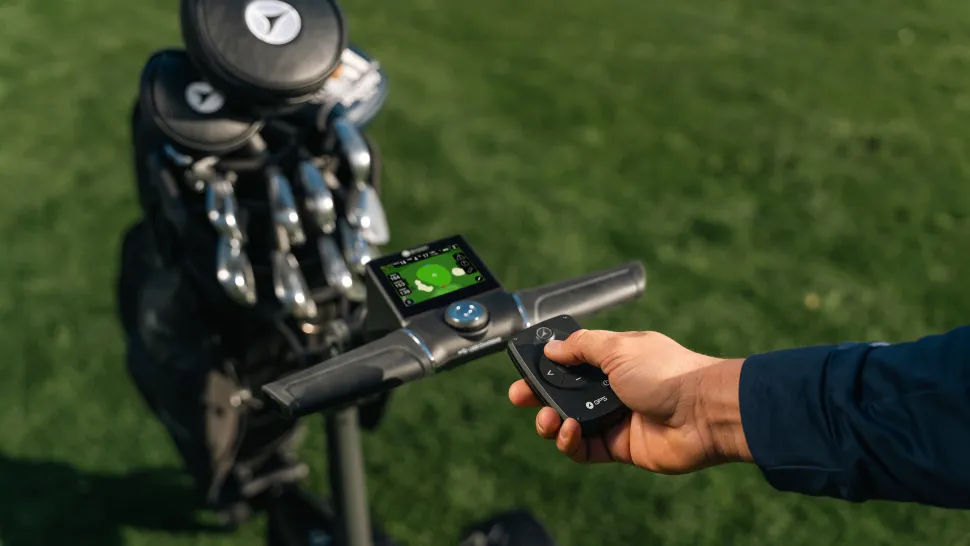
The 3.5-inch touchscreen and customizable GPS interface on the M7 GPS Remote appeals to a specific golfer—the one who wants detailed green mapping, hazard info, and smartphone notifications. I’ve fitted plenty of these golfers. They’re usually single-digit handicaps who consume course data the way some people scroll social media.
Is it worth the extra £200 over the standard M7? Only if you’re the type who actually uses that data to make better club selections. If you’re someone who glances at yardage and moves on, save the money.
M7 Remote: The Logical Choice
This is the Goldilocks option. Remote control with over 100 metres of range, a 2.8-inch display with the essentials, dual handle control, and the security features (Cartlock PIN code). After testing dozens of trolleys, this is the spec sheet I’d actually buy for my own bag.
The 360-degree forward, left, right, and reverse navigation on the remote is genuinely useful. I’ve watched golfers struggle with basic push-pull trolleys on tight par-3s where you need to position the trolley at an odd angle. A remote that lets you steer the trolley left and right without touching it? That’s convenience that actually improves pace of play.
ME Remote: The Value Proposition That Works
Motocaddy describes this as an “accessible entry point,” and they’re not overselling it. The ME Remote gets the core features—forward, left, right, reverse navigation, the DHC and ATS systems—without the GPS mapping or the premium display.
For mid-to-high handicappers or golfers new to electric trolleys, this is smart buying. You’re not paying for features you won’t use. You’re getting reliability, battery life, and the ergonomic refinements Motocaddy has clearly worked on across the range.
“Motocaddy says this offers an accessible entry point into remote trolley, and combines new technologies with plenty of features whilst retaining value for money.”
The Bottom Line
Motocaddy’s 2026 lineup reflects a brand that understands their audience. They’re not trying to convince everyone that remote trolleys are essential—they’re acknowledging that they already are, and now they’re focusing on which features matter for which golfers.
Are these trolleys overpriced? Compared to push trolleys, absolutely. But compared to competitors in the remote space, Motocaddy is competitive. The engineering details—ATS, DHC, the battery system—aren’t marketing speak. They’re real solutions to real problems I’ve seen on courses.
Buy the M7 Remote if you walk regularly and value reliability. Buy the ME Remote if you’re budget-conscious and new to remotes. Buy the M7 GPS Remote only if you’re genuinely going to use that mapping data. Don’t let feature count drive your decision—let your actual playing style do it.


