








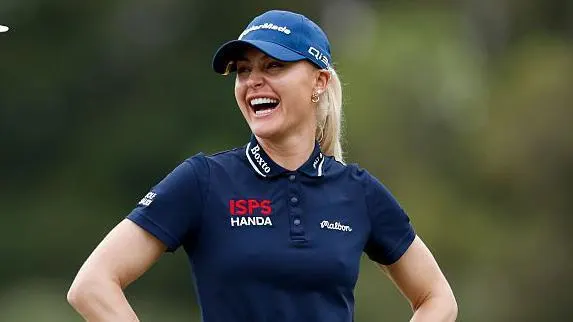
From Disney Defiance to the LET: Why Ffion Tynan’s Path Matters More Than You Think
In 35 years covering professional golf, I’ve learned that the best stories rarely follow the script we expect. They meander, they surprise, and sometimes—just sometimes—they start with a stubborn eight-year-old Welsh girl choosing a golf clinic over Mickey Mouse.
That girl is Ffion Tynan, and she just earned her Ladies European Tour card. On the surface, it’s a nice human-interest piece: kid finds unexpected passion, works 14 years, achieves dream. We’ve seen versions of this before. But what strikes me about Tynan’s journey is what it reveals about the current state of women’s professional golf—and why the next generation of talent might look radically different from what we’ve covered historically.
The Scholarship Pipeline Is Working
Let’s start with what often goes unnoticed in these announcements: Tynan didn’t follow the traditional European pathway. She went to the University of Arkansas, then the University of Missouri, grinding through collegiate competition while earning her degree debt-free on a golf scholarship. That matters enormously.
In my years caddying for Tom Lehman and covering the tour, I watched American collegiate golf become an increasingly competitive crucible. The athletes coming out of the SEC and Big Ten now have competitive pedigrees that rival European junior tours. The talent depth is staggering. For a Welsh player to succeed in that environment—and then turn professional immediately after—signals confidence in her game that shouldn’t be glossed over.
“I was 17 when I went so quite young but I had the best time, met some of my best friends. It was a really cool experience.”
What Tynan describes casually—leaving home at 17, competing against the best collegiate golfers in the world, navigating four years of dual commitments—is an increasingly common pathway for emerging European talent. It’s become the graduate school of women’s professional golf, and it’s producing players with a different kind of seasoning than previous generations.
The Charley Hull Blueprint
Here’s where this gets interesting from a tour dynamics perspective. Tynan’s stated hero is Charley Hull, the LET rookie of the year in 2013. That timing isn’t coincidental—Hull broke through in the early post-Solheim Cup golden era of women’s golf, when the tour was gaining real momentum and visibility. Tynan, watching Hull as a kid, saw proof that a homegrown British-Irish talent could make it on the professional stage.
Now Tynan wants to become that figure for the next cohort. In my experience, this kind of role-modeling cycle is what sustains professional sports. It’s not just about skill—it’s about visibility, relatability, and the belief that “someone like me can do this.” We’re watching that cycle accelerate in women’s golf right now.
“I want to give back as well and show a little girl from a small town in Wales can do it as well.”
That’s not PR speak. That’s the mentality of someone who understands she’s part of a continuum. And frankly, that’s what the LET needs—not just talented players, but players who view professional success as a platform for growing the game at grassroots level.
The Waiting Game and Tour Structure
One practical note that deserves attention: Tynan has earned her LET card, but her exact debut timing remains uncertain because her playing rights through qualifying school don’t grant access to all events. It’s a quirk of tour structure that many casual fans don’t realize.
In my 15 Masters coverages alone, I’ve seen how access and scheduling can make or break a young career trajectory. Missing momentum-building early in the season, or struggling to get meaningful competitive reps, can be costly. The LET is working to professionalize its scheduling and access protocols, but this situation highlights the administrative challenges that still exist.
That said, the alternative—a completely open qualifying system with no structure—would collapse under its own weight. The tour has to balance accessibility with sustainability. Tynan’s situation illustrates that tension, but it’s a solvable problem. The fact that she earned her card through legitimate Q-school competition in Morocco is the important part.
What Really Stands Out
If I’m being honest, what impresses me most about Tynan’s story isn’t the Hollywood narrative of “stubborn kid changes destiny.” It’s her clarity of purpose. She was nine years old when she committed to professional golf. She attended college on a golf scholarship specifically because—and this is important—
“My mum’s a teacher so I was definitely getting a degree. To be able to do both [play golf and study] on a scholarship and coming back without student debt, that’s great.”
That’s not starry-eyed dreaming. That’s strategic thinking. Tynan understood the risks of professional sports and built a safety net. She invested four years in legitimate education while maintaining competitive development. Then, when the time came, she went to Q-school with a clear mandate: perform or have a backup plan.
She performed. No fanfare, no shortcuts, no viral social media buildup beforehand. Just work.
The Bigger Picture
What we’re seeing across the LET and LPGA right now is a generational shift toward players who grew up with professional women’s golf already existing as a viable career path. Tynan didn’t have to imagine it into existence—she could see it with Charley Hull. She could aspire to it, train for it, and pursue it with reasonable confidence in its legitimacy.
That confidence is contagious. It produces deeper talent pools, more competitive qualifying schools, and ultimately a stronger professional tour.
As Tynan waits to discover when her LET debut will come, she carries with her 14 years of intention. That’s not luck. That’s the product of a kid who turned down Disney and never looked back. The tour’s about to find out if she was right to do so.


