







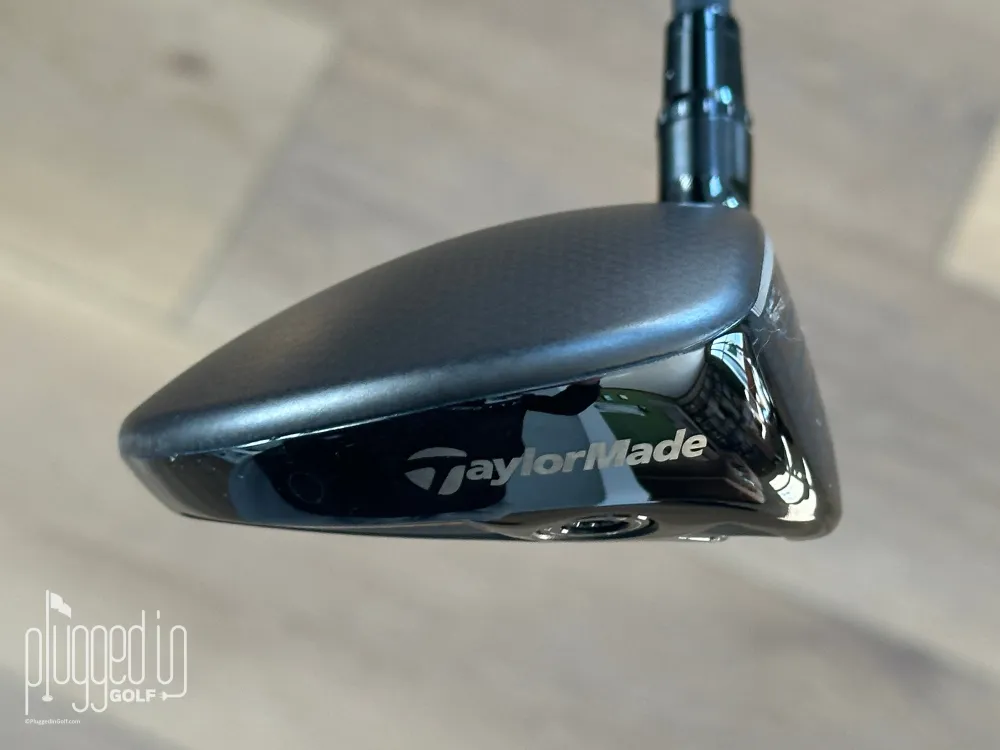


Alright, let’s talk about TaylorMade’s new offering in the long game: the Qi4D Tour fairway wood. As an equipment editor who’s spent countless hours staring at launch monitor data and fitting every conceivable golfer, I tend to approach any new “Tour” designated club with a healthy dose of skepticism. The marketing departments love that word. But does the Qi4D Tour actually live up to the name, or is it just another pretty face in a matte black finish?
First impressions, visually, are overwhelmingly positive. I pulled this out of the headcover, and honestly, it’s a looker. TaylorMade has crafted a club that screams “player’s club” without being overly intimidating. That compact footprint, the tall face, the subtle pear shape – it’s all there for the discerning eye. For golfers who appreciate a classic aesthetic at address, this head will certainly resonate.
“The TaylorMade Qi4D Tour fairway wood prompted an “Ooooh” the first time I took it out of its headcover and put it in the address position. This is the kind of compact footprint that lives up to the “Tour” name.”
Sound and feel, for me, are often overlooked but crucial elements, especially in a player’s club. You want feedback, but you don’t want it to sound like a tin can. The Qi4D Tour delivers a traditional, solid impact sound – definitely leaning towards a “wooden” thud rather than a metallic clang. My testing backed this up; strikes felt immensely satisfying, particularly when hit flush. The feedback is distinct: pure strikes feel fast and powerful, while mishits give you enough information to know where you missed without being overly harsh. This precision feedback is exactly what better players demand to fine-tune their ball striking.
The Real Innovation: Adjustable Weighting
Now, let’s get to the nitty-gritty: performance and technology. TaylorMade has traditionally leaned on a single, massive sliding weight in their Tour fairway woods for trajectory and spin adjustment. While effective for those parameters, it largely ignored directional control. The Qi4D Tour introduces a significant shift – a “Trajectory Adjustment System” featuring three independent weight ports:
- Heel (4 grams)
- Toe (4 grams)
- Rear (15 grams)
Alongside the adjustable hosel (+/- 2 degrees), this is where the Qi4D Tour truly separates itself. This is not just marketing fluff; this is genuine, measurable adjustability. In my fitting bay, running countless balls through the launch monitor, the impact of shifting that 15-gram weight was undeniably clear.
With the 15-gram weight in the toe, I observed a noticeable reduction in draw bias and an increased ability to work the ball with a fade. For golfers struggling with an unwanted hook, or those who simply want to shape shots more effectively, this is a game-changer. Conversely, placing the heavy weight in the heel would promote more draw. Given my natural slight draw, I found the heel position wasn’t ideal for me, but the data showed clear shifts in dynamic loft and spin axis that would certainly benefit a golfer looking for more draw bias. The rear position delivered the highest MOI, making the club feel considerably more stable, with a slight bump in launch and spin, as expected.
“In my testing, I found a noticeable difference in ball flight when moving the 15 gram weight among the three different positions. With the weight in the toe, my natural draw was muted and fades were more accessible. When the weight was back, the club was extremely versatile.”
My launch monitor data consistently showed that while the back weighting provided the most forgiveness across the face (higher ball speeds on off-center hits due to improved MOI), the margin between the heel and toe settings in terms of raw forgiveness wasn’t huge. What *was* significant was the impact on spin axis and shot shape, which is exactly why this new system is valuable for skilled players.
Forgiveness & Playability
Despite its “Tour” designation and compact profile, the Qi4D Tour isn’t a complete bear to hit. TaylorMade has integrated their core technologies like Twist Face and Speed Pocket, which do offer a helping hand on marginal strikes. While it’s true that elite players want to hit the center, even they miss. When I intentionally sought to hit off-center, I saw relatively good preservation of ball speed and tight dispersion, especially with the heaviest weight in the rear position. This isn’t a super game-improvement fairway wood, but it retains a surprising level of playability for its class. The key, as always, is finding the right shaft and the optimal weighting for your swing.
One critical point for golfers to understand is the stated launch and spin characteristics: “Mid-Low” for both. This aligns perfectly with what I observed. For me, a naturally low-launch, low-spin player, this meant I wasn’t seeing eye-popping carry distances. However, for higher swing speed players, or those who generate too much spin with their current fairway woods, the Qi4D Tour could be a distance generator. It’s designed to flight the ball low and penetratingly, which is fantastic for battling windy conditions or maximizing roll-out. This club isn’t trying to elevate the ball automatically; it’s giving the skilled player control over that trajectory.
Who is this club for?
The TaylorMade Qi4D Tour fairway wood is squarely aimed at the better player. We’re talking single-digit handicappers, low double-digits with consistent ball striking, and anyone who places a premium on shot-making and workability in their long game. If your fairway wood is primarily a “rescue club” or you struggle with consistent contact, there are more forgiving options in TaylorMade’s lineup that would better suit your needs. But if you value the ability to flight the ball up or down, fade it or draw it, and demand precise feedback, the Qi4D Tour is a very strong contender.
The updated adjustability system is a genuine improvement, offering a level of shot control that was somewhat lacking in previous iterations. This isn’t just cosmetic; it’s a functional enhancement that allows for truly tailored performance. As a club fitter, this kind of granular control is immensely valuable. Coupled with the right shaft, this club has the potential to transform a skilled golfer’s long game, offering confidence not just in distance but in pinpoint accuracy from the deck or tee.
Is it worth the money? For the target demographic, absolutely. The craftsmanship, the effective adjustability, and the performance characteristics all align to create a premium product. Just make sure you get fitted to unlock its full potential. Don’t just grab it off the rack; experiment with those weights and hosel settings on a launch monitor. The data will tell the story, and in this case, the story is one of precise control and solid performance for the player who knows how to wield it.


