








The Art of Putting: Zack Miller and the Evolution of Longbow Putting
Putting is often described as the great equalizer in golf. Despite being one of the finest putters in history, Tiger Woods himself pointed to a poor putting performance as a key factor in his 2009 PGA Championship loss after leading for 54 holes. To encapsulate the challenges on the green, one can confidently say: putting can be and is brutal.
While golfers can execute perfect drives and flawlessly navigate a course through strategy, a cold putter can overshadow every achievement, leaving an empty feeling on the scorecard. Interestingly, while putting seems to be the simplest aspect of golf to the eye, the reality is far more complex—driven by the powerful connection between sight and mind, which can make or break a golfer’s confidence.
The Rise, the Fall, and the Experiment
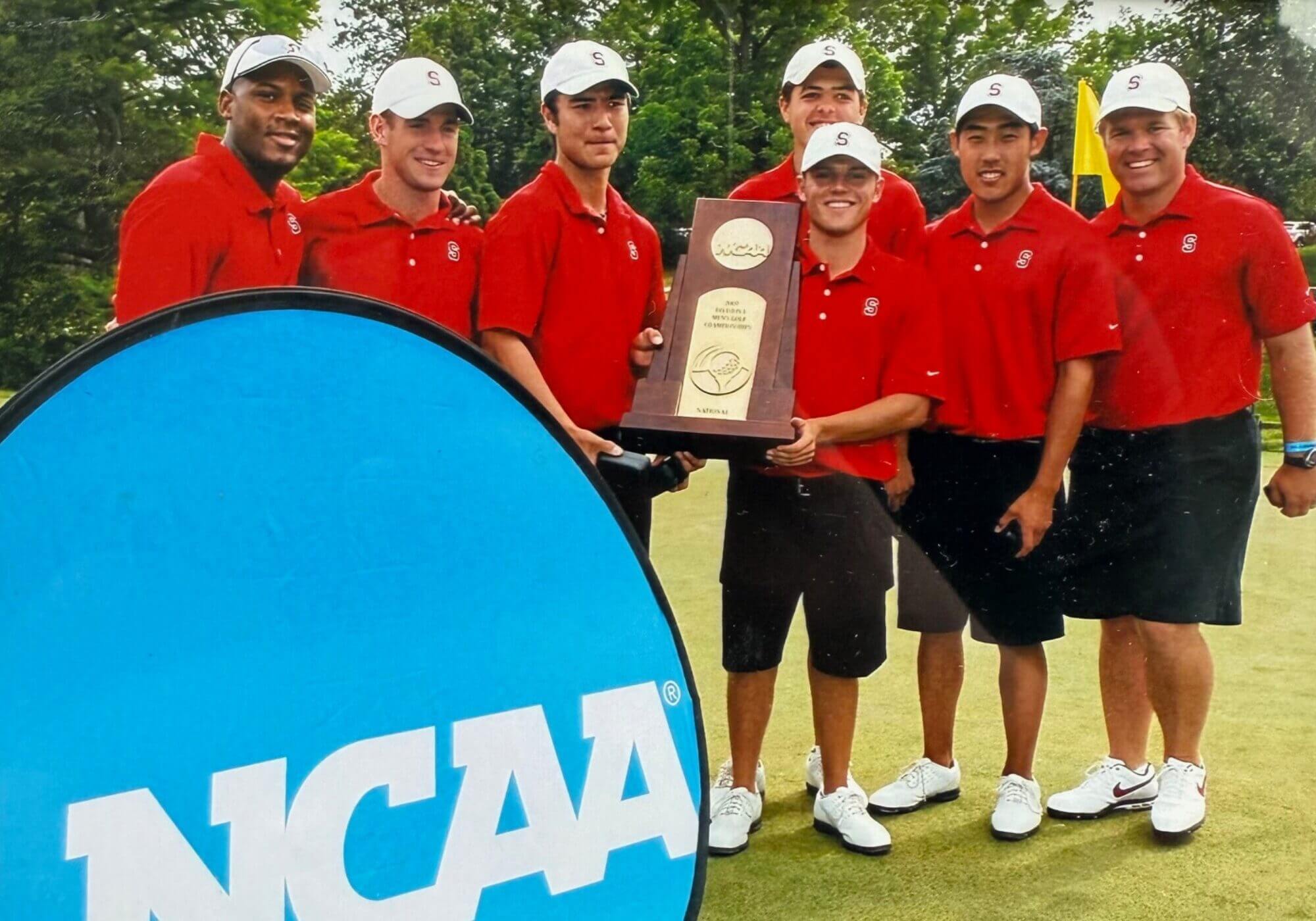
Zack Miller (third from left) celebrates with his Stanford teammates after winning the 2007 NCAA Division I Men’s Golf Championship at Golden Horseshoe Golf Club in Williamsburg, Va.
Zack Miller, like many great golfers—including his predecessor, Tiger Woods—was raised on public courses, which offered him not just a space to play but also a sense of freedom. “It was a unique experience where my parents felt comfortable leaving me with older kids to practice all day,” Miller recalled.
His prowess blossomed as he became one of Northern California’s top junior golfers. Recruited by Stanford University, he thrived there, earning All-American honors, and ultimately helping his team win the 2007 NCAA Championship as captain. However, even with his elite ball-striking, Miller found himself plagued by putting woes.
“I developed the yips, and my putting performance became so inconsistent,” Miller shared. Despite trying various techniques—like changing grips and switching putter weights—nothing seemed to work effectively.
In a pivotal moment, Stanford’s coach, Conrad Ray, introduced Miller to a long putter, specifically a PING B90. “I had never experienced something that fixed my problem so quickly; it changed the trajectory of my career,” Miller said, illustrating how this change became a turning point.
New Beginnings: Reinvention and Invention

Zack Miller watches his drive on the 13th hole in the final round of the 2007 AT&T Pebble Beach National Pro-Am.

After graduating from Stanford, Miller turned professional and spent two years competing internationally, including on the Korean Tour and the Gateway Tour, where he secured two wins. In 2010, he qualified for the Nationwide Tour, finishing 56th in the season standings to earn his PGA Tour card—a validation that his commitment to the long putter was not merely a last resort.
Miller became a trailblazer for long putters at a time when they were still viewed with skepticism. Although Bernhard Langer popularized the concept back in 1996, many in the golf community were hesitant to embrace it. However, with growing acceptance after major victories by players like Keegan Bradley and Adam Scott using long putters, Miller’s approach seemed to reflect a changing tide in the sport.
Yet despite the broader acceptance of alternative putting styles, Miller’s results on Tour did not meet his expectations. As life unfolded—with marriage and fatherhood—competitive golf took a backseat, but he continued to connect with fellow golfers in Baltimore.
Miller’s experiences evoked another wave of interest in long putters. As players began asking for guidance on finding long putters, it became clear that the demand was rising.
When the PGA Tour announced the anchoring ban in 2013, long putters became increasingly difficult to find. Miller faced challenges sourcing equipment and began gifting his spare putters to friends who struggled with their putting games. This sparked inspiration: “How great would it be if I could offer them something new, something I helped design? That’s how Longbow started.”
Bringing an Idea to Life: The Birth of Longbow Putting

Zack Miller with his wife, Sarah, and their son, Bo: the namesake behind Longbow Putting.
Realizing he wanted to create top-quality long putters, Miller partnered with renowned putter designer David Frisch. Their collaborative effort led to the establishment of Longbow Putting, inspired by the name of Miller’s son, Bo.
The initial line, the LP-Series, redefines long putters with advancements that separate them from traditional broomsticks. Instead of multi-piece construction, these putters are crafted from a single block of metal, enhancing stability.
The LP-1 showcases a traditional fang-style design, ideal for golfers who appreciate alignment and stability. Conversely, the LP-2 embraces a mallet shape encouraging easy alignment, allowing players to trust their strokes.
Following the success of the LP-Series, the team shifted focus to the next iteration, emphasizing feel and adjustability through innovative materials and a unique design framework. In long putting, where preference plays a crucial role, having a customizable putter can greatly enhance performance.
The Explorer: Designing a Putter that Adapts

Various configurations of the Longbow Explorer putter— their lowest torque offering. The Explorer features an interchangeable keystone, allowing players to swap in different shaft and balance options.
In September 2025, Longbow introduced The Explorer, an adaptable putter that lets golfers easily swap different balance profiles and shaft options. “It’s about making the putter evolve with the golfer,” Miller said, highlighting Longbow’s commitment to personalization.
With its interchangeable system, golfers can experience different setups without needing to purchase a completely new putter. This adaptability resonates with Miller’s philosophy of empowering golfers through customization—each individual golfer may respond differently to pressure, sight lines, and mechanics.
Moreover, Longbow’s partnership with YUMI provides golfers with high-quality, full carbon shafts that meet the requirements for stiffness and feel, further enhancing the performance of long putters.
Looking Ahead: The Legacy of Longbow Putting
Miller envisions a future where Longbow acts as a sanctuary for alternative putting styles. He believes that a long putter shouldn’t merely be an instrument but rather a tool that reinstates a golfer’s confidence and control over their game.
“Golfers today deserve the opportunity to choose their path,” Miller said, emphasizing the value of trust in putting—a frequently overlooked aspect of the game. He aims to shift the narrative around long putters, showing that they can be just as effective as traditional models when designed properly.
Ultimately, Miller’s aspirations for Longbow extend beyond sales and innovation; they reflect a deep commitment to improving golfers’ experiences on the greens.
The goal remains straightforward yet profound: bring joy back into putting. In a game often overshadowed by frustration, this mission stands as Longbow’s most significant contribution to the sport.
In an era where golf equipment sees rapid changes, Longbow’s Explorer is more than just a product; it’s a revolution built from real-life experiences aimed at transforming putting for golfers of all skill levels.
Embrace the evolution of putting—experience the difference with Longbow Putting today.


