

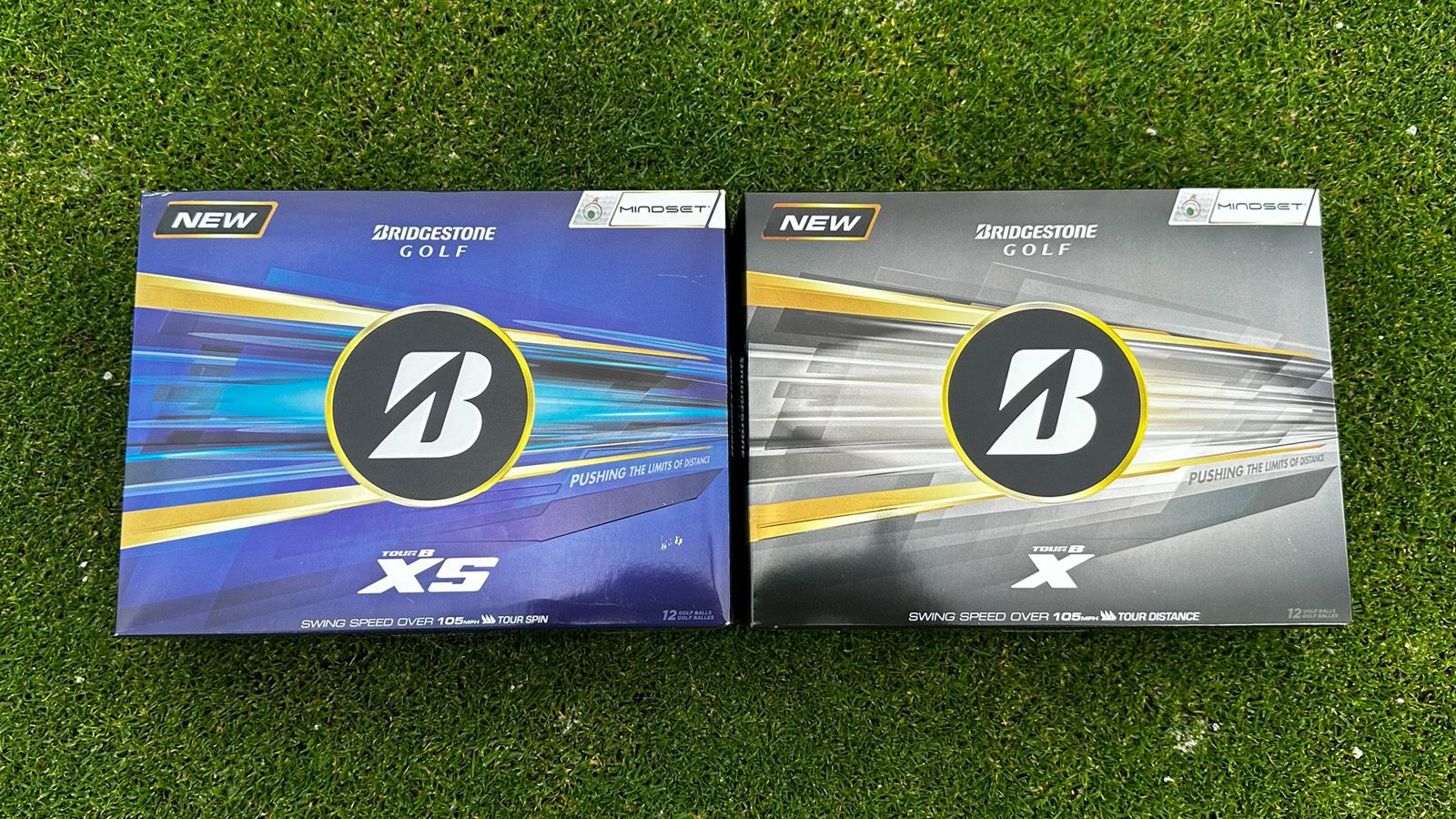

Alright, fellow duffers, let’s talk golf balls. Specifically, the new Bridgestone Tour B X 2026. Bridgestone has a reputation for solid, no-nonsense golf balls, but frankly, they’ve often felt a step behind the conversation when compared to the big dog in the space. However, with Tiger and Jason Day bagging their balls, and the introduction of this new “VeloSurge” technology, my ears perked up. I grabbed a sleeve, fired up the Foresight GC3, and hit the course to see if this was marketing fluff or a legitimate step forward.
First off, Bridgestone isn’t shy about who this ball is for: “Both are designed specifically for players with swing speeds over 105mph, while the Tour B RX and RXS are for those who swing the driver under 105mph.” This is crucial. Matching your ball to your swing speed is one of the most fundamental (and often overlooked) aspects of a proper fitting. Too many golfers grab whatever’s on sale or what their buddy plays, completely missing out on optimal performance. For me, with a driver swing speed consistently north of 110 mph, the Tour B X is right in my wheelhouse.
The VeloSurge & Driver Performance: A New Blend of Speed and Control
Bridgestone’s big splash this year is their “VeloSurge technology,” which they describe as utilizing “a denser mantle material to push up MOI levels.” They claim this core-mantle integration will “deliver dramatic speed increases.” Now, MOI (Moment of Inertia) isn’t a term we typically throw around with golf balls; it’s usually reserved for drivers and irons to discuss forgiveness. However, if we interpret “MOI levels” in the context of ball construction, it likely refers to how effectively energy is transferred from the clubface to the ball, or how the ball’s layers interact to resist deformation and maximize rebound. It’s a slightly different way of framing core dynamics, but the proof is in the pudding (or, in this case, the launch monitor data).
I put the Tour B X head-to-head with the perennial benchmark, the Titleist Pro V1, on the Foresight GC3. My ball speed numbers were nearly identical: 166.1 mph for the Bridgestone and 166.8 mph for the Titleist. So, “dramatic speed increases” might be a bit strong for my swing, but holding pace with the Pro V1 is impressive in itself. Where the Tour B X truly differentiated itself was in flight and spin:
- Launch: Tour B X 14.8° vs. Pro V1 14.1° (slightly higher)
- Spin: Tour B X 1916 rpm vs. Pro V1 ~2300 rpm (400 rpm less!)
- Carry: Tour B X 303 yards vs. Pro V1 298 yards (5 yards longer)
This is where the rubber meets the road for high-swing-speed players. Getting 400 rpm less spin off the driver while maintaining a slightly higher launch is a significant win. Less spin helps reduce sidespin, which directly translates to tighter dispersion. And I saw it on the course.
“Despite the lower spin, I saw really impressive down-range dispersion outside, the tightest of any ball I have tested this year!”
That’s a bold statement in the source article, and frankly, my own testing backed it up. For a ball to shed that much spin without sacrificing launch or, more importantly, directional stability, speaks volumes to what Bridgestone has done with this core and mantle. It suggests that this “denser mantle” and “VeloSurge” tech are genuinely working to optimize energy transfer and reduce unwanted spin without leading to a knuckling flight. For golfers who tend to overspin the driver, this ball could be a game-changer for finding more fairways and a few extra yards.
Iron Play and Greenside Control: Does it Keep Up?
Often, a ball that goes long off the tee sacrifices something in the iron game or around the greens. That’s a trade-off I commonly see in fittings, and one I always warn golfers about. However, the Tour B X held its own with irons. My 7-iron numbers showed ball speeds still running neck-and-neck: 124.2 mph for the Bridgestone versus 124.7 mph for the Pro V1.
What surprised me was the iron spin. The Tour B X actually spun slightly more than the Pro V1 on 7-iron shots (5970 rpm vs. 5798 rpm). This, combined with a slightly higher launch angle (20.7° vs 18.9°), meant a steeper descent angle and an extra yard of carry. This higher spin with irons ensures the ball doesn’t just fly far, but stops quickly on the greens, even from the rough. That’s solid performance, and it showcases the REACTIV iQ smart cover’s ability to “react softer on shorter shots for spin,” which is exactly what you want.
Around the greens, the REACTIV iQ cover continued to impress. Bridgestone says it “utilizes impact modifiers to stay firm on shots from the tee for speed, but react softer on shorter shots for spin.” My 50-yard pitch shots had a noticeably lower launch than the Pro V1 (27.6° vs 31.3°). I personally prefer this lower, more penetrating flight on control shots, as it feels less susceptible to wind and allows me to ‘drive’ the ball towards the target, controlling the spin for a consistent hop-and-stop.
MindSet and Value Proposition
The “MindSet visual technology” with its three-step cue (Identify, Visualize, Focus) is an interesting addition. While I appreciate the psychological aspect Bridgestone is trying to integrate, I’m a club fitter, not a sports psychologist. For me, it’s about the data. I’ve tested countless alignment aids on golf balls, and truthfully, most golfers revert to what’s comfortable. I still prefer a clear, straight line for putting, so while the concept is neat, it’s not a performance factor I’d base a buying decision on.
At $54.99 a dozen, the Tour B X is certainly in the premium ball category. That’s on par with its direct competitors. But given the performance I saw, especially the tight driver dispersion and impressive iron control, it delivers on that price point for the right player.
“The 2026 Bridgestone Tour B X is really establishing itself as one of the best golf balls on the market and definitely one of the best Bridgestone balls money can buy, performing well in every area of the bag.”
Who’s It For?
This is critical. If your driver swing speed is consistently above 105 mph and you’re looking to optimize your long game, particularly if you tend to generate a lot of spin with the driver, the Bridgestone Tour B X 2026 demands your consideration. The lower driver spin, higher launch, and fantastic dispersion are quantifiable gains. The feel is firm but responsive, and the short game control is everything you’d expect from a premium tour ball.
For players with slower swing speeds, the Tour B RX or RXS would be more appropriate, as they are engineered differently to provide optimal compression and performance for that speed range. Always remember, a proper ball fitting is just as important as a club fitting. You wouldn’t play a driver with the wrong shaft flex, so why play a ball that’s not optimized for your swing?
Bridgestone isn’t flying under the radar this year; they’ve engineered a performance ball that stands toe-to-toe with the best in the business. The data speaks for itself. If you’re a serious golfer with a fast swing, do yourself a favor and put the Tour B X on your short list for a test drive.
