

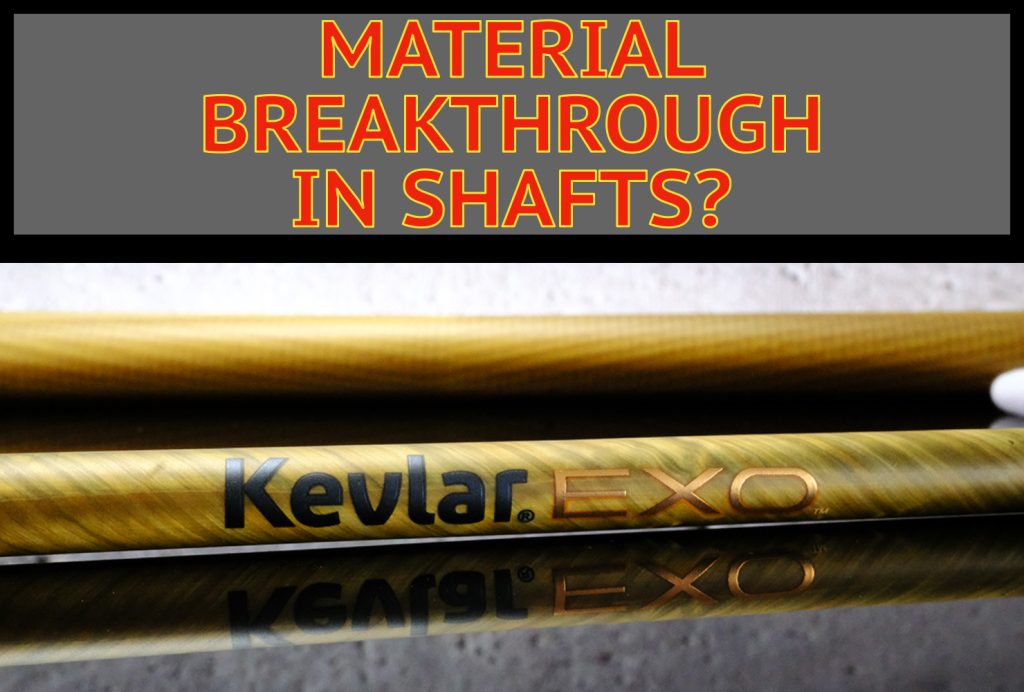

Here at The Daily Duffer, we’re always on the lookout for the next big thing in golf equipment. Every week, manufacturers bombard us with claims of revolutionary materials, groundbreaking designs, and unprecedented performance gains. My job, as your Equipment Editor, is to cut through that noise, subject every piece of gear to rigorous testing, and tell you what’s actually going to make a difference in your game, not just your wallet.
My ears perked up recently when I caught wind of Kinetixx Shafts and their Kevlar-EXO material, being discussed on the “Off Course” podcast. Anytime a new material is touted as a “breakthrough” in shaft technology, my club fitter’s instincts kick in. We’ve seen a lot of exotic materials come and go – boron, titanium mesh, various carbon fiber weaves – but few truly deliver a quantifiable advantage that translates to consistent, repeatable performance for the everyday golfer. Is Kevlar-EXO different?
“Off Course is back this week with a fantastic show and this is episode 284…Today, Jason from Kinetixx joins the show to discuss Kevlar-EXO and why it might just be a material breakthrough in shafts.”
Based on the podcast discussion with Jason from Kinetixx, the focus seems to be on the unique properties of Kevlar-EXO and its specific application in their SyrgeX and FlexurX shafts. Kevlar, as a material, is known for its incredibly high strength-to-weight ratio and its resistance to impact and abrasion. In a golf shaft, theoretically, this could translate to several benefits: enhanced stability, improved energy transfer, and perhaps even better feel without adding unnecessary weight. But as I always say, theory is one thing, launch monitor data is another.

What I Look For: Beyond the Marketing
When I test shafts, especially those claiming a “material breakthrough,” I’m not just looking for a few extra yards. Incremental distance gains can often be attributed to slight changes in launch or spin that might be unsustainable for a golfer over an entire round. What I prioritize are metrics like:
- **Tight Dispersion:** This is paramount. A few extra yards don’t matter if your ball is 30 yards offline. Shaft stability, particularly at transition and impact, plays a huge role here.
- **Consistent Ball Speed Transfer:** Are we seeing a high smash factor? Is the shaft efficiently transferring energy from the swing into the ball? Inconsistent ball speeds on similar swings raise a flag.
- **Optimized Launch and Spin:** For a driver, we’re typically looking for a high launch, low spin profile for maximum distance. For irons, controlled spin for stopping power is key. Does the material help achieve this consistency across different swing speeds and attack angles?
- **Feel vs. Stability Balance:** A shaft needs to feel stable, but not boardy. A good shaft provides feedback without causing excessive vibration or a harsh feel.
The podcast touched on the idea of a “potential for material and practical advantages.” From my extensive fitting experience with golfers of all skill levels, from scratch players to 20+ handicappers, I’ve learned that consistent performance is valued far above occasional hero shots. If Kevlar-EXO can genuinely offer improved stability and energy transfer without drastically altering feel for the worse, then it merits a serious look.
Is it a True Breakthrough, or Just a New Ingredient?
“Is this a Material Breakthrough for Shafts?”
This is the million-dollar question. Many “new materials” in golf shafts are often proprietary blends or new applications of existing materials. It’s rare to find something that fundamentally changes the physics of how a shaft behaves in a way that’s significantly superior to advanced carbon fiber composites. Kevlar certainly has impressive properties, but its integration into a golf shaft construction is where the magic (or the marketing hype) lies. We’ve seen companies use various exotic fibers to stiffen certain sections, dampen vibrations, or reduce torque. The key is *how* Kinetixx is weaving or layering this Kevlar-EXO into their design.
Without getting a Kinetixx shaft onto my Foresight QuadMAX and comparing it head-to-head with some of the industry stalwarts, it’s hard to make a definitive judgment. However, if Kinetixx can leverage Kevlar-EXO to create a shaft with:
- **Lower overall torque without feeling overly stiff**, especially for higher swing speeds hitting drivers.
- **Improved stability through the impact zone**, reducing dynamic loft and face angle variation, leading to tighter dispersion.
- **A discernible improvement in energy transfer**, potentially showing a fractional increase in ball speed for the same clubhead speed,
then we might indeed be looking at something more than just clever marketing.
Practical Buying Advice
For the average golfer, the question always boils down to: “Is this worth my hard-earned money?” A new shaft is an investment, and often, an overlooked one. Many golfers obsess over the latest driver head, but a shaft that’s not correctly fitted can negate any benefits of the head.
“An Update on Kinetixx
A Potential for Material and Practical Advantage
What is Kevlar-EXO
Unique Application and Buildfor SyrgeX and FlexurX
Is this a Material Breakthrough for Shafts
And so much more”
If you’re a golfer who struggles with excessive spin, inconsistent ball striking, or a feeling of the clubhead “wobbling” at impact, a shaft with enhanced stability, potentially like one using Kevlar-EXO, could be very beneficial. This might be particularly true for players with faster swing speeds (above 95 mph with driver) or those with aggressive transitions in their swing. These swings put more stress on the shaft, and a material like Kevlar-EXO could theoretically help the shaft recover more efficiently, leading to a squarer face at impact and better energy transfer.
However, for golfers with moderate swing speeds or those who prioritize a very active, “whippy” feel, a super-stable, low-torque shaft might not be the best fit. I’ve fitted hundreds of golfers, and the “best” shaft isn’t universal; it’s entirely dependent on individual swing characteristics, preferred feel, and desired ball flight. My advice, as always, is to find a certified club fitter who carries Kinetixx shafts, and try them head-to-head against your current gamer and other leading options. Look at the data – how does ball speed, launch, spin, and dispersion compare? Trust the numbers, not just the marketing.
The “Off Course” podcast certainly stirred my interest in Kinetixx and their Kevlar-EXO. While the claims of a “material breakthrough” always need to be verified with empirical data. I’m keen to get these shafts on the launch monitor and see what they can truly do. For now, Kinetixx has my attention, and if they can back up their claims with tangible performance gains for a broad range of golfers, they might just earn a spot in more bags.
