

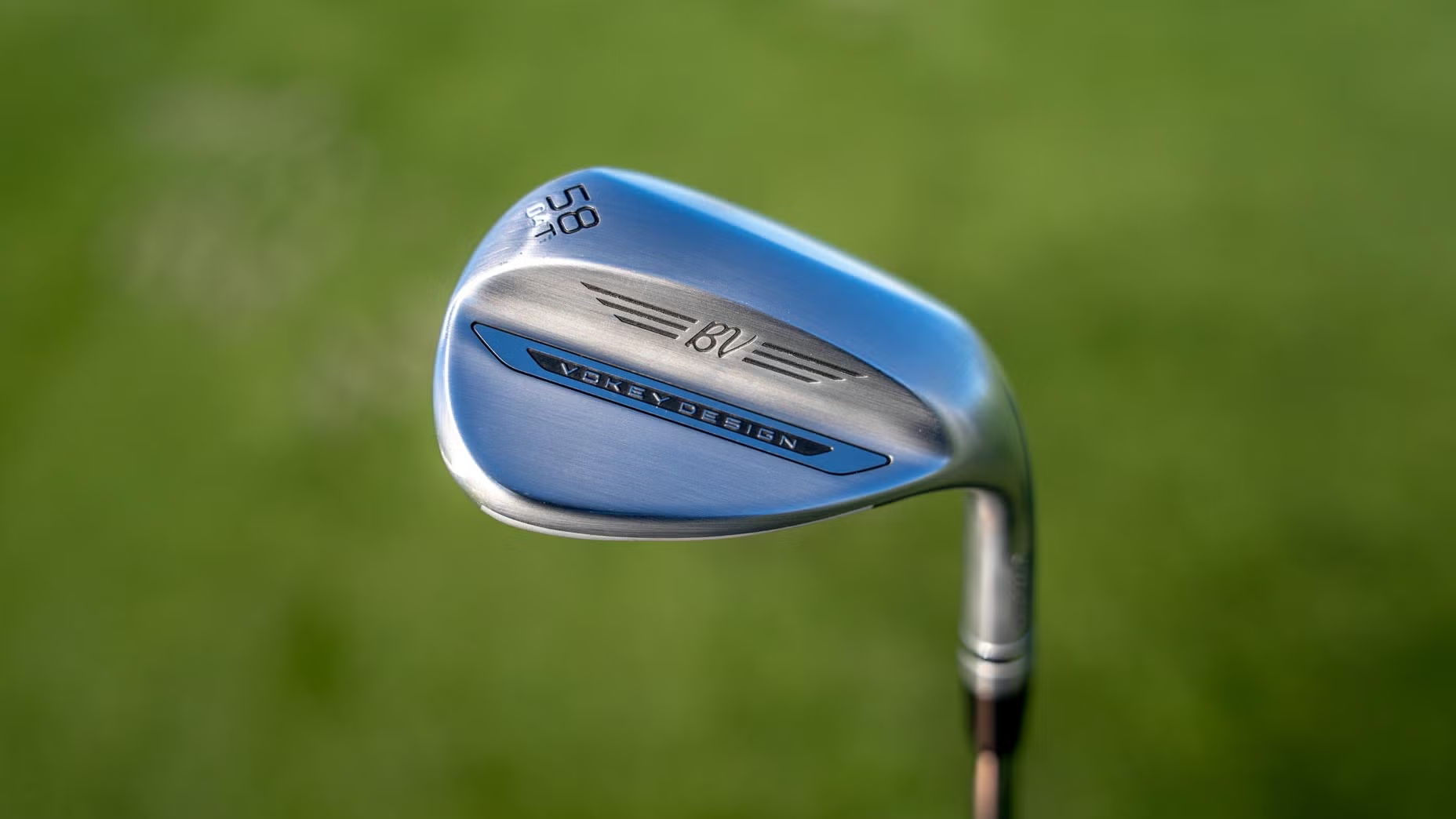

As the Equipment Editor for The Daily Duffer, I’ve seen countless trends come and go in the world of golf clubs. Every year, manufacturers roll out new lines, touting innovative tech and performance gains. My job, and my passion, is to cut through the marketing noise and tell you what actually works on the course.
When it comes to wedges, it’s a category where the “feel” and “art” often overshadow the hard data, but that doesn’t mean we should throw data out the window. This week’s discussion on GOLF’s Fully Equipped, featuring Johnny Wunder and Jake Morrow, tackled a topic near and dear to my club-fitter’s heart: wedge grind, and why the bounce number alone is a terrible guide.
The Bounce Conundrum: More Than Just a Number
For years, golfers have been told to match bounce to their swing and course conditions – low bounce for tight lies, high bounce for soft turf. While there’s a kernel of truth there, it’s vastly oversimplified. The article highlights this perfectly:
“More often than not, the stated bounce on a wedge bounce isn’t actually what the bounce of the sole is.”
This is a critical point that I’ve seen play out hundreds of times in my fitting bay. The “effective bounce” of a wedge is dramatically influenced by the grind – how the sole is shaped, heel to toe, and leading edge to trailing edge. A wedge with a 10-degree bounce could play completely differently from another 10-degree bounce wedge due to its sole geometry. I’ve had players come in with what they thought was a low-bounce wedge, only to find during testing that its heel relief made it behave like a higher bounce club on full swings, or vice versa around the green.
Morrow’s personal experience underscores this beautifully:
“I was hitting the Opus T, and I was on the very left side of a two-weeks-without-rain ECPC range, which is the tightest lie they have. And with the T grind, which they say on paper and in the forums and everything, that should be the one that works, right? Because it’s super tight. You’re going to be able to nip it, but whatever. Well, the problem is for me as a steeper player, it just turns into a knife and then it doesn’t come out of the ground.”
This is precisely why relying on bounce numbers alone is a fool’s errand for a steeper player. A T-grind, with its narrow sole and often low effective bounce, can dig aggressively if you deliver a steep angle of attack. For that player, the club isn’t sliding along the turf; it’s attempting to bury itself. This can lead to excessive spin rates that kill distance, or worse, heavy contact that sends balls nowhere. My launch monitor data often shows a sharp drop in ball speed and inconsistent launch angles when a player’s attack angle doesn’t match the grind.
The Blind Test: Data Doesn’t Lie, Feel Confirms It
Morrow’s solution, and one I wholeheartedly endorse, is blind testing. “I’m almost at the point where I wish the bounce number would just be eliminated from wedges,” he stated. This isn’t just about subjective feel; it’s about eliminating preconceived notions. When a player grabs a wedge and doesn’t know its stated bounce, they’re free to feel how the club interacts with the turf and observe the ball flight. This is where real performance shines through.
In my fitting sessions, I often use a similar approach. I’ll hand golfers wedges with different grinds, even if they have the same stated bounce, and have them hit various shots – full swings, chips, pitches, bunker shots. We then look at the data: carry distance consistency, spin rates, dispersion, and launch angle. While the player might describe the feel of one grind as “smoother” or “stickier,” the launch monitor provides the objective truth.
For example, a golfer struggling with tight lies might be convinced they need a low-bounce wedge. However, their impact data might show a slightly steeper angle of attack. Introducing a mid-to-high bounce wedge with significant heel and trailing edge relief (like a Vokey M Grind or K Grind) often yields surprising results. The wider sole and relieved edges prevent digging while still allowing for versatility. They feel like a “god,” as Morrow put it, because the club is doing the work to effectively manage their angle of attack, leading to better turf interaction, consistent ball speeds, and predictable spin.
  <div class="g-block-wrapper--slider">
    <div class="swiper-container">
      <div class="swiper-wrapper">
                      <div class="swiper-slide">
            <div class="g-block-slider__photo">
              <img decoding="async" loading="lazy" class="inner block-shop-card__image" src="https://golf.com/wp-content/uploads/2026/01/SM11FTImage.jpg" alt="Vokey's SM11 T-Grind wedge."/>
            </div>
          </div>
                  </div>
    </div>
          </div>
It’s About Your Delivery, Not Just the Course
The key takeaway from this discussion, and my years of fitting, is that finding the right wedge is fundamentally about matching the club to *your* delivery conditions – your angle of attack, your release pattern, and how you present the clubface at impact. While course conditions certainly play a role, designing your wedge set based solely on the assumption of “firm” or “soft” turf is a flawed approach.
I find that many amateur golfers are steeper than they realize. They might *think* they’re sweeping, but their impact data reveals otherwise. For these players, a versatile grind with moderate bounce and significant sole relief can be a game-changer. It provides forgiveness on chunky shots by preventing digging, yet allows for open-face shots around the green without the leading edge getting too far off the ground.
For someone with a very shallow angle of attack, who truly sweeps the ball, a lower effective bounce grind could be ideal, allowing them to clip the ball cleanly without the sole “bouncing” too soon. But even then, the shape of that sole is paramount. A low-bounce grind with a wide, flat sole could still cause issues if they’re trying to open the face.
Buying Advice: Ditch the Labels, Embrace the Fitting
So, what does this mean for your next wedge purchase? Here’s my advice:
- Forget the Bounce Number: Use it as a starting point if you must, but understand it’s a poor indicator of true performance.
- Focus on Grind Shape: Understand that different manufacturers have different names for similar sole characteristics (e.g., C-grind, M-grind, K-grind, S-grind, etc.). Each is designed to offer specific turf interaction and versatility.
- Get Fitted by an Expert: This is non-negotiable for wedges. A skilled fitter will use a launch monitor to analyze your angle of attack, club path, and how the club interacts with turf (ideally using divot patterns if hitting off grass). They’ll have you hit various shots from different lies and recommend grinds based on your actual swing, not just your handicap or stated preference.
- Blind Test if Possible: If your fitter offers it, or if you can arrange it at a demo day, try wedges without knowing the specific “grind” name. Trust your feel and the data.
Manufacturers like Titleist Vokey, Callaway Jaws, Cleveland RTX, and TaylorMade MG have invested heavily in diverse grind options precisely because one size does NOT fit all. The new Titleist Vokey SM11 wedges, for example, boast “a new precise CG position across each grind in a loft, meaning every wedge will now perform the same way with the same strike.” This CG placement is crucial for consistent launch and spin, especially on partial shots. But even with perfect CG, the grind still determines turf interaction – that’s where your performance gains or losses will truly be felt.
Don’t be swayed by marketing jargon about “ultimate spin” or “extreme versatility” without proof. Rely on fitting professionals, launch monitor data, and your own experience with how the club interacts with the turf. That’s how you’ll find the wedges that truly make you feel like a “god” around the greens.
