


Hello, Daily Duffer readers! Sarah Chen here, and I’m excited to dive into a topic that’s been sparking some fantastic discussion in the golf world: putting.
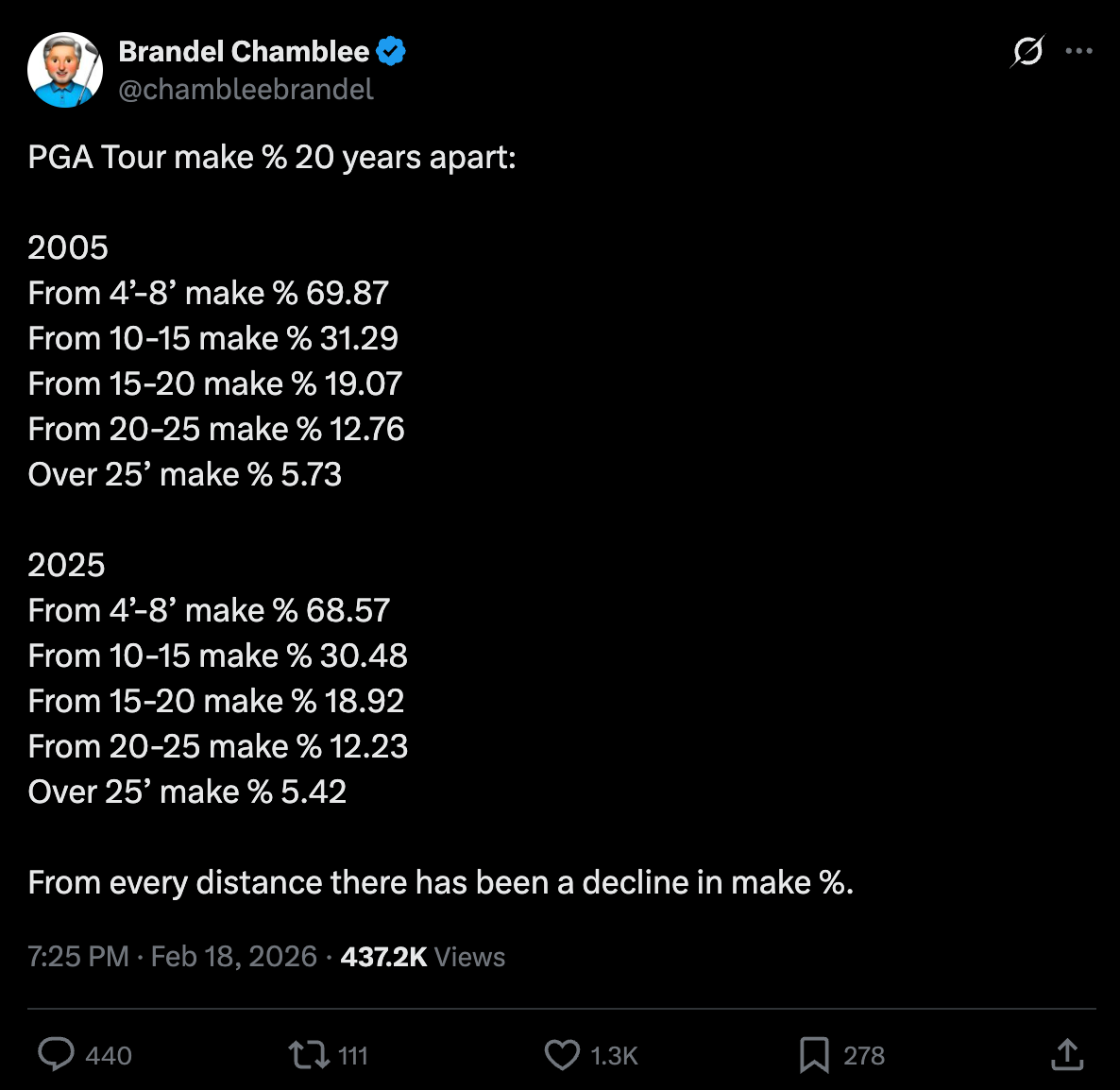
Recently, Golf Channel analyst Brandel Chamblee dropped some interesting data on X that caught my eye. He presented a fascinating study indicating a slight but discernible decline in putting make percentages over the last two decades. Now, your initial thought might be, “Wait, aren’t golfers getting better?” And in many ways, they are! But putting, as we all know, is a unique beast.
Let’s take a look at the data Chamblee shared:
These numbers, presented matter-of-factly, show a consistent dip across various distances. For instance, putts from 5 feet were made at a 77.0% clip in 2003, but that’s down to 74.5% by 2023. A similar trend is seen all the way up to 25 feet, where the percentage dropped from 9.9% to 8.6%.
This information certainly got people talking, and the theories poured in. Here are some of the responses Chamblee received:


There are some really interesting points in those responses. Some suggest green speeds, others point to technology creating longer approach shots, and one even suggests the modern putting stroke isn’t as pure. While the exact causes are up for debate, what’s clear is that putting remains a critical, and often challenging, part of the game.
So, what does this mean for *your* game? It means that focusing on your putting mechanics, your green reading, and your practice habits can give you a significant edge. In my 15+ years of teaching, I’ve seen firsthand that anyone, from a weekend golfer to a tour professional, can improve their putting with the right approach.
The Fundamentals are Your Friends
Regardless of what’s happening on tour, the core principles of great putting haven’t changed. When I work with my students, we always come back to these key elements:
- Square Face at Impact: This is paramount. If your putter face isn’t square to your intended line at impact, you’re fighting an uphill battle.
- Consistent Speed Control: Distance control is often more important than line, especially on longer putts. Rolling the ball with the correct speed dramatically increases your chances of making it or leaving a tap-in.
- Accurate Green Reading: Understanding the break and slope of the green is crucial for choosing the correct starting line.
One of the comments on Brandel’s post really resonates with me:
“I know people say greens are faster but I don’t buy that it causes a lower make rate. If you hit your lines it doesn’t matter what speed the greens are going. Speed control will just be a hair more sensitive.”
This is so true! Faster greens demand more precision, but they don’t fundamentally change the goal. It simply means your technique for line and speed needs to be even more dialed in.
Actionable Drills for Better Putting
Let’s get practical. Here are a few drills you can incorporate into your practice routine to sharpen your putting skills and defy any potential “decline.”
Try This: The Gate Drill for Face Control
This is a classic for a reason. Place two tees slightly wider than your putter head, just in front of your putter face at address. Your goal is to swing the putter back and through this “gate” without touching either tee. This drill immediately gives you feedback on whether your path is consistent and if your putter face is staying stable.
- Why it works: It trains your hands and arms to work as a unit, promoting a square impact face and a consistent putter path.
- Progression: Once you’re comfortable, place a ball in the middle and putt through the gate towards a target. Gradually narrow the gate as your control improves.
Here’s a Drill: The 3-6-9 Drill for Speed Control
Too many golfers neglect distance control in their practice. This drill will change that. Find a flat section of the practice green and set up three balls. Place a tee at 3 feet, 6 feet, and 9 feet from your starting point. Your goal is to hit each ball, one after another, and stop it as close to each respective tee as possible without going past it.
“The only thing that has changed is the putting stroke. Guys are trying all these new styles/grips. More moving parts, more inconsistency”
While I don’t necessarily agree that “new styles” inherently lead to inconsistency (we’ve seen many great putters with unique styles!), the core idea of *consistency* is crucial. This speed control drill is all about developing a consistent stroke length and tempo for various distances, regardless of your grip or stroke style.
- Why it works: It forces you to feel the correct amount of energy needed for different distances, building your “touch.” It also highlights inconsistencies in your tempo or stroke length.
- Progression: Once you’re consistently hitting the tees, try the drill with your eyes closed on a few putts to really rely on feel.
Mental Game Checkpoint: The “One-Putt Goal”
Putting isn’t just about technique; it’s hugely mental. When you’re standing over a putt that feels absolutely crucial, that’s when your mental game shines (or falters).
“It’s definitely mental. Guys are probably more worried about hitting it too far than trying to make it from 10ft nowadays”
This observation highlights a critical point: fear of the three-putt can lead to timid strokes. Instead of *trying not to three-putt*, shift your focus to a positive goal. For any putt, especially those outside of tap-in range, your primary goal should be to give it a chance to go in while ensuring it doesn’t leave you with a difficult second putt. I tell my students to visualize the ball dropping into the cup with the perfect speed, not just ending up near the hole.
- Why it works: It changes your mindset from avoidance to actively pursuing a positive outcome. This often leads to a more confident and assertive stroke.
- Practice: Before each putt on the course, take an extra moment to visualize the ball’s entire journey, from contact to drop. This mental rehearsal can significantly enhance your confidence.
The beauty of golf is its constant evolution and debate. While the data suggests a dip in tour putting percentages, it’s also an opportunity for us all to recommit to the fundamentals and practice with purpose. You have the power to improve your putting, and with these drills and a focused mindset, you can start seeing those putts drop more consistently!
