

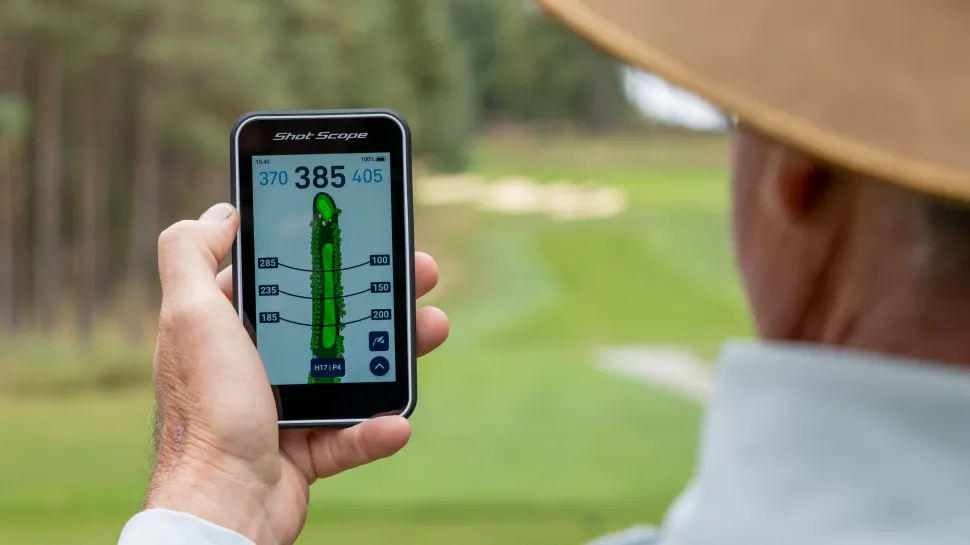

Alright, Daily Duffer faithful, Tyler Reed here, and today we’re diving into a piece of golf tech that’s trying to make a comeback in a big way: the handheld GPS. Specifically, Shot Scope has dropped their new H50 GPS Handheld, and in a world increasingly dominated by feature-packed GPS watches, this kind of device feels almost… retro.
Now, I’ve spent countless hours in the fitting bay, staring at launch monitor data – ball speed, spin rates, launch angles, you name it. And what I’ve learned from fitting hundreds of golfers, from weekend warriors to scratch players, is that information, when accurate and actionable, is gold. But when it’s just noise, it’s a distraction. The big question for the H50 is: does it deliver actionable insights, or just more numbers on a screen?
The source article notes that GPS watch technology has seen a massive surge, and that’s true. My own testing confirms that these watches have become incredibly sophisticated, offering everything from basic yardages to advanced shot tracking. It’s no wonder handhelds have lost a bit of their swagger. But Shot Scope, a brand I respect for their data-driven approach in other products, is making a clear play for the handheld market.
The headline here is the emphasis on “fast and accurate yardages as well as visual data in a compact touchscreen device.” Accuracy is paramount. I’ve seen too many golfers rely on questionable yardage readings, leading to poor club selection and ultimately, higher scores. If the H50 can deliver on its promise of “highest levels of precision from a handheld device” through dual-band GPS, that’s a significant win. In my fitting experience, even a few yards off makes a difference in carry distance, especially when you factor in a player’s typical spin rates and launch angles. Overestimating or underestimating a carry by 5 yards can mean the difference between a perfect approach and finding a bunker.
One feature that immediately caught my eye is the ‘plays like’ yardages. This is critical. I’ve often seen golfers, particularly those with slower swing speeds, struggle to account for uphill or downhill shots. The mental calculation of adjusting for elevation changes is often where amateur golfers falter. Having the device do that math for them allows for more confident club selection, which directly translates to better contact and more consistent ball striking. This isn’t just a convenience; it’s a legitimate game improvement tool, especially for those who might not have a reliable rangefinder with slope capabilities.

The CEO of Shot Scope, David Hunter, makes a compelling statement:
“The launch of the H50 represents an important milestone in our mission to transform the way golfers visualise each hole. By bringing detailed mapping and green contour insights to a large, responsive touchscreen, the H50 helps golfers plan every shot from tee to green with confidence.”
He hits on a key point: visualizing the hole. That’s where the “detailed hole maps, green view with pin placement, green contours, and elevation maps” come into play. While I can see ball flight on a launch monitor, translating that into course strategy requires understanding the terrain. Green contours are particularly useful. Knowing how a putt is going to break requires more than just yardage; it requires understanding the slope. This is a level of detail that many basic GPS watches simply can’t offer effectively on their smaller screens.
The Tech That Matters
The 4.3-inch touchscreen, waterproof design, and “brightness and clarity in all lighting” are practical considerations. I’ve been on courses where mid-round rain can render some devices useless, or bright sun makes the screen unreadable. These are crucial elements for on-course performance. The interactive mapping, with satellite imagery and touch-and-drag functionality for hazards and landing areas, essentially gives you a virtual caddy in your hand. This helps golfers not just with the “what” (the distance) but the “how” (the best line, the optimal carry).

The H50 being ready to go with “more than 42,000 golf courses worldwide” and regular updates is essential. There’s nothing worse than getting to a course, ready to use your fancy new tech, only to find the course mapping is out of date or non-existent. This level of comprehensive mapping means golfers won’t be left playing blind. And for those who play competitive rounds, the “competition mode” to disable slope and elevation is a smart inclusion, ensuring compliance with the rules of golf.
Now, let’s talk value. An RRP of £249.99 puts it firmly in the premium GPS device category. Is it worth it? For the golfer who consistently walks courses and prefers a larger, more detailed visual for course management, yes. I’ve found in my fittings that some players simply prefer the tactile experience of a handheld device over fumbling with a watch. Its ability to show green contours and detailed hole maps could genuinely help players understand the course better, leading to improved strategy, which is often a bigger differentiator than an extra 5 mph of ball speed for the average amateur.

So, who is this for? Not the golfer who wants to track every shot and compile reams of post-round data through automatic shot tracking (though it does include a scorecard that links to the Shot Scope app). This isn’t their advanced shot-tracking watch. This is for the golfer who prioritizes clear, visual course management and precise yardages, without the need for constant wrist glances. It’s for the player who finds traditional rangefinders a bit fiddly or struggles with line of sight on blind shots. It’s also probably attractive to the golfer who prefers not to wear a watch while playing. If you’re a mid-to-high handicapper looking for serious help with strategy and club selection, the H50 could be a valuable addition to your bag.
My take? The Shot Scope H50 isn’t revolutionary in introducing handheld GPS, but it appears to refine the offering significantly. The detail in mapping, dual-band GPS for accuracy, and the ‘plays like’ feature are legitimate performance enhancers. It’s not about adding 10 yards to your drive or dropping your spin rate by 500 RPM, but rather helping you make smarter, more confident decisions on the course. And in golf, smart decisions are often the shortest path to lower scores.
