

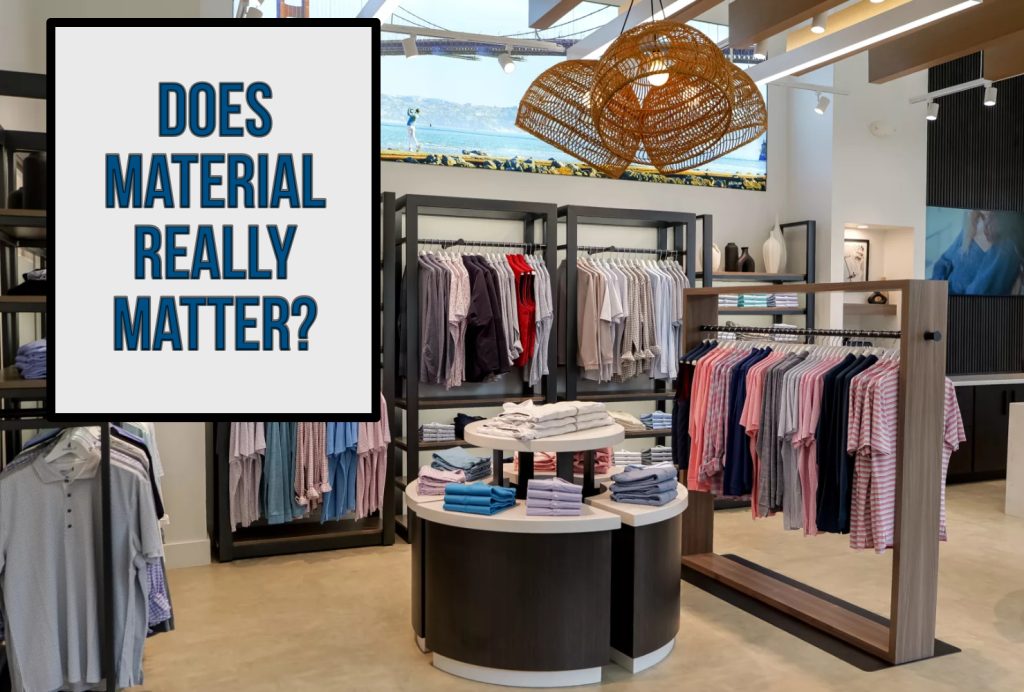

Alright, let’s talk about the latest “Off Course” podcast. As the resident equipment editor, my ears perked up at the mention of material and design, even if the primary focus was apparel. Why? Because the principles they discuss – how materials are chosen, how design impacts feel and performance – are fundamentally the same ones we dissect when talking about drivers, irons, and even golf balls. While I’m not fitting anyone for a polo shirt on a launch monitor (yet!), understanding a company’s approach to product development is crucial for discerning genuine innovation from mere marketing.
Episode 288 featured the team from Johnnie-O, an apparel brand, discussing their approach to clothing. Now, you might be thinking, “Tyler, what does a golf shirt have to do with MOI or ball speed?” And you’d be right, directly, not much. But indirectly, it speaks volumes about a brand’s philosophy. When a company invests heavily in researching materials for comfort, sweat-wicking, or range of motion, that same meticulousness often translates to other parts of their business, or at least, indicates an understanding of what high-performance means.
The podcast touched on several interesting points, not least of which was the discussion around “material and design.”
“It wouldn’t be Off Course without some tangents, but Dan and the Johnnie-O team dive into many topics including Johnnie-O on tour and how material and design play a role in creation.”
This is where my equipment editor hat really starts to fit. When we talk about drivers, material science is EVERYTHING. We’re chasing infinitesimally thin, yet incredibly strong, alloys and composites to push Coefficient of Restitution (COR) to the limit. We’re strategically placing discretionary mass to achieve target launch windows and spin rates. The design isn’t just about aesthetics; it’s about aerodynamics, weight distribution, and feel. A driver head, for example, might be designed with a specific moment of inertia (MOI) in mind, say over 5000g/cm², to resist twisting on off-center hits. If Johnnie-O is genuinely prioritizing material and design in their apparel, it suggests a similar commitment to performance, albeit in a different domain.
Another point that resonated with me, despite the apparel context, was the discussion of “Johnnie-O on Tour.”
“Today, the team from an apparel favorite joins the show to discuss material, design and Johnnie-O on Tour.”
This matters. When professional athletes use a product, it speaks volumes. While golf shirts don’t influence ball speed, they contribute to comfort and focus, which indirectly impacts performance. Similarly, when a company like Callaway or Titleist sponsors tour pros, it’s not just about visibility. It’s about getting their gear into the hands of the best players, validating its performance under extreme competitive pressure. These pros demand gear that performs, whether it’s a driver that consistently delivers a 170 MPH ball speed with optimal 10-degree launch and 2200 RPM spin, or an iron that provides consistent dispersion and feel. If Johnnie-O is successful on tour, it suggests their products meet the high standards of top-tier athletes, which is a good indicator of overall quality and attention to detail.
I also found the mention of “Accessibility to Product from Different Vantage Points” intriguing.
“Exploring Licensed Collections from Johnnie-O Accessibility to Product from Different Vantage Points.”
From an equipment perspective, accessibility is key. We see this with adjustable drivers, where golfers can tweak loft, lie, and even weighting to fine-tune their ball flight without needing a full re-fit. Or with iron sets that offer mixed compositions – cavity backs in the long irons for forgiveness and blade-like designs in the short irons for workability. This caters to a wider range of golfers and skill levels, making high-performance available to more players. If Johnnie-O is making their product accessible, it shows an understanding of their customer base, which is a positive trait for any brand.
So, what’s my take?
While this particular podcast episode didn’t dive into the nitty-gritty of clubhead speed or smash factor, it provided a valuable glimpse into product development philosophy. A brand that obsesses over material and design, validates its products with tour professionals, and aims for broad accessibility, is a brand worth watching. Even if we’re not talking about clubs, these principles translate. I’m always looking for companies that don’t just churn out products but genuinely think about how their offerings enhance the golfer’s experience.
For the average golfer, what does this mean? It’s a reminder to look beyond the flashy marketing. Don’t just buy a driver because a pro uses it, but understand *why* they use it and if those attributes align with your game. Don’t just pick an iron because it looks good; ask about the materials, the weight distribution, and how its design impacts launch, spin, and consistency for *you*. As I’ve learned from fitting hundreds of golfers, the small details in design and material choice often make the biggest difference in performance, whether we’re talking about a driver engineered for maximum ball speed or a shirt designed for maximum comfort on the course.

My final thought on this particular episode of Off Course and brands like Johnnie-O? It reinforces my belief that the best companies in golf, regardless of whether they make clubs or clothing, share a core philosophy: innovate with purpose, design for performance, and listen to the end-user. That’s the formula that earns my stamp of approval, whether I’m analyzing a 0.83 COR driver face or a moisture-wicking polo.
