

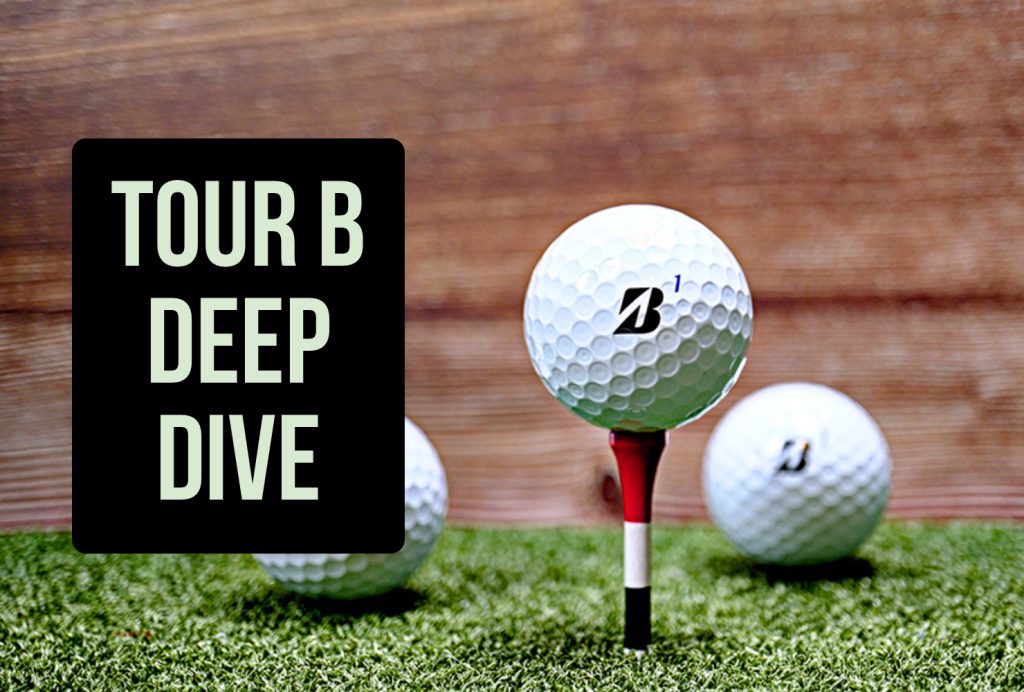

As the Equipment Editor for The Daily Duffer, my inbox is a constant barrage of new product announcements, marketing buzzwords, and promises of revolutionary breakthroughs. Most of the time, it’s a lot of noise. But every so often, something genuinely piques my interest, especially when it involves the golf ball – the one piece of equipment every golfer uses on every single shot.
I recently tuned into the latest episode of “Off Course” where Dan Edwards chatted with Adam Rehberg from Bridgestone Golf about their new Tour B golf balls and a new material called VeloSurge. As a club fitter who’s put hundreds of balls through their paces on every launch monitor imaginable, Bridgestone has always held a special place. They consistently deliver performance, especially for those who prioritize control and consistency.
Unpacking VeloSurge: More Than Just a Catchy Name?
The industry is rife with proprietary terms, and “VeloSurge” immediately had me skeptical. Is it a true technological leap, or just a clever marketing moniker for a slight tweak? From listening to the podcast, it sounds like Bridgestone is genuinely invested in innovation, especially when it comes to the core and cover. Rehberg emphasizes that the discussion goes beyond just fluff:
“It wouldn’t be Off Course without some tangents, but Dan and Adam dive into many topics including the performance and durability of cover material and what exactly is VeloSurge in a fun deep dive.”
From what I gather, VeloSurge refers to a new core formulation designed to maximize energy transfer and create a more efficient engine for ball speed. In my experience, core technology is where many of the most significant and often invisible gains are made in golf ball performance. Getting every last ounce of energy from impact translated into ball speed without sacrificing feel or spin is the holy grail. I’ve seen countless golfers leave yards on the table because their ball’s compression simply doesn’t match their swing speed. If VeloSurge can truly optimize this, it’s a big win.
The Cover Story: Performance and Durability
Beyond the core, the cover material is critical, particularly for short game control and overall durability. I’ve seen golfers switch balls almost purely based on how well the cover stands up to wedge grooves. A great feeling, high-spinning cover is useless if it’s shredded after three holes.
“Dan and Adam discuss the following topics and a whole lot more. Introducing an Important New Material into Bridgestone Tour B. Performance and Durability of Cover Material.”
This suggests Bridgestone isn’t just focusing on speed, but also on the full-game performance expected from a Tour-level ball. My launch monitor data consistently shows that even minor changes in cover hardness or dimple pattern can dramatically affect launch angle, spin rate, and peak height, especially with wedges and short irons. If Bridgestone has found a way to enhance greenside spin and feel while also improving durability, that’s a genuine benefit for golfers who demand premium performance without compromising the lifespan of their expensive ammunition.

From Marketing Hype to Launch Monitor Reality
Tour adoption is often cited as proof of concept, and for good reason. Professional golfers are notoriously demanding and will only play what gives them a tangible advantage. While I don’t see specific data points on ball speed gains or spin rate changes from the podcast summary, the mention of “Immediate Tour Success and Adoption” is a strong indicator. Pros aren’t swayed by marketing alone; they need to see results on TrackMan, GCQuad, and most importantly, on the course under competitive pressure. If the new Tour B is delivering measurable improvements in areas like lower driver spin for more distance, or higher iron spin for better control, tour players will gravitate towards it.
In my fitting bay, when a ball truly performs, the numbers don’t lie. We look for increased ball speed (without a corresponding increase in driver spin for the same launch angle), tighter dispersion, and consistent spin rates on approach shots. For a premium ball like the Tour B, I’d expect to see a relatively low, penetrating driver flight with minimal side spin for maximum distance, coupled with high spin rates on short irons and wedges for maximum control and stopping power.
Who is this ball for?
Based on Bridgestone’s history and the “Tour B” designation, these balls are almost certainly aimed at faster swing speed, lower handicap players. These are golfers who can compress the ball effectively and demand precise feel and spin around the greens. If a golfer is struggling with excessive spin off the driver, or lacking bite with their wedges, the promise of VeloSurge and an improved cover could be a game-changer.
For the average mid to high-handicapper, while the technology is impressive, the benefits might be marginal compared to the price point. These players often prioritize a softer feel and greater forgiveness. However, if Bridgestone has managed to make these Tour B models more accessible in terms of feel without sacrificing their premium performance, then it opens up the market. I’ll reserve final judgment until I can get these new balls on the launch monitor myself and see how they stack up against the competition across different swing speeds and attack angles.
The Daily Duffer Verdict (Initial Thoughts)
Bridgestone’s discussion of VeloSurge and refined cover materials for their new Tour B line sounds promising. As someone who consistently cuts through marketing jargon, the focus on core efficiency and cover durability hits the right notes for genuine performance improvement. The immediate tour adoption further suggests that this isn’t just hype. I’m keen to get these in my hands, run them through my battery of tests, and see if the launch monitor data backs up Bridgestone’s claims. If they deliver on improved ball speeds without sacrificing short game control, these new Tour B balls could be a serious contender for top performers in the premium ball category. Stay tuned for a full, data-driven review once I’ve had a chance to put them through their paces.
