

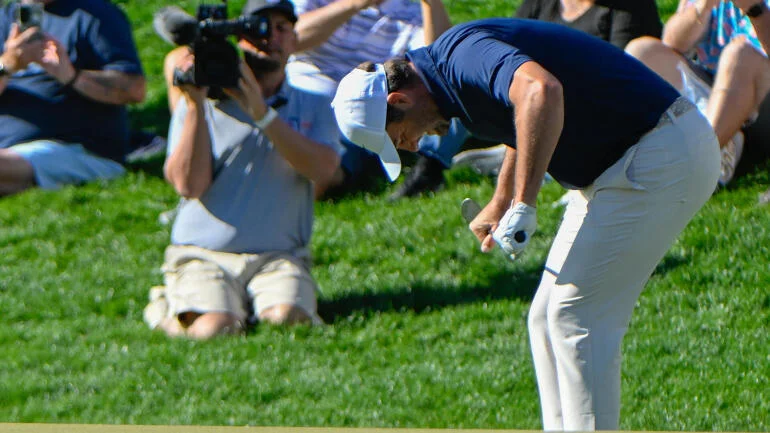

Scottie’s Phoenix Stumble: A Reminder That Even the Best Have Rough Fridays
I’ve been covering professional golf for 35 years, and I’ve learned that the most compelling stories aren’t always about the victories. Sometimes they’re about the 73s—particularly when they come from the world’s best player in the middle of an otherwise spectacular run.
Scottie Scheffler’s opening round at the 2026 WM Phoenix Open was, by his standards, a disaster. And yet, watching the reaction from certain corners of the golf world, you’d think he’d missed the cut entirely. Let me be clear about something: one bad round doesn’t redefine a player’s trajectory. But it does tell us something worth examining.
Breaking the Streak, Breaking the Pattern
What happened Thursday morning at TPC Scottsdale was remarkable precisely because it was unremarkable by normal standards. Scheffler carded a 2-over 73—his first round over par since June 2025. That’s eight months of at least par or better. To put that in perspective, having caddied for Tom Lehman back in the ’90s, I can tell you that kind of consistency isn’t just impressive; it’s historically aberrant. The golf world doesn’t produce many stretches like this anymore, if it ever really did.
The numbers tell the story better than I can:
- 33 consecutive rounds at par or better
- Only one round in the 70s during that span—a 70 at the Procore Championship, which he won
- The streak dated back to the third round at the Travelers Championship last June (a 2-over 72)
When you’re that good for that long, regression isn’t a failure—it’s physics.
The Unforced Errors That Define Days
What strikes me most about Scheffler’s round isn’t that he played poorly overall. It’s that he played poorly in specific, telling ways. According to the scorecard, he posted five birdies, five bogeys, and a double bogey. Sounds like it could’ve been worse, right? But dig deeper, and you see the patterns that separate a 73 from a 68:
“He did not make his first par on a par 4 until the fifth hole — his 14th hole since he teed off on the back nine.”
That’s the kind of detail that makes me lean back and say, “Ah, that’s what happened.” Scheffler started reasonably well, taking advantage of both par 5s on the back nine and the drivable par-4 17th. He was 2 under through eight holes. Then came the turn, and with it, the kind of sloppy golf we rarely associate with him:
“Around the turn, he went bogey, bogey, double bogey thanks to self-inflicted wounds like missing short putts, leaving chips at his feet and being out of position.”
In my experience, this is where you separate the merely talented from the transcendent. Most professional golfers can hit the ball far and straight. Scottie’s long been exceptional at the inches-around-the-green game—the chipping, pitching, and short-putt conversion that wins majors. Thursday, those skills abandoned him. The chips climbed toward the pin only to roll back to his feet. The short putts didn’t fall. The distance control with irons was off.
A Humbling Perspective
Here’s where I think some observers are overreacting: one poor round doesn’t suggest Scheffler is in decline or that his recent dominance is cracking. What it suggests is that even the best players in the world have days where things don’t click. I’ve seen it hundreds of times. The difference is that when it happens to Scottie, it’s news because it’s so rare.
Consider the broader context. Scheffler won The American Express in his first event of the season. He arrived at Phoenix as a two-time champion at this event, and many observers (myself included, initially) had him as the favorite before a shot was struck. That’s the kind of pressure and expectation that can weigh on anyone.
What I’m more interested in is how he responds Friday. The article notes that he’s now holding the longest active made-cut streak on the PGA Tour following Xander Schauffele’s early exit last week at Farmers Insurance. That’s not trivial. Scheffler has proven he’s a great player on difficult courses under pressure. One rough morning doesn’t erase that.
The Left Miss and Other Demons
One detail caught my eye: Scheffler battled a left miss off the tee, including a water ball on No. 11 with the driver. In my decades around the tour, I’ve learned that when your natural shot is working against you, it’s usually a sign of something mental—tension, overthinking, doubt. It rarely means a fundamental swing flaw has suddenly appeared.
“To say it was an uncharacteristic day for Scheffler would be an understatement. He battled the left miss off the tee — Scheffler found the water with the driver on No. 11 — struggled with distance control with his irons and even mishit some, looking uncomfortable with shots around the green.”
This is what happens when the machine occasionally stalls. It’s human, and honestly, it’s refreshing. The relentless perfection of recent months was beginning to feel almost unfair to the rest of the field.
Looking Forward
Phoenix Open crowds are notoriously tough, particularly on the back nine. The course is playing firm, and Scottie found out that even the most dominant players can get punished by course setup and conditions. Friday presents an opportunity to scrape the wheels back on and push toward the cut line.
The fact that this is even a question—whether Scheffler makes the cut—tells you something about expectations. For most players, a 73 in round one is acceptable. For him, it’s a crisis. That’s not pressure; that’s perspective.
I’ll be watching Friday closely. Not because I’m worried about Scheffler’s future, but because great players reveal themselves in how they respond to adversity, not how they perform on comfortable days.
