

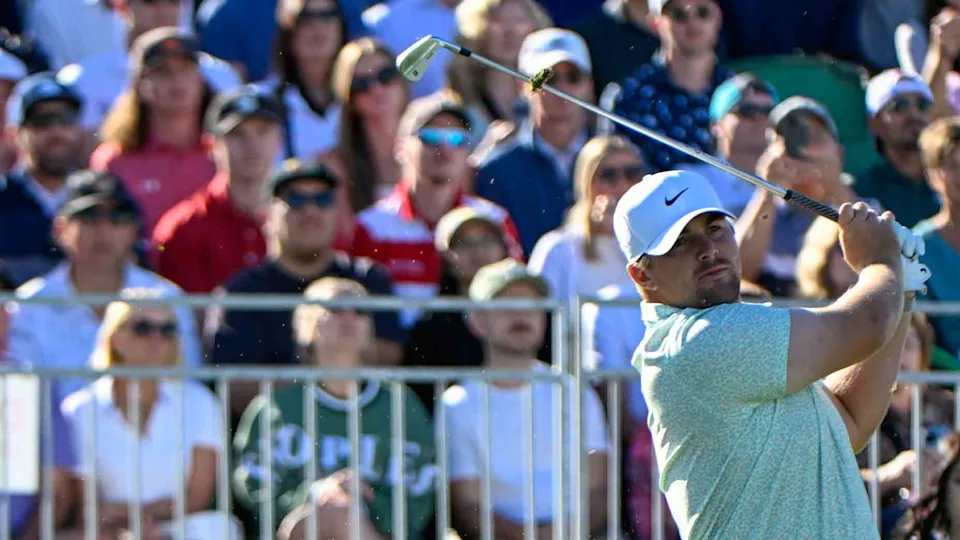

Chris Gotterup’s Masters Bet With Himself: Why Self-Belief Matters More Than Ever
I’ve spent 35 years around this game, caddied for Tom Lehman, and watched enough young talents flame out to know when someone’s got the right mental architecture to stick around. Chris Gotterup has it. And what strikes me most about his approach to Augusta National isn’t just that he’s arriving as a two-time PGA Tour winner this season—it’s the principle underlying his decision to get there.
He turned down Masters invitations before he’d qualified as a player.
Let that sit for a minute.
The Psychology of a Champion-in-Waiting
In my experience, the players who separate themselves from the pack aren’t always the ones with the purest swings or the longest drives. They’re the ones who understand something fundamental about ambition: watching from the gallery is a different animal than competing on the course. Gotterup gets this instinctively, and his reasoning reveals a maturity I don’t often see in 20-something competitors.
“I don’t really like watching other people play unless I’m not playing that week. It’s just my, I don’t know, I’m kind of weird in that sense. Like I wanted it to be, like it’s the most hyped-up tournament in the sport and I don’t want to go over there and be a spectator; I want to play.”
That’s not arrogance talking. That’s clarity. In three decades covering this tour, I’ve seen plenty of talented kids make the pilgrimage to Augusta as spectators, soaking in the mystique, the azaleas, the history—and somehow, that experience seemed to work against them later. It’s as if they’d already had their moment, even if just as an observer. The awe became a weight instead of fuel.
Gotterup deliberately avoided that trap. He wanted his first experience at Augusta to matter, to count, to carry the weight of competition. That kind of discipline—turning down a chance most amateurs would sell their best 3-wood for—tells you something about how his mind works.
Two Wins in 2025, and the Pattern Is Clear
Let’s talk about what he’s actually doing out here. The Sony Open victory in January followed by a win at the WM Phoenix Open? That’s not luck. That’s a player who’s figured something out. I watched him work alongside Scottie Scheffler for the first two rounds in Phoenix, and there’s a telling moment buried in the article that reveals Gotterup’s golf IQ.
“If I could bet on golf, I would have put a lot of money on him to come out and play good on Friday.”
Gotterup was reading the world No. 1 like a book. Scheffler shot two-over on Thursday—genuinely off his game by his standards—but Gotterup recognized what most amateurs miss: that’s temporary. He knew Scheffler would adjust, would attack Friday, would finish eight strokes better. That’s the kind of pattern recognition that separates pretenders from legitimate threats.
What’s happening with Gotterup’s game right now is the blend of power and precision. He’s got length off the tee—necessary at modern tour stops—but he’s married that with the short game touch that makes Augusta National so demanding. He’s not hitting 340-yard drives and hoping to birdie his way around. He’s thinking his way around the course.
Augusta National As Mirror, Not Museum
Here’s what fascinates me about his mindset heading into the Masters: Gotterup isn’t approaching it as some sacred museum piece to be reverently explored. He’s treating it like a puzzle to solve, and he’s already started doing the mental work.
“It’s just one of those tournaments where I think—like here is similar in the fact that I could tell you every hole on that course even if I didn’t step foot on it. So I’m excited to just kind of be out there and enjoy maybe in one of these off weeks, enjoy, like get the, not the nerves, but like the awe factor of it hopefully away and try to get settled in by the time the tournament comes.”
Notice what he’s doing: he’s already mapped the course mentally. He’s talking to Freddie Couples, Tiger Woods, Jason Day—guys who’ve won there or contended. He’s systematically removing the mystery before he ever arrives. That’s championship behavior. That’s someone who understands that Augusta rewards preparation and confidence in equal measure.
The Danger and the Promise
Now, I’d be dishonest if I didn’t acknowledge the other side of this equation. Gotterup’s got confidence, yes—but confidence without results is just noise. Two PGA Tour wins in a season is meaningful, but it’s not a Masters championship. The field at Augusta will include majors winners, veteran grinders, and other players his age who are equally hungry.
What gives me pause, though, isn’t his ability. It’s the standard he’s set for himself. He’s made a private bet—show up as a player, not a fan—and now the whole golf world knows it. That’s pressure he’s chosen, which is admirable, but it’s still pressure.
Yet here’s what I’ve learned in my three-plus decades around this game: the players who thrive under self-imposed pressure are usually the ones worth watching. Gotterup’s bet with himself, made years ago when he was 13 or 14 and shot that 69 at Rumson Country Club (his mom still has the scorecard framed), isn’t about ego. It’s about honoring a commitment to excellence.
Come April, we’ll see if that’s enough. But I’m betting on him—if I could bet on golf.
