

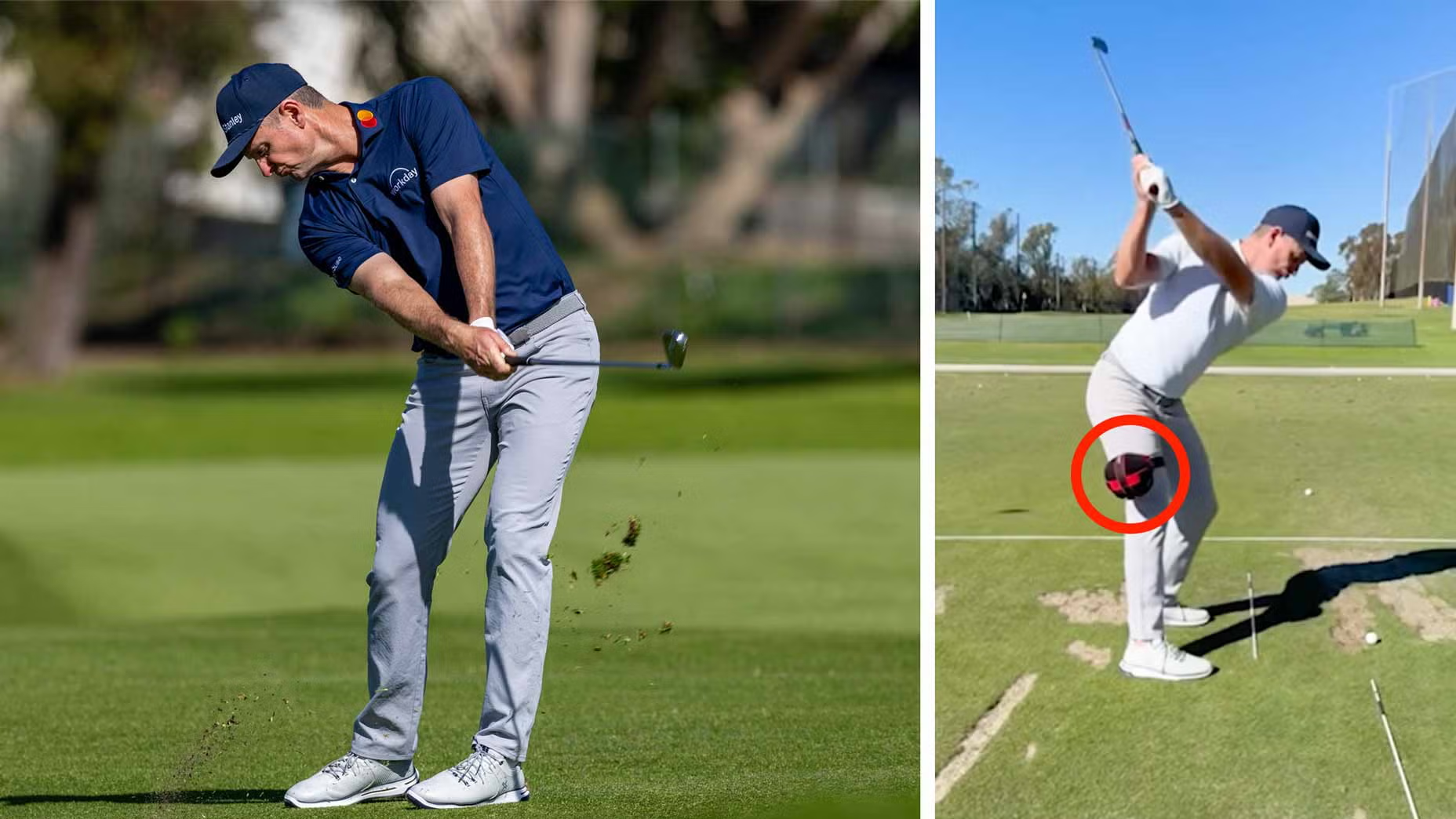

Hello, Daily Duffer readers! Sarah Chen here, and I’m excited to dive into a topic that’s often overlooked but incredibly impactful for your golf swing: the movement of your trail leg during the downswing. We just saw Justin Rose, fresh off his PGA Tour victory at the Farmers Insurance Open, showcase incredible consistency, and a recent interview with his coach, GOLF Top 100 Teacher Mark Blackburn, gave us a fascinating look into one of his key swing thoughts. What we learned can absolutely help you improve your ball striking and rotation.
For years, I’ve taught golfers of all levels that the chain reaction of the golf swing starts from the ground up. Many players focus intensely on their arms and shoulders, but the truth is, a stable and dynamic lower body is the engine of power and consistency. Justin Rose’s success, in part, highlights this perfectly.
The Critical Role of Your Trail Leg in the Downswing
When I’m out on the range, I often see golfers who, in an effort to get more power, aggressively push off their trail leg, causing it to collapse inward towards the ball or slide laterally. As Mark Blackburn explains with Justin Rose:
“One of the things Rosie likes to feel as a player, is he likes to be quite passive through impact. So he has a tendency at times for his right knee and right leg to work a little too inward, towards the ball, which then leaves his torso backing up a little bit and then he has to straighten his arms out.”
This “backing up” or “secondary axis tilt” often leads to a variety of inconsistent shots – slices, pushes, or thin contact. It makes it very difficult to deliver the club squarely and powerfully to the ball. Your hips and torso get stuck, and you’re forced to rely on your hands and arms to “save” the shot, which is far less consistent. As Blackburn puts it, Rose’s “bad golf” involves “a lot of slide and tilt and arm throw out.” This is precisely what we want to avoid.
The solution, in Rose’s case, and what I encourage you to focus on, is to get that trail knee — your right knee for right-handed golfers — tracking more efficiently towards your lead knee during the downswing. This isn’t about keeping it completely static, but rather controlling its movement. You want it moving *towards* the target, not collapsing *inward* or *downward* towards the ground.
When you achieve this feeling, it allows your hips to turn more effectively, giving you that powerful rotation that the pros exhibit. You can stay centered over the ball, allowing the club to move on plane and providing a more “passive” yet powerful strike through impact. This controlled movement facilitates staying “centered and turn through the shot” as Blackburn notes, which is key for precision and power.
Actionable Drills to Master Your Trail Leg Movement
You might be thinking, “That sounds great, Sarah, but how do I *feel* that?” This is where drills come in! Here are a couple of checks and drills you can incorporate into your practice routine.
Drill 1: The Trail Knee Track Check
This simple drill requires only an alignment stick or even just a golf club placed on the ground.
- Set up as you normally would, with an alignment stick placed on the ground just outside your trail foot, parallel to your target line.
- Make a slow-motion or rehearsal backswing. Your trail knee will naturally have some flexion (bend) and rotation, but try to feel like it’s staying generally in place, supporting your turn.
- As you initiate your downswing, focus on feeling your trail knee moving UP and FORWARD, towards your lead knee and the target. Imagine it’s trying to “meet” your lead knee.
- The key is that your trail knee should move FORWARD along the line of the alignment stick, not inward towards your lead heel or downward towards the ground.
If you see your knee bumping inward, you’re likely sliding your hips or collapsing your trail side, which can lead to that “backing up” feeling. The goal is to feel the rotation of your hips pulling your knee forward, rather than your knee pushing inward.
Drill 2: The Smart Ball (or Towel) Connection
Justin Rose uses a sophisticated training aid called a ‘Smart Ball’ for this. You don’t need to go out and buy one immediately. A rolled-up towel or even a small soft ball can serve a similar purpose to give you a feeling of connection and feedback.
- Place a rolled-up towel, or a small, soft ball (like a beach ball or even a soccer ball if you’re careful), between your lower thighs, just above your knees.
- Take your normal golf setup.
- Now, make some slow practice swings, focusing on keeping the towel/ball gently compressed between your legs.
- As you move into the downswing, you’ll find that maintaining this compression naturally encourages your trail knee to track more effectively towards your lead knee, without collapsing inward. It prevents that disconnected, “splaying out” motion of the trail leg.
The feedback is instant. If you lose the towel, your legs have likely moved too much independently or collapsed. This drill helps promote a more unified and rotating lower body. As Blackburn said about Rose’s experience with the Smart Ball:
“He [Rose] likes it [the drill] because it then allows him to to reflex or cover the golf ball and be quite passive through the hit.”
This “passive through the hit” feeling is tremendously effective once you achieve it. It means your body is rotating efficiently, allowing the club to work naturally through impact without needing to overuse your hands and arms.
Checkpoint: Post-Impact Balance
After your swing, make sure you can hold your finish for a full 2-3 seconds. Your weight should be predominantly on your lead foot, and your trail foot should be up on its toe, with your trail knee almost touching or very close to your lead knee. This is a visual indicator that your lower body has rotated fully and efficiently, leaving no “sway” or “slide” behind.
What’s truly impressive is that Rose and Blackburn only incorporated this drill a week before his PGA Tour victory. This just goes to show that even tiny, focused adjustments can lead to dramatic improvements quickly when they address a core issue.
Unlocking Your Rotational Power
Remember, the goal isn’t just about mimicry; it’s about understanding the “why.” By controlling your trail leg’s movement, you allow your body to rotate better, stay more centered, and deliver the club with a more consistent path and face angle. You’re building a solid foundation for your swing, rather than compensating for a weak one. This leads to more solid contact, better direction, and ultimately, more power.
“His ‘bad golf’ is played with a lot of slide and tilt and arm throw out.”
Let’s make sure that’s not your story! Focus on your lower body and you’ll immediately feel a difference. Give these drills a try on your next range session. You might be surprised at how quickly an awareness of this one small aspect of your swing can unlock a whole new level of consistency and confidence. Keep swinging well, and I’ll see you on the course!
