

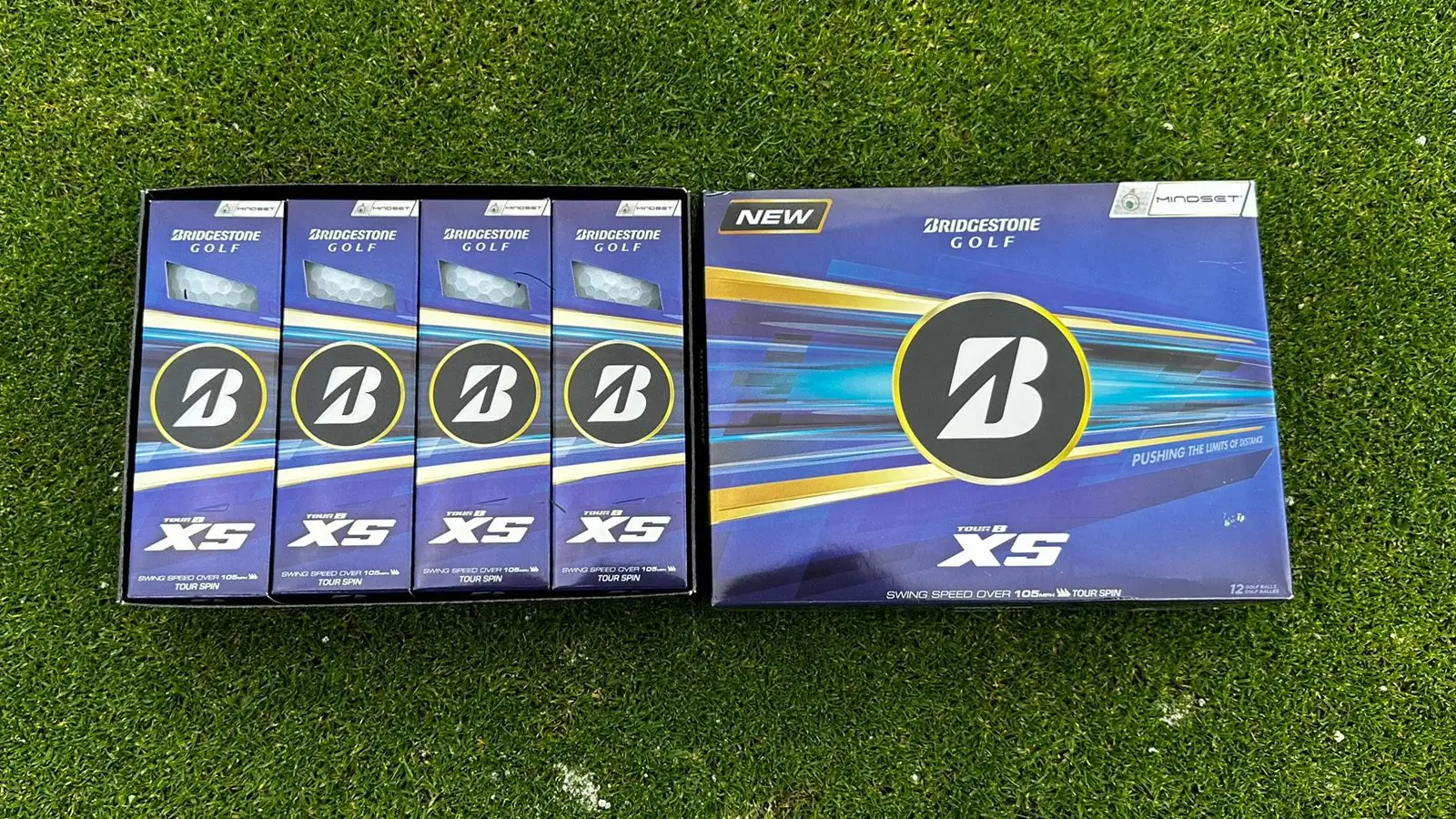

Alright, Duffers, Tyler Reed here, Equipment Editor at The Daily Duffer, and we’re diving deep into the Bridgestone Tour B XS 2026 golf ball. Now, for years, the XS has been synonymous with “Tiger’s Ball,” the softer, more workable sibling in Bridgestone’s lineup, aimed squarely at players with north of 105 mph swing speeds who value feel and greenside control. Bridgestone isn’t shy about that legacy, but for 2026, they’re making some interesting claims. They’re telling us this new XS is bridging the gap with its distance-focused counterpart, the Tour B X, all while maintaining that Tour-level bite around the greens.
My job, as always, is to cut through the marketing white noise and see if those claims hold up under the glare of a launch monitor and real-world play. I put the new Tour B XS through its paces against the gold standard: the Titleist Pro V1, a ball I’ve fit countless golfers into and know intimately.
Unpacking the Tech: VeloSurge Core-Mantle
The big talking point for Bridgestone across the entire 2026 Tour B family is the VeloSurge technology. This isn’t just a fancy name; it’s a denser mantle layer designed to increase the ball’s Moment of Inertia (MOI). In plain English, a higher MOI theoretically means more efficient energy transfer at impact, which translates to more ball speed, and better stability through the air. Now, MOI is a term usually tossed around with drivers, referring to forgiveness on off-center strikes, so seeing it applied to a golf ball’s internal structure for speed and stability is certainly intriguing. Bridgestone is betting that this denser mantle, originally teased in their ‘VS Blue’ prototype, will give the XS a boost without sacrificing its short-game prowess.
“Like the rest of the 2026 family, the Tour B XS features the VeloSurge technology. This denser mantle allows for a higher MOI, designed to maximize energy transfer at impact, while in theory remaining more stable through the air.”
My initial thought? If they can genuinely infuse more long-game power into the softer XS without compromising greenside spin, that’s a true engineering feat. All too often, gains in one area come at the expense of another in ball design.

(Image credit: Future)
The Driver: Surprising Distance from a “Feel” Ball
I took the Tour B XS straight to the Foresight GC3 launch monitor, my trusted tool for stripping away marketing fluff and delivering cold, hard data. My initial swings with the driver confirmed what’s always been true about the XS: it feels fantastic. But what was genuinely surprising was the distance. I recorded an average ball speed of 165 mph, just shy of the Pro V1’s 166.8 mph. Understandable, given the XS’s historically softer nature (I measured its compression at 86 on the Rimac machine, right in line with the Pro V1).
“It actually spun less than the Pro V1 (2146 rpm vs 2312 rpm), which I wasn’t expecting, and launched slightly higher (14.7° vs 14.1°). This high-launch, low-spin combination meant that despite the slower ball speed, the Tour B XS actually carried 299 yards – one yard past the Pro V1.”

Capturing data inside using a GC3 launch Monitor
(Image credit: Future)
Here’s where the VeloSurge tech seems to earn its keep. The Tour B XS produced less driver spin than the Pro V1 (2146 rpm vs. 2312 rpm) and a slightly higher launch angle (14.7° vs. 14.1°). This high-launch, low-spin characteristic is the holy grail for driver distance, and it pushed the XS to a carry distance of 299 yards – a yard *further* than the Pro V1 for me. This isn’t just marketing; the data shows genuinely impressive efficiency. This will be player-dependent, of course. My swing speed sits right in that target zone for the XS, and its design seems perfectly matched to my launch conditions. For many golfers I’ve fit who struggle with excessive driver spin, this ball could be a revelation.

Bridgestone Tour B XS 2026 Golf Ball dispersion
(Image credit: Future)
Iron Play: Holding the Greens Where it Matters
With a 7-iron, the XS started to show its more traditional character, but with a twist. Ball speed was still slightly lower than the Pro V1 (122.8 mph vs. 124.7 mph). However, the spin *jumped* with the Tour B XS, turning in 6096 rpm compared to the Pro V1’s 5798 rpm. This higher spin, combined with a higher launch (21.3° vs. 18.9°) and a higher peak height (122ft vs. 118ft), made for a fantastic iron shot. While it carried two yards shorter (173 yards vs. 175 yards) for me, the key here is the *quality* of descent. Higher spin and a steeper descent angle mean the ball simply stops faster on the green. For players who often watch their iron shots bound over the back of firm greens, this trade-off is absolutely worth it.
“If you are a player who sometimes struggles to hold firm greens with mid-irons, this trade-off for a couple of yards and steeper landing angles feels as though it would be worth it.”
In my fitting experience, many golfers prioritize being able to attack pins over an extra yard or two of carry. The XS delivers that control in spades.
The Short Game: Control with a Different Trajectory
Around the greens, the Tour B XS presented an interesting nuance. On a 50-yard pitch with my 54-degree wedge, it spun 7149 rpm. This was actually a bit lower than the Pro V1 (7645 rpm), which was unexpected given the XS’s reputation and my previous experiences with high-spin balls. However, the Tour B XS launched significantly lower (26°) than the Pro V1 (31.3°). This lower launch, while still generating plenty of stopping power, is a preference for many better players. It allows for a more penetrating flight, giving the sensation of driving the ball into the green rather than floating it, which often translates to greater control, especially in windy conditions.
Despite the slightly lower spin number compared to the Pro V1 on this particular shot, the ball grabbed reliably on the greens. And the feel off the face was exceptional – noticeably softer and more nuanced than the previous Tour B X model I tested. For touch shots around the green, that feel translates directly to confidence.
Image 1 of 3


The Verdict: More Than Just Tiger’s Ball
The 2026 Bridgestone Tour B XS is a seriously impressive golf ball, and Bridgestone delivered on its promise. They’ve managed to inject substantial distance off the tee without sacrificing the feel and greenside control that has always defined the XS. The VeloSurge core-mantle technology isn’t just marketing hype; it translates to measurable performance gains.
For me, the most striking takeaway was the driver performance. To get a ball with an 86 compression, known for its softer feel and greenside manners, to carry a yard further than a Pro V1 for my swing is an engineering win. This speaks volumes about the aerodynamic efficiency and energy transfer that Bridgestone has achieved. It truly is a “best of both worlds” scenario for the right player.
“The 2026 Bridgestone Tour B XS is a interesting evolution of the ‘Tiger’ ball, with Bridgestone having successfully injected distance into its higher-spinning model, making it a real all-rounder.”
Who is this ball for?
The Bridgestone Tour B XS 2026 is an ideal choice for the golfer with a swing speed over 105 mph who:
- **Wants Tour-level greenside control and exceptional feel** but doesn’t want to compromise on driver distance.
- **Struggles with excessive spin off the driver** and is looking for a ball that can produce that sought-after high-launch, lower-spin profile for maximum carry.
- **Needs reliable stopping power with approach shots**, especially on firm greens, valuing a steep descent angle and healthy spin from their mid and short irons.
This ball truly is a complete package for the serious golfer seeking a premium, all-around performer. Don’t let the “softer” label fool you; the 2026 Tour B XS brings serious firepower to the big stick while maintaining that surgical precision you expect.
Image 1 of 2


