

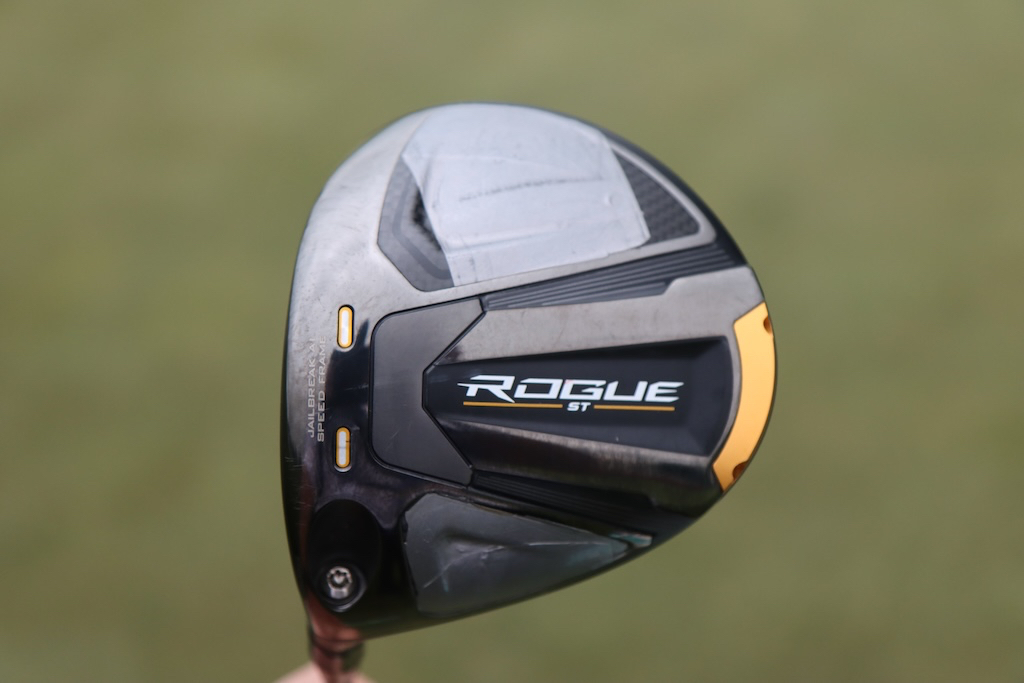

Alright, Daily Duffer readers, Tyler Reed here, and today we’re dissecting the tools one of the game’s brightest young stars, Akshay Bhatia, uses to carve up courses. Forget the glossy ads for a minute; we’re diving deep into the tech choices and asking: does this setup make sense, and what can the average golfer learn from it?
First up, the big dog:
The Driver: Rogue ST, A Blast from the Not-So-Distant Past
Bhatia is still rocking a Callaway Rogue ST (9 degrees) paired with a Fujikura Ventus Black 7 X shaft. Now, the Rogue ST was a phenomenal driver in its time, known for its stability and impressive ball speeds thanks to its Tungsten Speed Cartridge and Jailbreak Speed Frame. What’s interesting here is that it’s not the absolute latest model. This isn’t a knock; it’s a testament to the fact that when a club works, it *works*. In my fitting bay, I’ve seen countless golfers chase the newest release only to find marginal gains, if any, over a well-fitted previous generation. The Rogue ST, especially the LS and Max models, delivered outstanding MOI and low spin characteristics that translated to serious firepower for high swing speed players.
The Ventus Black shaft? That’s no surprise. This shaft is a known quantity for elite players seeking maximum stability and control with minimal torque. For someone with Bhatia’s swing speed, this combination is designed to keep spin low and launch optimized, ensuring every mph of swing speed translates to yards down the fairway. I’ve tested this shaft extensively, and while it’s incredibly stable, it demands a strong, consistent tempo. For most amateurs, it’s often too stiff and unforgiving, leading to a loss of feel and potentially ballooning shots if not loaded correctly.
Fairway and Hybrid: Ventus Black Dominance Continues

His TaylorMade Qi10 3-wood (15 degrees) with a Fujikura Ventus Black 8 X shaft is a classic powerhouse setup. The Qi10 series has impressed me with its balance of forgiveness and ball speed. TaylorMade’s “infinity carbon crown” design lowers the CG, promoting higher launch with less spin, which is a fantastic blend for a 3-wood off the tee or deck. Pairing it with the Ventus Black 8 X suggests a need for even more stability in a longer club. That 8 X is a serious piece of equipment, indicating a player who prioritizes stability and control over any potential “jump” off the face.
The Callaway Apex UW Prototype (19 degrees) hybrid with a Fujikura Ventus Black 10 X is perhaps the most intriguing club in the longer part of his bag. The UW, or “Utility Wood,” concept is a favorite of mine. It’s designed to bridge the gap between a traditional hybrid and a smaller fairway wood, offering a more penetrating flight and greater workability than many hybrids, but with more forgiveness than a low-lofted driving iron. The “Prototype” designation means Bhatia is likely playing something that’s either tweaked to his precise specs or an early version of a club that might see a wider release. The Ventus Black 10 X in a utility wood? That’s a tank of a shaft, signifying maximum stability for control, especially when hitting it hard into greens from long range. For the everyday golfer, this setup is likely overkill; the sheer weight and stiffness would be difficult to manage.
Irons: Precision Machines


Bhatia’s iron setup is a blend of specialized tools: a Callaway X Forged UT (22 degrees) and Callaway Apex TCB Raw (5-PW) with KBS $-Taper 125 S+ shafts. The X Forged UT is a low-spin driving iron, perfect for when control and a penetrating flight are paramount off the tee or for long approaches. I’ve found these utility irons provide a much higher MOI than a traditional blade-style long iron, making them more forgiving on slight mishits without sacrificing too much workability.
The Apex TCB (Tour Cavity Back) Raw irons are another story. These are player’s irons, designed for feel, control, and workability. The “Raw” finish will rust over time, which many pros prefer for reduced glare and a softer feel. The KBS $-Taper 125 S+ shafts are heavy, low-launch, and low-spin, again pointing to a player who controls dynamic loft exceptionally well and needs shafts that can handle high swing speeds and aggressive transitions. In my fitting experience, these shafts typically shine for golfers with quick tempos and precise ball-striking, helping to keep trajectory down and spin rates consistent. For someone with a slower swing or less consistent contact, they can be incredibly demanding.
Wedges: Spin and Control

He’s playing Callaway Opus SP wedges (50-10S, 54-10S, 60-08C) with KBS Hi-Rev 2.0 135 X shafts. Callaway’s Opus wedges are a new offering, and the “SP” likely denotes a specific grind or prototype. The 50-10S and 54-10S suggest a standard grind with moderate bounce, versatile for various conditions. The 60-08C (C-grind) is a classic for short-sided shots and opening the face, offering relief on the heel and toe. The KBS Hi-Rev 2.0 135 X shafts are designed to increase dynamic loft at impact, promoting higher launch and more spin. This is a common choice for pros who want to maximize control and generate “one-hop-and-stop” spin on their wedge shots. I’ve seen the Hi-Rev shafts deliver fantastic spin numbers on the launch monitor, but again, the 135 X is a heavy, stout shaft demanding a powerful swing.
Putter, Grips, and Ball: Personal Preferences & Consistency

His Odyssey Jailbird 360 putter with a SuperStroke Zenergy Split grip is another setup that highlights how personal putting can be. The Jailbird gained significant popularity last year, and its unique design, often combined with a heavy counter-balanced grip, promotes a very stable stroke. For someone like Bhatia, who obviously has incredibly consistent mechanics, this stability frees him up to focus purely on line and speed. The SuperStroke Zenergy grips are known for their vibration dampening and consistent feel, which can definitely translate to better distance control on the greens.
The Iomic grips throughout his full swing clubs are a firm favorite among many pros. They offer a tacky feel and excellent feedback, though some golfers find them too firm compared to rubber alternatives. Finally, the Callaway Chrome Tour ball is Callaway’s flagship tour-level ball, engineered for high performance, greenside spin, and consistent flight. The data I’ve seen on the Chrome Tour shows it delivers excellent overall performance, especially in the short game and off the tee.
The Tyler Reed Takeaway: Consistency Over Hype
What truly stands out about Akshay Bhatia’s bag is the absolute commitment to stability and control, particularly evidenced by the near-ubiquitous Fujikura Ventus Black shafts. This isn’t a player chasing maximum distance at all costs; it’s a player who wants to know exactly where the ball is going, every single time. The X-Flex shafts and heavy weights are a clear indicator of a high-swing speed player with an aggressive transition who needs to minimize dispersion.
“I’ve tested hundreds of drivers, and while the latest models certainly offer incremental improvements, seeing a top pro stick with a Rogue ST that clearly performs for him underscores a crucial point: a well-fitted club that you trust is often better than the ‘latest and greatest’ that might not suit your swing.”
The blend of the older Rogue ST driver with the newer Qi10 3-wood also shows a pragmatic approach to equipment. He knows what works in each slot. There’s no pressure to update everything annually if the numbers on the launch monitor and the feel on the course aren’t better.
“In my fitting experience, the Ventus Black line of shafts is phenomenal for players who generate high clubhead speeds and need to control spin and dispersion. However, for the vast majority of amateur golfers, forcing yourself into an X-flex is a recipe for disaster. You’ll likely lose feel, struggle to load the shaft properly, and actually see *worse* performance.”
For the average golfer, the key takeaway here isn’t to run out and buy an X-flex Ventus Black. It’s about building a bag that suits *your* swing, not just mirroring a pro’s. Focus on finding shafts that allow you to feel the clubhead, deliver it consistently, and optimize your launch and spin numbers for *your* speed. Bhatia’s setup is a masterclass in highly personalized equipment for an elite swing, prioritizing control and consistency. It’s a testament to thorough fitting and understanding one’s own game.
“The sheer dedication to a consistent shaft profile across his woods, with a progression in weight, tells a story about clubhead feel and consistency. He’s looking for the same stability and response from his driver all the way down to his utility wood, just scaled for their respective lengths and clubhead weights.”
This is a bag built for a tour professional who understands their game at an incredibly deep level. It’s about precision, control, and maximizing every ounce of their athletic potential. For us mere mortals, the lesson is clear: fit don’t follow.
