

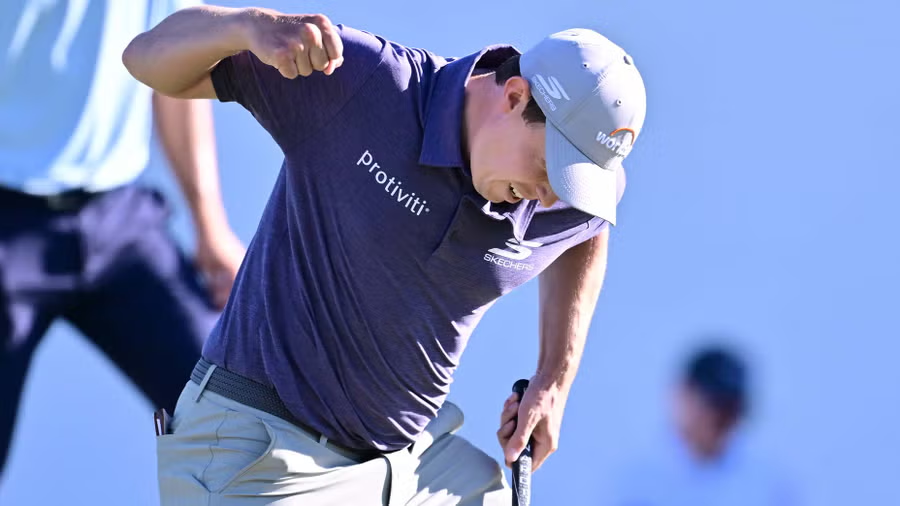

As the Equipment Editor for The Daily Duffer, my job is to cut through the marketing hype and tell you what really works. We’ve all seen the flashy ads and heard the bold claims. But when it comes to golf equipment, the only truth that matters is the data, and how that data translates to tangible performance gains on the course. Today, I want to tackle a topic that, while not directly related to a new driver or iron, has a profound impact on every golfer’s performance: pace of play.
Matthew Fitzpatrick’s recent Valspar Championship win brought this issue back into the spotlight, and honestly, it’s a conversation that frustrates me as much as it frustrates him. I’ve spent countless hours in fitting bays, watched thousands of golf swings on launch monitors, and seen golfers of all skill levels try to squeeze every ounce of performance out of their gear. And one thing is clear: consistency and rhythm are paramount. Slow play disrupts both.
When I’m fitting a golfer, we’re meticulous. We’re dialing in lie angles to fractions of a degree, adjusting swing weights to perfect feel, analyzing launch windows that are mere tenths of a degree apart. The goal? To create a repeatable, consistent impact that maximizes ball speed, optimizes spin, and delivers predictable dispersion. But all that detailed work can be undone by external factors, and a stop-start round is a major culprit.
Fitzpatrick himself articulated this perfectly after his win:
“When you’re not ready to play a golf shot it gets frustrating after awhile. Particularly when you playing well yourself or you’re in contention or whatever it is. It definitely knocks you out of your rhythm. Because you hit, you walk to it, you kind of think about it, you hit again, and you go.”
This isn’t just about a pro golfer’s mental game. This is about physiology and mechanics. Think about a golfer who has just hit a fantastic drive – perhaps a 165 mph ball speed, 2200 RPMs of spin, launching at 12 degrees. They’ve got a 7-iron into the green, feeling confident, their body warmed up, their timing in sync. Then they have to wait five minutes while their playing partner deliberates, lines up, re-lines up, takes practice swings, and then finally hits. That five-minute delay can cool down muscles, disrupt blood flow, and most importantly, break that crucial rhythm. The next swing, which should be a crisp 7-iron, might now be rushed, leading to a thin contact, a loss of ball speed and an inconsistent spin rate that sends the ball short of the green.
I’ve seen this countless times in casual rounds and even in competitive amateur play. A golfer will come out hot, hitting every shot cleanly. Then, a slow group ahead or a particularly ponderous playing partner will cause a backup, and suddenly, their tempo is off. Their average clubhead speed might drop slightly, their attack angle becomes inconsistent, and that tight dispersion circle we worked so hard to achieve in the fitting bay opens up. It’s a real, measurable effect.
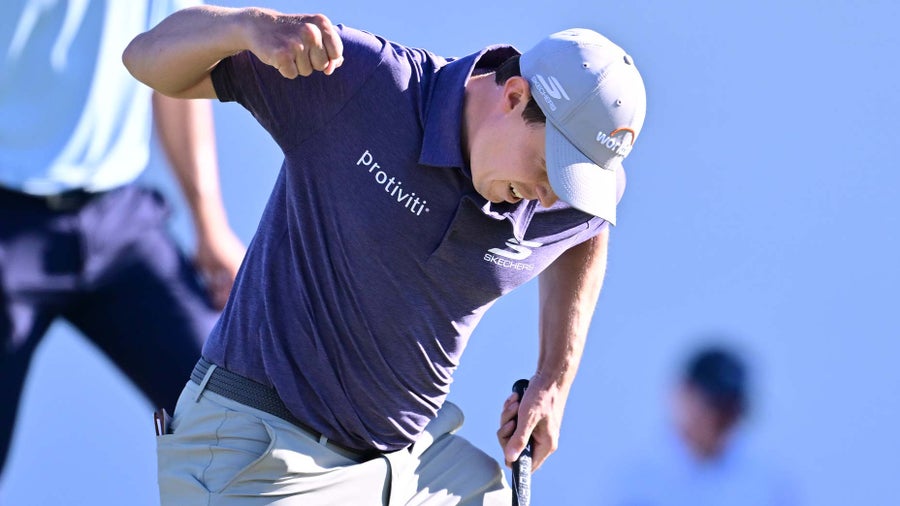
A week after heartbreak, Matt Fitzpatrick roars to Valspar victory
Fitzpatrick’s frustration with playing partner Adrien Dumont de Chassart highlights another key point: there’s a difference between a bad shot and slow play. As he put it, he was “drawing a distinction between making a high score — which happens and can inevitably slow up play — and playing slowly while doing so.” We all hit duffs and triples; it’s part of the game. But the reaction and subsequent execution shouldn’t grind play to a halt.
NBC’s on-course reporter, John Wood, described Chassart’s pace as “glacial, to be kind.” This isn’t just an inconvenience; it can be demoralizing. Imagine having a hot round going, your swing feeling dialed, and then having to stand over a shot for an extra 30-60 seconds because of the group ahead or your playing partner. That’s more time for doubt to creep in, for muscles to lose their readiness, for focus to waver.
The PGA Tour has tried to address this. They’ve introduced new measures, and officials do issue warnings, as was the case with Chassart. But as Fitzpatrick noted, these efforts often feel like a “work in progress.”
“The problem is, though, this conversation has gone on for years and years and years, and no one has ever done anything,” he said at the time. “So I feel it’s almost a waste of time talking about it every time. I have my opinions — they’re probably strong opinions, but PGA Tour, DP World Tour, no one’s going to do anything about it.”
From my perspective, the Tour needs to take a harder stance. A “warning” is a slap on the wrist when millions of dollars are on the line and the integrity of the game, and the experience for other players and fans, is being compromised. Strict timing, and more consistent, visible penalties are crucial. If a player knows that taking an extra 20 seconds on a stroke will result in a penalty, they will adjust. Simple as that.
Is there a technology solution? Not directly. No amount of advanced MOI in a driver or low spin in a golf ball will mitigate the impact of disrupted rhythm. This is a behavioral problem that requires behavioral solutions. However, I can attest that the more confidence a player has in their equipment, the less likely they are to overthink a shot. A well-fitted club that gives consistent ball speeds and reliable dispersion means less agonizing over club selection or target line, which in turn can shave precious seconds off a routine.
Ultimately, pace of play affects everyone, from the weekend warrior to the major champion. It’s not just about etiquette; it’s about maintaining the cadence and flow that allows players to perform at their best. As club fitters, we can optimize your equipment for peak performance, but it’s up to the players and the governing bodies to ensure the environment allows that performance to shine consistently.
