


As the Equipment Editor for The Daily Duffer, my desk is a revolving door for the latest and greatest golf gear. From drivers promising 20 more yards to irons crafted from exotic alloys, I’ve seen it all. Most of it is incremental improvement, some is pure marketing smoke and mirrors, and a rare few are genuinely innovative. So, when the IB Sweet Spot Quaternion Putter landed, I was immediately intrigued.
My history with “tiny-headed” putters goes back a while. The original IB Sweet Spot was less a putter and more a surgical instrument for your short game. It stripped away all forgiveness, forcing me, and many golfers I’ve fitted, to confront every flaw in their stroke. In my world, where launch monitor data dictates truth, a putter that inherently promotes better mechanics, even through sheer difficulty, gets my attention.
The “Zero-Torque” Revolution: A Closer Look
The Quaternion builds on this philosophy, aiming for a “zero-torque” design. This isn’t just marketing fluff; it’s a measurable characteristic. In fitting sessions, one of the biggest killers of a consistent roll is unwanted face rotation. Whether it’s due to poor path, insufficient stability, or just nervous hands, an opening or closing face at impact leads to inconsistent contact and directional errors.
The original article notes:
“The Quaternion takes the center-shafted, zero-torque DNA of the original and evolves it into something that looks like it belongs in space.”
This “zero-torque DNA” is crucial for me. On the SAM PuttLab, we measure face rotation throughout the stroke. Putters with higher MOI (Moment of Inertia) naturally resist twisting when impact isn’t perfectly centered. The claim of “zero-torque” implies an extreme level of stability, which in theory should lead to a squarer face at impact more consistently, even on slight off-center strikes. While the physical size of the Quaternion might not scream “high MOI” like a modern mallet, its unique shape is engineered to distribute mass in a way that minimizes twisting. I’ve often seen golfers develop better face control when forced to be more precise, and this kind of tool can accelerate that learning curve.
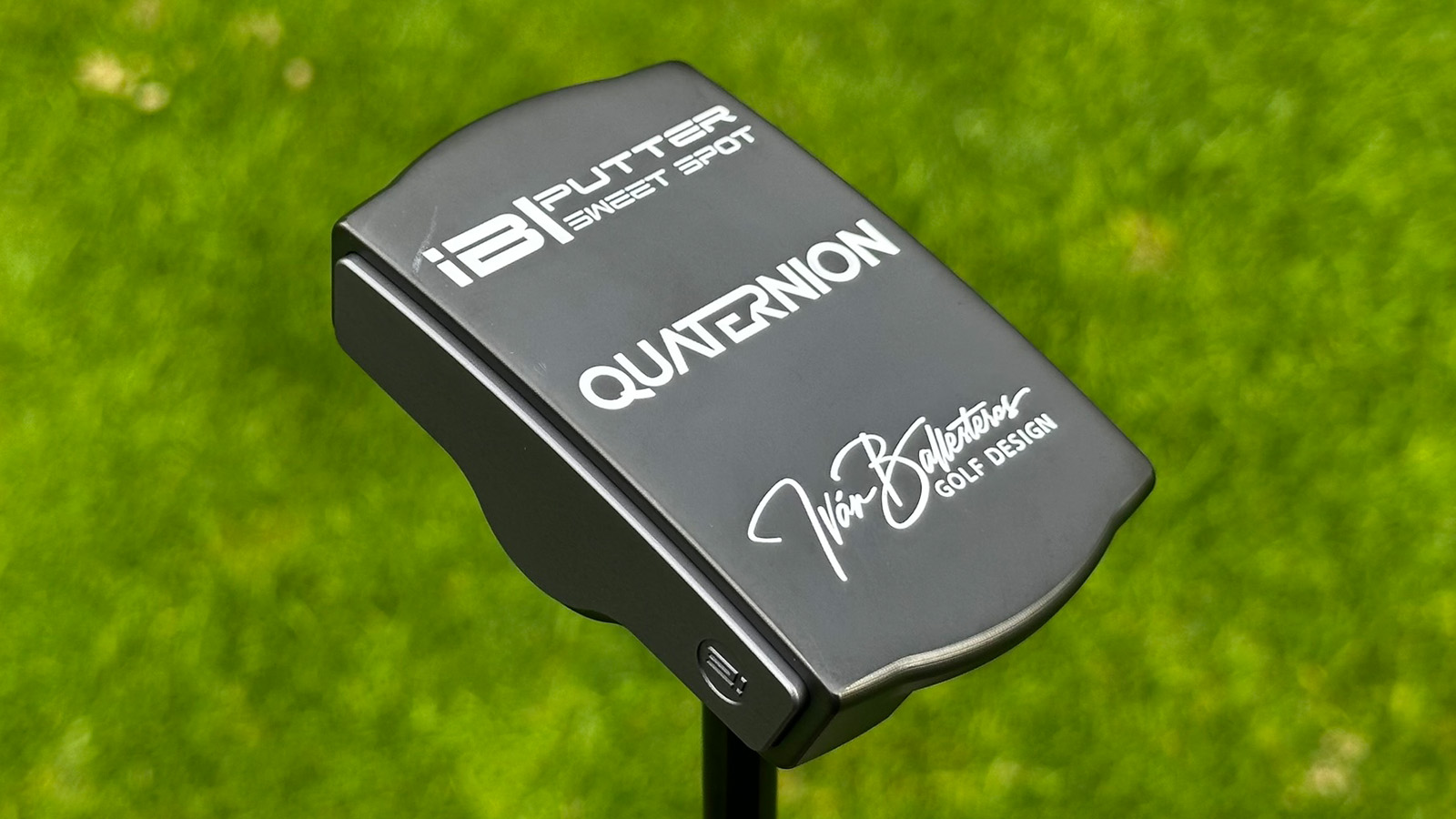
IB Sweet Spot Quaternion Putter
(Image credit: Future)
Forgiveness vs. Precision: The Quaternion’s Trade-off
The visual of the Quaternion is stark. It’s undeniably small. The writer mentions:
“The small head won’t suit those who are less confident down behind the ball, even though it’s designed to hone your focus.”
This is where the marketing meets reality. While designed to “hone focus,” the psychological impact of a small head can be detrimental for many. For golfers struggling with confidence, seeing less clubhead can lead to increased tension and a shorter, more jabby stroke, counteracting any potential physical benefits. When I fit a golfer, I’m looking for a blend of physical performance and mental comfort. Some advanced players thrive on minimal designs, but for the average amateur, visual confidence is a real performance enhancer.
The core concept of “zero-torque” is to create a perfectly balanced putter. The source mentions its symmetry allowing for left or right-handed use. While a neat engineering trick, as an equipment editor and fitter, I fully agree with the article’s assessment:
“One of the major talking points of the Quaternion is its symmetry, with a selling point being that it can be used left or right-handed, but if you’re buying it for this reason, I think you’d best invest your money in some putting lessons instead!”
Exactly. Nobody is switching hands mid-round, and the few ambidextrous golfers out there aren’t the target market for “zero torque.” The true value of this symmetry is in the balanced weight distribution it implies, aiming to keep the clubface square through the stroke without relying on complex, multi-material constructions seen in many high-MOI mallets. The question is, does this minimalist approach achieve the same, or better, results?
(Image credit: Future)
The Missing Element: Face Technology
This is where my technical alarm bells start ringing. The article observes: “But it is interesting how there is no milling on this face to help with the roll or improve sound… In an era where almost every premium putter boasts milled face grooves or inserts to optimize forward roll and skid-distance, the flat face of the Quaternion relies entirely on the pure, square pendulum stroke that the putter’s balance promotes, and I feel they may have missed a trick.”
I couldn’t agree more. My launch monitor data consistently shows that face optimization plays a significant role in achieving optimal forward roll, minimizing skid, and controlling ball speed. Modern putters use various face technologies – grooves, inserts, varying depths, and materials – to immediately get the ball rolling true. Without this, even with a perfectly square face at impact, you’re relying purely on the loft to initiate roll, which can lead to excessive skidding and a less consistent reaction to green surfaces. This could translate to unpredictable distance control, especially on longer putts. It’s a fundamental aspect of putting performance that, from a data perspective, feels like an omission on a £349 putter.
IB Sweet Spot Quaternion Putter at address
(Image credit: Future)
Who is this Putter for? Decision-Making Time.
The Quaternion is a niche product. It’s not designed for the masses, and its price point further narrows its appeal. For £349, you have a wealth of established options from brands with decades of R&D in putter technology, many featuring advanced face inserts and forgiveness technologies.
My advice, after fitting hundreds of golfers, is this: if your primary putting issue is an inconsistent face angle at impact, and you are disciplined enough to work with a less forgiving head, the Quaternion could be a potent training aid that transitions into a gamer. Its ability to “genuinely resist face rotation and force a better, straighter stroke” is a powerful claim, and for some, it will be true. However, this is likely for single-digit handicappers or highly motivated mid-handicappers who prioritize stroke mechanics above all else and are willing to sacrifice overt forgiveness.
If you’re someone who often struggles with contact off the center of the putter face, or thrives on the visual confidence of a larger, more stable head, this putter will likely frustrate more than it helps. The lack of face technology to aid roll is a significant strike against it for me, as consistent speed and roll are paramount in putting. While the premium leather grip feels good, its potential for grip issues in damp conditions further highlights that this isn’t a “set it and forget it” solution.
The leather grip on the IB Sweet Spot Quaternion Putter
(Image credit: Future)
The Quaternion is a bold statement piece, leaning heavily into a specific technical advantage (zero torque) at the expense of others (face technology, visual confidence for some). For the right golfer – one who truly understands their stroke mechanics and values precision over maximum forgiveness – it might just be the “secret weapon” the article alludes to. But for a majority, there are more forgiving, data-proven options that offer a better overall package for improving putting performance.
