

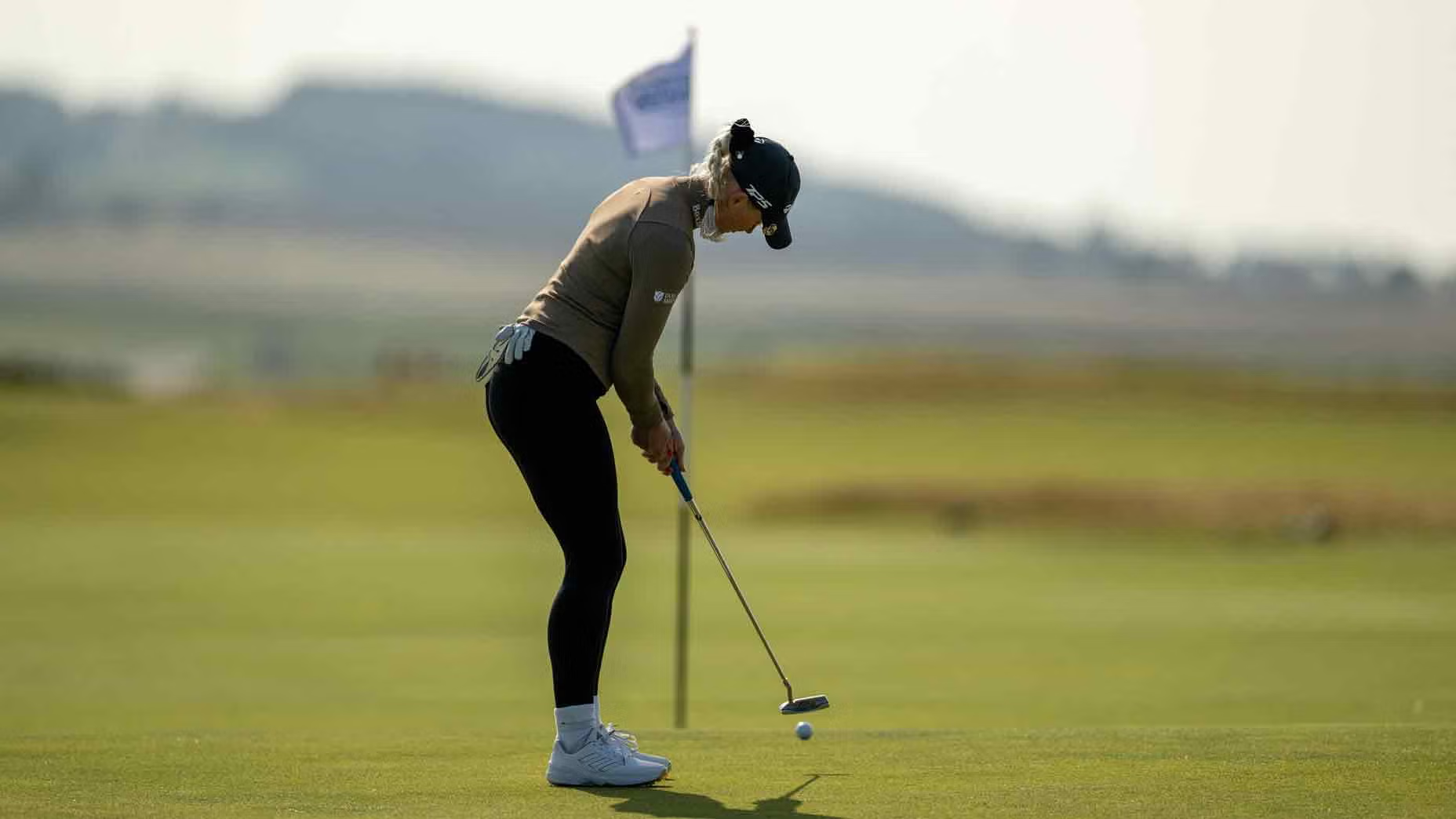

Alright, Daily Duffer faithful, Tyler Reed here, and today we’re stepping off the tee box and onto the greens to talk about putting. Specifically, a technique suggested in a recent article on GOLF.com about improving distance control by pacing off your putts. As someone who’s spent countless hours staring at launch monitor data for drivers and irons, the idea of applying a systematic, almost rangefinder-like approach to putting distance immediately caught my eye.
Now, before we dive in, let’s be clear: when we talk about putting, we’re not tracking ball speeds in the triple digits or measuring spin rates in RPMs. The science here is more about human perception and consistency. However, the principles of data-driven calibration and repeatable execution are absolutely paramount, whether you’re trying to optimize a 300-yard drive or a 30-foot putt.
The Real Culprit: Poor Distance Control on the Greens
The GOLF.com article hits the nail on the head from the jump:
“Typically, the culprit for the dreaded three-putt is poor distance control. While a stroke that can start the ball on line is important, there’s nothing that can substitute for proper touch.”
This is gospel. In my fitting bay, I’ve seen golfers with strokes as pure as crystal still struggle because their pacing is off. They’ll hit a 15-foot putt with the speed for 25 feet, or vice-versa. And guess what? No amount of high MOI or precise CG placement in your putter head can compensate for consistently blowing the ball five feet past the hole, or leaving it woefully short.
The “Rangefinder” for the Green: Pacing it Off
The core concept is to treat your steps on the green like you treat your rangefinder in the fairway. The author states:
“We use rangefinders from the fairways and tee boxes, so why not use one on the putting green? No, I don’t mean you should actually pull out a laser when you’re reading your putts, but I do suggest stepping off the distance to the hole with your feet.”
And this is where, from an equipment editor’s perspective, my ears perk up. While it’s not a new piece of tech, it’s a systematic approach to what I often preach: calibration. Just as I’d never recommend a driver without understanding your clubhead speed, attack angle, and launch conditions, I wouldn’t expect anyone to develop consistent putting speed without some form of repeatable input. Pacing provides that input.
In my experience fitting hundreds of golfers, many players operate on feel alone, and while feel is crucial, it’s notoriously inconsistent under pressure. One day your feel is great, the next it’s completely uncalibrated. This pacing method provides an objective measure. You’re giving your brain a number, a physical dimension, to associate with a specific stroke length and feel.
Data (Your Steps) Drives Consistency (Your Stroke)
The beauty of this method lies in its simplicity and repeatability. The article outlines a clear practice regimen:
- Set up your practice station: Measure out 5, 10, and 15 paces.
- Adjust your stroke: Focus on taking the putterhead back and through a consistent distance for each paced distance, maintaining tempo.
- Dial in each distance: Practice from various slopes, making mental notes.
This, folks, is essentially building your personal putting database. When I’m working with a golfer on a launch monitor, we’re building a data set: clubhead speed, ball speed, launch angle, spin rate, carry distance. For putting, your “data” is the number of paces, and your “output” is the length of your stroke and the resulting roll. By consistently practicing at known distances, you begin to hardwire the correlation between ‘X’ paces and ‘Y’ stroke length.
The article emphasizes maintaining consistent tempo, only varying stroke length. This is critical. One of the biggest pitfalls I see in putting is golfers trying to accelerate more for longer putts, leading to deceleration on shorter ones, impacting face stability and ultimately, roll consistency. A pendulum-like stroke, varying only in amplitude, is the gold standard.
Who Benefits and Is It Worth It?
So, does this “tech” – if we can call a systematic approach tech – actually work? Absolutely, and it costs nothing but time. This isn’t some marketing hype promising 10 extra yards off the tee with a new face material. This is fundamental golf. For golfers who struggle with distance control, particularly those mid-to-high handicappers who frequently three-putt from the 15-30 foot range, this method is a game-changer.
I’ve tested numerous putting aids and training systems. Some utilize lasers, some have pressure plates, others offer elaborate visual feedback. While many of them offer valuable insights (especially for path and face angle), none of them inherently give you a repeatable physical reference for distance quite like simply pacing it off. This method forces you to engage with the green, rather than relying on a gadget.
The value proposition here is immense: lower scores, increased confidence, and more committed strokes. As the author notes:
“Additionally, when they step off their putts, it forces them to be more structured during their practice time, which is always good for improvement.”
And structured practice is where real improvement happens. This isn’t about buying a new putter (though a well-fitted putter with the right MOI does help with off-center strikes). This is about leveraging your own body as a measurement tool and then dedicating the time to calibrate that tool. It’s a classic example of how mastering the fundamentals, rather than chasing the next quick fix, leads to lasting gains on the golf course.
If your putting suffers from inconsistent speed, forget the gimmicks for a bit and try this simple, data-driven approach. Your scorecard will thank you.
