

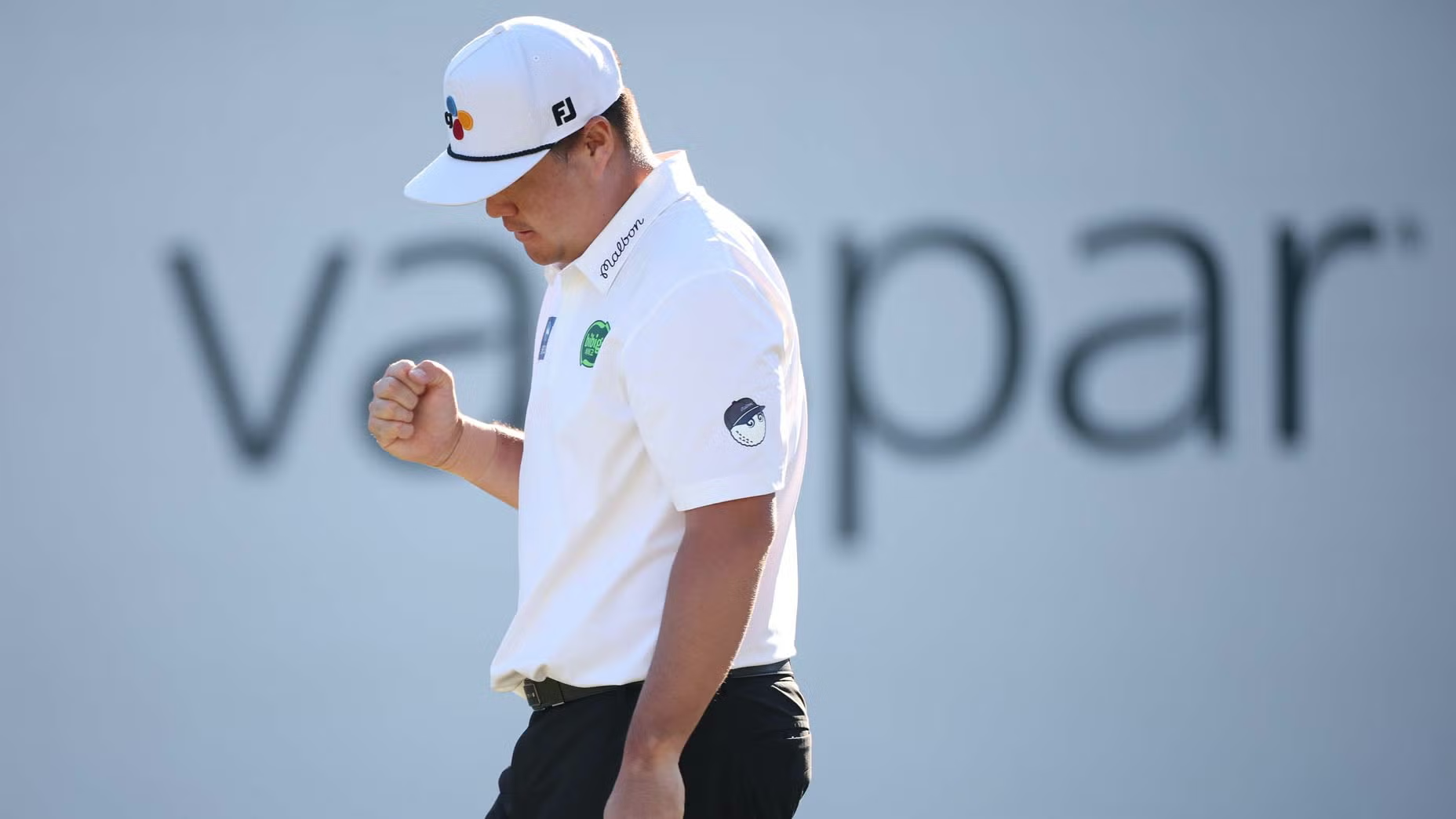

Hello, fellow Duffer! Sarah Chen here, your Golf Instruction Editor, and I’m always on the lookout for compelling stories from the tour that offer a fresh perspective on how we can all improve our game. This week, Sungjae Im has really caught my attention. His journey back to contention at the Valspar Championship, leading at 11 under par after a spectacular two-eagle opening-round 64 and back-to-back 69s, is a testament to resilience and smart practice.
What I find particularly inspiring about Sungjae’s recent performance isn’t just his talent, but how he turned a significant setback—a wrist injury and a forced layoff—into an opportunity for improvement. Many of us, when faced with an injury or an extended break, feel disheartened. We worry about losing our touch, our feel, our swing tempo. But Sungjae’s experience shows us that sometimes, a break can be exactly what we need to reset and refine our game.
When injuries or life events pull us away from the course, we often dread the return. We anticipate a struggle to regain our form. But what if we reframed that time away? What if we saw it as a chance to reflect, analyze, and build a better swing?
“So after the wrist injury, I wasn’t able to practice for two months. So I think a lot of my shots that I didn’t like from last year I was able to, once I started practicing, I was able to correct and it’s just been consistently getting better. Even though there were shots I’m not happy about, I feel comfortable now.”
This quote from Sungjae perfectly encapsulates the power of a “reset.” He wasn’t just resting; he was evaluating. He realized he could use this enforced downtime to identify and correct issues in his swing that had been nagging him. This isn’t just about physical rest; it’s about mental recalibration.
The Power of the Mindful Pause: Rebuilding Your Swing from the Ground Up
So, how can you apply Sungjae’s philosophy to your own game, even without a two-month injury layoff? It starts with mindful reflection. Before you even pick up a club, think about your golf game. What are your consistent struggles? Is it a slice you just can’t shake? Are you topping your irons? Do you feel disconnected in your swing?
Sungjae had the luxury of not touching a club for over 45 days during his break. While most of us can’t afford that much time off, we can absolutely dedicate focused periods to reflection and rebuilding. I tell my students all the time that practice isn’t just hitting balls; it’s also about thinking, visualizing, and understanding.
Here’s how to translate that “mindful pause” into actionable improvement:
Drill 1: The “Mirror, Mirror” Reset
This drill is all about isolating and correcting specific swing flaws without the pressure of hitting a ball. Sungjae used his time off to identify “shots I didn’t like from last year.” You can do the same!
Why it works: Without a ball, you can focus purely on movement patterns. It allows your body to learn new, more efficient motions without the ingrained habits of hitting the ball. It also helps you understand the cause of those “unliked” shots without the distraction of the outcome.
Try this:
- Find a full-length mirror, ideally one where you can see your entire swing.
- Without a club, or with a very light alignment stick, make slow, deliberate practice swings. Pay attention to your posture, your takeaway, your club path at the top, and your finish.
- If you struggle with a slice, for example, focus on feeling your club path more to the inside on the takeaway and then releasing it more to the outside/right (for a right-handed golfer) through impact. Feel the rotation of your body leading the arms.
- Record yourself if you can! A video can be even more revealing than a mirror. Compare your swing to what you idealize, or even to slow-motion swings of your favorite pros.
Drill 2: The “Balanced Finish” Stability Check
A consistent, balanced finish is often an indicator of a fundamentally sound swing. Sungjae’s return to consistent play suggests a rebuilt, stable movement pattern. When you’re injured, you realize how crucial stability is.
Why it works: If you can’t hold your finish, it means there’s a breakdown in energy transfer or balance earlier in your swing. This drill helps reinforce proper body rotation and weight transfer.
Here’s a drill:
- After every practice swing (or even after hitting a ball on the range), hold your finish for a full count of three.
- Your weight should be predominantly on your front side, your belt buckle facing the target, and your right heel (for right-handers) should be off the ground.
- If you wobble or can’t hold it, that’s your body telling you something needs adjustment. It could be an overswing, a poor weight shift, or collapsing too early.
- Focus on feeling powerfully coiled and then fully uncoiling, finishing tall and balanced.
“It’s been a while since I’ve been in the lead like this, and I’m sure I will be nervous, but the best I can do is just to play my own game.”
Sungjae’s honesty about nerves, even with a two-shot lead, reminds us that even the pros feel the pressure. But his solution – “to play my own game” – is a powerful one. This comes from confidence in your mechanics, which is built on solid practice.
Drill 3: The “Tempo Whisper” Rhythm Check
After a layoff, whether due to injury or just a busy schedule, tempo is often the first thing to go. When you’re unsure, you tend to rush. Sungjae’s ability to return to form, despite not touching a club for so long, points to a strong underlying sense of rhythm.
Why it works: A consistent tempo is the glue that holds a good golf swing together. This drill helps you internalize a smooth, repeatable rhythm, essential for striking the ball purely.
Try this:
- Pick a simple phrase or count (e.g., “One-and-Two,” “Back-and-Through,” or “Slow-Motion-Fast”).
- As you make practice swings, vocalize (or silently repeat) your chosen rhythm.
- For “One-and-Two”: “One” for the takeaway, “and” at the top, “Two” for the downswing and follow-through. Experiment with what feels natural and helps you maintain a smooth, unhurried motion.
- Do this without a ball first, focusing purely on feeling the rhythm. Then, bring it to the range and try to maintain that same internal “whisper” as you hit balls.
“Within that period of time I’ve been able to play really well. I’ve had some second and third places. For me, just being able to finish within the top and to have success in that way is important for me and been something that I’ve been happy with,” he said.
This quote speaks volumes about perspective. Even seasoned pros like Sungjae find satisfaction in consistency and top finishes, not just wins. This is a crucial mindset for amateur golfers too. Celebrate your incremental improvements, your better shots, your fewer three-putts. Every step forward, no matter how small, builds confidence and enjoyment in the game.
Embrace Your Own Golf Journey
Sungjae Im’s story is a powerful reminder that improvement isn’t always linear. Sometimes, a forced break or a challenging period can offer a unique opportunity to re-evaluate, strip away bad habits, and build a stronger, more reliable swing. So, the next time you feel a little rusty after some time away, don’t despair. Instead, channel your inner Sungjae. Approach your return with a mindful attitude, use these drills to rebuild intelligently, and remember that every round is a chance to learn and grow. You can absolutely improve, no matter the circumstances!
