

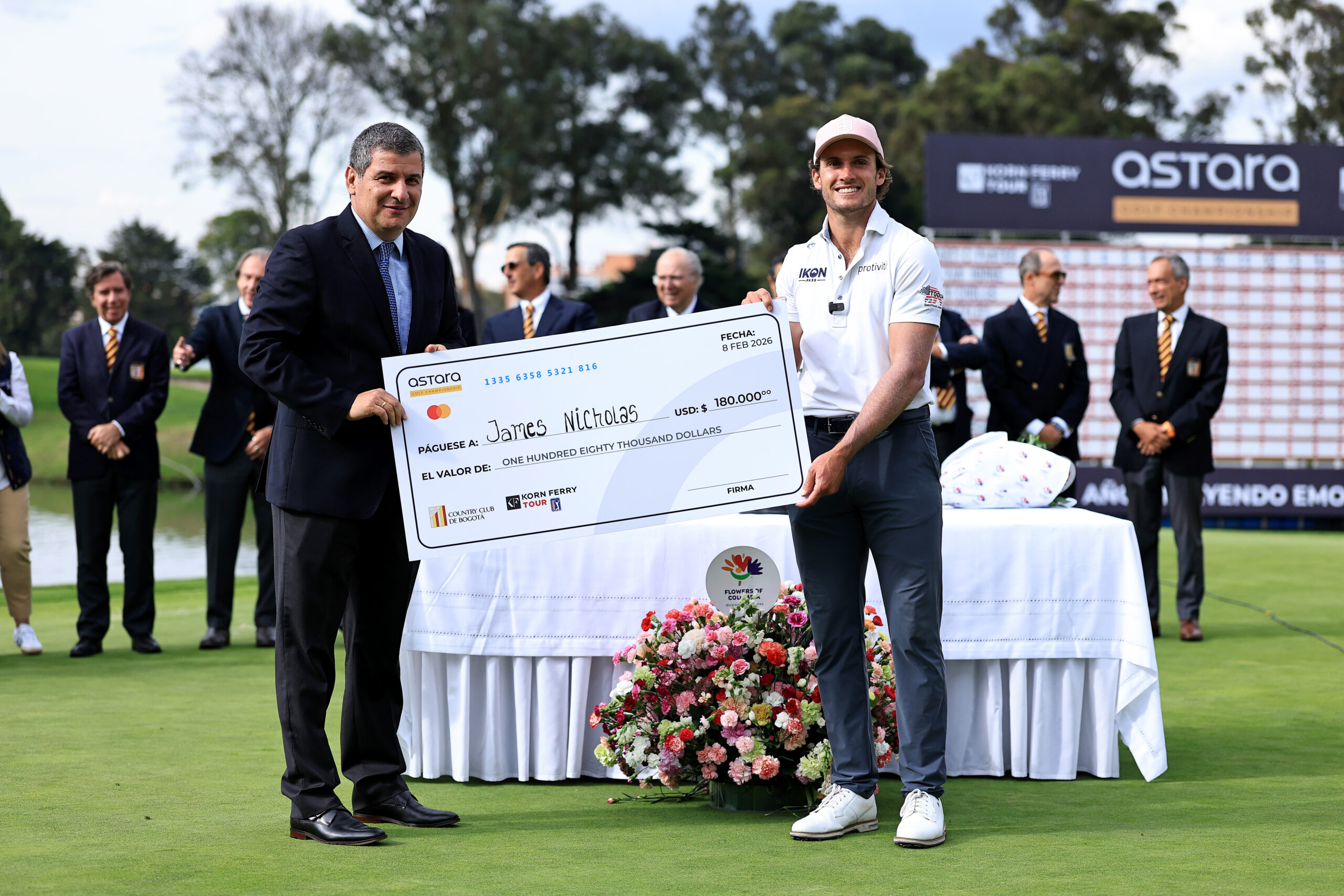

James Nicholas’ Bogota Win Reveals an Uncomfortable Truth About Professional Golf Economics
I’ve been covering professional golf for 35 years, and I’ve watched this sport transform in ways that would make my younger self’s head spin. Prize money has exploded. Technology has revolutionized the game. But what James Nicholas just did in Bogota—and more importantly, what he revealed about the economics of that victory—tells us something crucial about where professional golf really stands in 2026.
On the surface, Nicholas’ first Korn Ferry Tour win at the Astara Golf Championship is exactly the feel-good story we need. A Yale-educated American grinding his way up the ranks, holding the 54-hole lead, and then executing under pressure with that dramatic 13-foot eagle putt on the final hole to seal it. That’s golf at its finest. That’s why we watch.
But the real story—the one that matters for understanding the current state of professional golf—lives in the numbers that followed.
The Math That Shouldn’t Need Explaining
Nicholas finished with $210,000 in total income for the week: a $180,000 winner’s check plus roughly $30,000 in sponsor bonuses. Before taxes. Before he even thought about his ongoing expenses as a touring professional. And here’s what struck me: after accounting for flights, accommodation, food, caddie fees, tips, and miscellaneous expenses, his actual profit came to $187,215.
That’s not nothing. For most people, that’s life-changing money. For a 28-year-old trying to establish himself on professional golf’s second-tier tour, it’s absolutely significant. But here’s what I think matters most: Nicholas felt compelled to document and share every penny of this breakdown publicly, then seemed genuinely amazed at his own earnings.
“I’ve never made that much before!” Nicholas reflected after calculating his profit.
In my three decades around this game, I’ve learned that when players start obsessively tracking their finances like accountants, it usually means one thing: the margins feel precarious. Nicholas isn’t some struggling club pro. He’s a top-tier amateur pedigree playing at an elite developmental level. And yet he’s documenting his costs like he’s managing a tight household budget.
The Caddie Economics Nobody Talks About
Let’s talk about Brian, Nicholas’ caddie, for a moment. He earned a base of $1,750 for the week, then received 10% of the winner’s check as a bonus—bringing his total to $19,750. That’s solid money for one week’s work, and the 10% structure is standard across professional golf.
But here’s what that tells us: a caddie needs his player to win major tournaments just to make upper-middle-class money in a single week. Most weeks on the Korn Ferry Tour, caddies are making their base salary against modest cuts of smaller prize purses. Nicholas’ caddie will have weeks where he makes $300-400 total. This creates an often-overlooked pressure in professional golf—caddies are betting on their players just as much as players are betting on themselves.
The caddie bonus structure is one of golf’s best features—it aligns incentives beautifully. But it also means caddies live in a state of financial volatility that would make most salaried workers uncomfortable.
What This Tells Us About Professional Golf’s Future
Nicholas’ detailed financial transparency is becoming a trend among younger professionals, particularly on the Korn Ferry Tour. And I think that’s actually healthy. It demystifies the sport and shows aspiring golfers exactly what they’re signing up for.
But it also reveals something uncomfortable: even with a first-place finish—the best possible outcome—the financial reality of professional golf is more modest than casual fans imagine. Nicholas had to play 29 holes on Sunday due to weather delays. He had to execute perfectly on the final hole. He had to beat Norman Xiong by two strokes. All of that resulted in roughly $187,000 in profit before taxes.
Most players don’t win. Most weeks don’t pay this well. The economics only work for the elite minority.
Here’s what gives me optimism, though: Nicholas is third in the Korn Ferry Tour standings and could secure his PGA Tour card by season’s end. If he does, the financial calculus changes dramatically. The PGA Tour’s $500,000 annual stipend alone would transform his earning potential, before we even discuss the exponentially larger prize purses at that level.
“Nicholas has moved up to third in the Korn Ferry Tour standings and could end the year progressing onto the PGA Tour if results continue to follow a similar trend to last week.”
That trajectory—from grinding on the Korn Ferry Tour to the PGA Tour’s significantly better economics—is exactly what the development system is designed to create. Nicholas is proof the system works, at least for players with his talent level and resources.
The Larger Picture
What Nicholas’ Bogota victory represents, ultimately, is both the promise and the precariousness of professional golf in the modern era. The prize money is real and increasingly substantial at the top levels. Sponsorships provide meaningful additional income. But the path to genuine financial security requires excellence at nearly every turn.
His willingness to share these numbers—celebrating victory while also acknowledging the costs of competing at this level—is refreshingly honest. In my experience, that kind of transparency is exactly what younger players need to hear as they consider professional careers.
Nicholas earned that $180,000 winner’s check. He deserved every penny. And if he keeps playing like he did on that Sunday in Bogota, the financial breakdowns he shares next year might look quite different indeed.
