


Alright, golfers, Tyler Reed here, Equipment Editor at The Daily Duffer. We’re diving into Titleist’s latest move: expanding their Alignment Integrated Marking (AIM) to four more golf ball models for 2026. Titleist’s philosophy is pretty clear: if it doesn’t genuinely aid performance, it doesn’t make it into their design. That’s a philosophy I can get behind, especially given how much marketing fluff we see in this industry.
My job, as you know, is to cut through that fluff. I’ve spent countless hours in fitting bays, on launch monitors, and out on the course, testing just about every piece of equipment under the sun. When a manufacturer talks about “performance gains,” my first thought is always, “Show me the data.”
AIMing for Better Alignment: Deconstructing the Claim
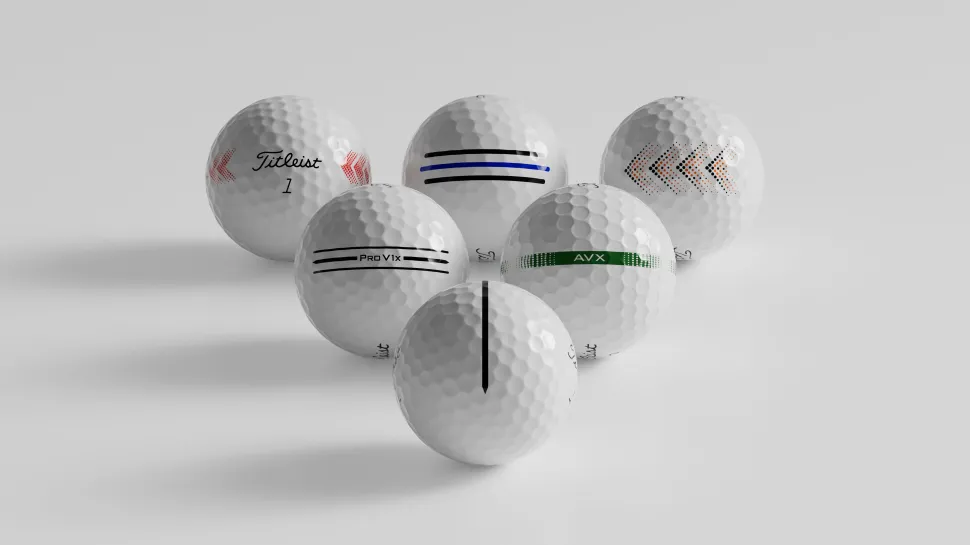
The core premise behind Titleist’s AIM is simple: help golfers align more accurately on the green. This isn’t a new concept; golfers have been drawing lines on their balls for decades. What’s new is Titleist integrating various alignment aids directly into the ball’s design across a wider range of their lineup. The pattern was already seen on the Pro V1, Pro V1x, and Pro V1x Left Dash, and now we’re seeing four unique designs on the AVX, Tour Soft, Velocity, and TruFeel models.
The article states:
Titleist say that around 65% of their players on the PGA Tour mark their ball using some kind of alignment cue. As a result, the AIM Performance design, which is currently available on the Pro V1 range, was inspired by a single straight line – the most popular addition that these golfers made.
This isn’t surprising. I’ve seen this firsthand. In my fitting sessions, a significant number of golfers, regardless of handicap, instinctively reach for a Sharpie and draw a line. Why? Because the visual cue helps them set up square. Putting is arguably the most feel-dependent part of the game, but good alignment is a non-negotiable fundamental. Even a degree or two off at setup can lead to missed putts, especially on longer ones.
Where my ears really perked up was the mention of Titleist’s R&D device.
Their R&D team then came up with a device to measure how accurately golfers were in aligning their golf ball to a target. Whilst using AIM alignment aids, golfers were found to be 35% more accurate than those using a standard length sidestamp.
Now, that’s a data point that gets my attention. “35% more accurate” is a substantial claim. While the article doesn’t detail the specifics of their testing protocol or the demographics of the “wider range of golfers,” the premise makes sense. A longer, more pronounced, or more distinctive alignment aid provides a clearer visual reference. My experience with fitting hundreds of golfers confirms this; when given a strong visual aid, many golfers feel more confident in their setup, which can directly translate to better putts. It’s not about making you putt better once you hit the ball, but about ensuring you’re aimed correctly before you even take the putter back.
Beyond the Pro V1: What’s New?
The key takeaway for 2026 is the democratization of these alignment aids across Titleist’s broader ball lineup. Let’s look at the specific additions:
In 2025, the AVX and Tour Soft already had an AIM option. For 2026, we see the addition of new AIM 360 markings. These wrap around the circumference of the ball. On the Tour Soft and Velocity, there are also AIM performance designs opposite the sidestamp, similar to the Pro V1 range.
- Titleist AVX AIM 360 (£44): The AVX now gets a “distinctive” alignment design that “gradually dissolves around the circumference of the ball.” This is an interesting visual. For golfers who prefer a softer feel, lower spin, and a more penetrating flight with longer clubs (all hallmarks of the AVX), this integrated alignment could be a subtle edge. If you’re someone who often feels like your putter is aimed slightly right or left, this visual can certainly help.
- Titleist Tour Soft AIM Performance (£34): This ball features an “extended three-line alignment,” available in blue/black or red/black options. An extended line is precisely what many golfers draw on their ball, so having it factory-printed is a definite convenience. The Tour Soft is a great all-around performer for those seeking a balance of distance, feel, and spin without the premium price tag of a Pro V1/X. This makes perfect sense for Tour Soft users.
- Titleist Velocity AIM Performance (£28): An “orange and black arrow alignment design” for the distance-focused golfer. The Velocity is all about raw speed and minimal spin off the driver, so targeting players who prioritize that with a distinct visual aid is a smart move. Again, it’s about making a familiar process easier and more consistent.
- Titleist TruFeel AIM 360 (£26): This ball gets a “continuous red arrow design” that wraps around the circumference. As Titleist’s softest ball, aimed at feel and consistent greenside spin for players who prioritize comfort, a continuous alignment aid is a nice touch. For players who struggle with feeling aligned, this could be a secret weapon.


The Tyler Reed Take: Does AIM Actually Work?
Here’s the straight talk: A line on a ball doesn’t inherently change the golf ball’s launch, spin, or ball speed characteristics. It doesn’t magically impart more MOI or alter CG. It’s a visual aid, pure and simple. But that doesn’t mean it’s not a legitimate performance enhancer.
I’ve witnessed countless times during fittings how a golfer’s perception and confidence can directly impact their stroke. When a player feels aligned, they often make a freer, more confident swing. Placebo? Maybe partially, but the results are real. If you’re 35% more accurately aligned, as Titleist’s research suggests, that’s fewer pushed or pulled putts because of setup errors, not stroke errors. That’s a genuine performance gain, especially for amateur golfers who often struggle most with alignment.
For me, the real value here isn’t in some groundbreaking new material science or aerodynamics. It’s in the psychological edge and the simplification of a fundamental. No more shaky lines drawn with a sharpie. No more second-guessing if your line is truly straight. It’s consistent, factory-precise alignment for every putt.
Who is this For? Practical Buying Advice
This expansion of AIM models is a smart move by Titleist to cater to a broader audience. It’s not just for the Pro V1 purists anymore.
- High-handicappers: If you struggle with inconsistent alignment, especially on the greens, trying one of the TruFeel or Velocity AIM balls could be incredibly beneficial. The visual clarity can build confidence and help engrain better habits.
- Mid-handicappers: For those playing the Tour Soft, you’re likely looking for a good all-around performer. The AIM performance designs give you that added alignment boost without sacrificing the ball’s core characteristics. It’s a low-cost, high-return “upgrade.”
- Low-handicappers (non-Pro V users): If you prefer the softer feel and penetrating flight of the AVX but still want that alignment aid, the AVX AIM 360 is a no-brainer. Every stroke counts, and anything that helps you start the ball on your intended line is a win.
The price difference between the standard and AIM versions of these balls is negligible, if it exists at all. So, if these alignment aids genuinely help you aim better, there’s no reason not to choose them. It’s the kind of subtle innovation that I appreciate because it addresses a fundamental human element of the game rather than just chasing marginal gains in ball speed that only a few pros can consistently maximize.
In wrapping this up, Titleist isn’t reinventing the wheel here. They’re taking a proven beneficial practice—using alignment aids—and integrating it cleanly and consistently across their product line, backed by some internal data on its effectiveness. From a club fitter’s perspective, I always tell golfers to embrace anything that helps them gain confidence and consistency. If a factory-printed, scientifically-backed alignment aid can help you putt better, that’s a win in my book. Go hit some putts with these, see what works best for your eye, and let the results speak for themselves.
