

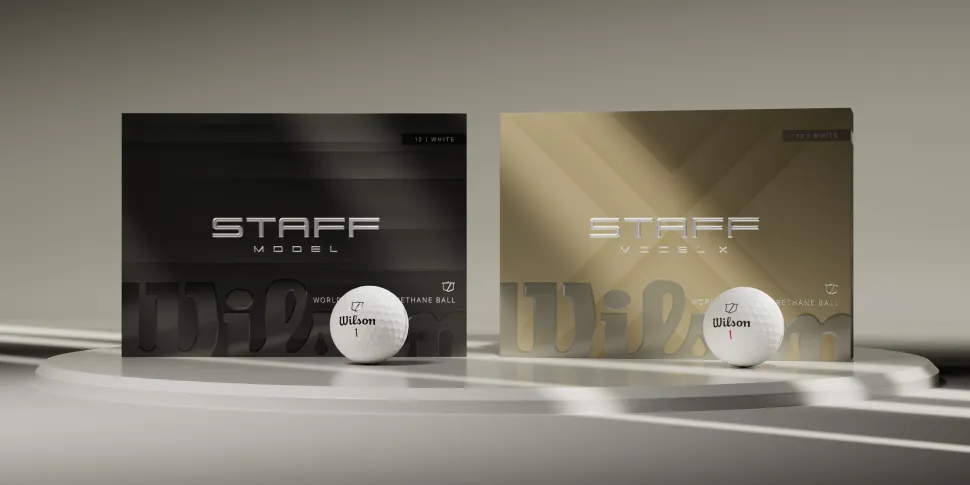

Alright, fellow duffers, Tyler Reed here, and we’re diving into Wilson’s latest offering for 2026: the updated Staff Model and Staff Model X golf balls. Wilson has been making some serious strides in the premium ball market, and while they might not be the first name that pops into everyone’s head when thinking ‘Tour ball,’ their performance has consistently impressed me in recent years. I’ve tested a lot of balls on the launch monitor, and I’ve fitted even more golfers, so let’s cut through the marketing jargon and see what’s really under the hood here.
The big takeaway from the source article is the introduction of their new V-COR technology, which Wilson claims will generate “maximum velocity off the club face” and “the fastest ball speeds on the market according to their testing.” This is a bold claim, and one that immediately piques my interest as a club fitter. Faster ball speed is the holy grail for many golfers, but it’s crucial to analyze how that speed is achieved and what trade-offs, if any, are made.
“Both balls use a new V-COR technology. This offers a unique core construction, helping to generate maximum velocity off the club face. As a result, Wilson say that this produces the fastest ball speeds on the market according to their testing.”
My experience tells me that “fastest ball speeds on the market” often comes with caveats. Is it fastest across all swing speeds? Is it at the expense of feel or short-game spin? These are the questions we need to answer once we get these balls on the launch monitor.
The Staff Model: Lower Spin, More Speed?
The 2026 Staff Model ball is positioned for “elite golfers who want the performance of a Tour ball, but with a lower spin rate than a harder urethane ball.” With a compression of 90, it’s certainly on the firmer side of the market, but still 10 points softer than the Staff Model X. The article claims it provides “better ball speed and distance” and a “spin rate of around 4% lower than a ‘harder’ premium urethane ball, with both drivers and irons.”
Let’s unpack that. A 4% reduction in spin across both drivers and irons is significant, assuming constant launch angles and ball speeds. For stronger players who generate too much spin with their driver, this could translate to valuable yardage gains due to a more penetrating flight. But the key is “across both drivers and irons.” Often, a ball designed to lower driver spin compromises iron spin, making it harder to hold greens. Wilson’s description of a “soft-compression rubber core, with a softer inner mantle to control driver spin” and “a harder outer mantle adds speed and distance” combined with “a thin, soft urethane cover produces higher levels of spin on approach shots” suggests they’re trying to walk that fine line. My launch monitor data, especially on iron shots from 150-200 yards, will be critical to verify this claim. We’ll be looking for consistent spin numbers that don’t plummet when moving from driver to mid-irons.

The Staff Model X: The “World’s Fastest”?
The Staff Model X, with its even higher compression (presumably 100, based on the Staff Model’s 90 and the “10 less than” comment), is being touted as the “world’s fastest urethane golf ball.” Again, a big claim. The construction – “small, mid-compression core, a soft terpolymer inner mantle layer, extra stiff ionomer outer cover, and ultra-thin urethane cover” – is interesting. The addition of a soft terpolymer layer usually implies some feel enhancement, which aligns with their feedback about “softer feel and sound” from tour staff. However, an “extra stiff ionomer outer cover” typically means more speed and less spin, potentially at the cost of short-game feel. We’ll see if the ultra-thin urethane cover can truly bring back the required greenside control.
“Wilson call this the ‘world’s fastest urethane golf ball’. This time around there’s a softer feel and sound, as a result of feedback from their own tour staff.”
In my fitting experience, players chasing “world’s fastest” often have very high swing speeds and are looking to maximize every MPH off the face. For these players, a slightly firmer feel can be a non-issue if the ball speed gains are there. The hexagonal seamless dimple pattern, designed for “optimum ball flight to maximise distance,” is a common optimization strategy. We’ll need to see if it consistently holds its line in various wind conditions compared to some of its competitors.

TRK360 Alignment: A Practical Feature
The optional TRK360 alignment design is a welcome addition. Visual alignment aids are increasingly popular, and I’ve seen firsthand in fittings how they can improve a golfer’s confidence and stroke consistency on the greens. The ability to use the side-seam stamp as a training aid for end-over-end roll is a smart, understated benefit often overlooked.

“The side-seam stamp works as a training aid during putting practice, allowing golfers to work on achieving an end-over-end roll.”

Who are these balls for?
Based on the initial information, the Staff Model and Staff Model X are clearly aimed at the serious golfer who prioritizes performance. The £53.99 per dozen price tag firmly places them in the premium category, on par with Titleist Pro V1/X, TaylorMade TP5/X, and Callaway Chrome Soft/X. This isn’t a casual purchase; it’s an investment in your golf game.
- The **Staff Model** (90 compression, lower driver/iron spin, softer inner core) sounds ideal for the mid to high-swing speed player (95-105+ mph driver) who might be losing distance due to excessive driver spin but still wants good greenside control. This could also be a good option for players who like a slightly softer feel but still demand Tour-level performance.
- The **Staff Model X** (100-ish compression, “world’s fastest”) is likely for the highest swing speed players (105+ mph driver) who generate a lot of power and need a ball that can keep up. These players typically prefer a firmer feel and minimal spin off the driver to maximize carry and roll. The feedback from Tour staff for “softer feel and sound” is a good sign that Wilson is addressing a common complaint with ultra-firm balls.
My Initial Data-Driven Thoughts
While I haven’t put these through my rigorous launch monitor testing yet, the claims are compelling. The idea of a “V-COR technology” for maximum velocity will be the first thing I measure. Consistency in ball speed across different impact points on the clubface will also be vital to assess the true performance gains. Any gains in ball speed must translate to tangible distance without sacrificing trajectory or shot shape control.
For the Staff Model, the 4% lower spin claim will be cross-referenced against spin numbers from leading premium balls at similar swing speeds. A ball that genuinely reduces driver and mid-iron spin without killing wedge spin would be a game-changer for many golfers. The multi-layer construction described suggests they’re meticulously engineering each layer to achieve specific performance goals, which is exactly what we want to see in a premium ball.
As for the Staff Model X, the “world’s fastest” claim will be put to the test against the absolute fastest balls on the market in my controlled environment. I’ll be looking at peak ball speeds, but also how well it maintains that speed on slight off-center strikes – a crucial factor for real-world playability. The balance between firm compression for speed and the described “softer feel and sound” will be interesting to evaluate. Ultimately, in a fitting, we’re looking for the optimal blend of speed, spin, and feel for each individual, and these two offerings from Wilson appear to provide distinct options within that premium spectrum.
I’m looking forward to getting these on the launch monitor and providing some definitive data. Wilson has quietly been building a strong case for its place in the premium ball market, and these 2026 updates could further solidify that position if the performance lives up to these promising initial reports.
