

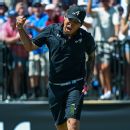

Morikawa’s Pebble Redemption: Why This Win Signals Something Bigger Than 28 Months of Drought
There’s a moment in every golfer’s career when you realize the game itself becomes the enemy. I saw it happen to Tom Lehman back in ’98—same guy I caddied for, same talent, same competitive fire—when he started overthinking every swing instead of trusting his gifts. Collin Morikawa looked like he was living in that particular purgatory these past 28 months. Until Sunday at Pebble Beach, when he didn’t.
What struck me most about Morikawa’s one-shot victory over Sepp Straka and Min Woo Lee wasn’t just the quality of his play down the stretch—though holing a 30-foot birdie putt on 15 and then sticking a 4-iron from 235 yards over the ocean on 18 will do nicely. It was the philosophical shift he announced afterward, coupled with his news about expecting his first child this spring. For once, a professional golfer at the highest level seemed to understand something that takes most of us a lifetime to learn: the technique matters less than the joy.
“There’s so much to life, there’s so much to enjoy,” Morikawa said.
That’s not typical tour speak. That’s a guy who’s recalibrated.
The Real Story: When Context Becomes Everything
In 35 years covering this tour, I’ve learned that the most meaningful victories often aren’t about the final scoreline. They’re about what the winner needed at that specific moment in their career. Morikawa’s 22-under 266 tied Brandt Snedeker’s 2015 mark for the lowest 72-hole total in Pebble history—genuinely impressive. But here’s what matters more: he did it after 45 starts without a win, with the pressure of professional irrelevance starting to creep into the conversation.
The two-time major champion had become a footnote. Not because he stopped being talented—the Pebble Beach field proved that notion was absurd—but because in modern professional golf, you’re only as good as your last tournament. Morikawa was stuck in that netherworld where the talent is undeniable but the results have gone silent. Now he’s back to No. 5 in the world, and more importantly, he’s back to remembering why he loves this game.
The Scheffler Context Nobody’s Talking About
I want to take a moment to properly acknowledge what Scottie Scheffler did here, because it almost got lost in the narrative shuffle. The man started eight shots back, shot 63 with three eagles—making him the first player in PGA Tour history to post three eagles in a single round at Pebble Beach—and nearly pulled off what would’ve been the greatest final-round comeback in tournament history.
Scheffler’s comment afterward deserves attention:
“I had to do something special to give myself a chance. The back nine, I felt like I had to get to 21 or 22 (under). I played a bit more aggressive than I normally am. It was a fun day overall. These are the weeks I’m proud of.”
That’s championship mentality. That’s a player who understands that sometimes you lose, but you do it trying to win rather than playing not to lose. His 63 was genuinely spectacular, yet he finished tied fourth. He’s now extended his streak to 18 consecutive PGA Tour top-10 finishes. The man is operating at a different altitude than the rest of the field, yet Morikawa still found a way.
What Pebble Beach Taught Both of Them
Here’s the moment that crystallized everything for me: Morikawa standing in the fairway on the 18th, waiting roughly 20 minutes while Jacob Bridgeman figured out how to escape the beach. Morikawa said he walked down to the ocean and back about ten times, actively trying to stay loose, stay warm, stay present instead of drowning in the mechanics of the shot ahead.
“I tried to think about anything else other than golf. Thankfully, you had the nicest backdrop you could ask for, so that was very, very easy. For me, it was how do I stay loose, how do I stay warm and not just think about the shot.”
That’s wisdom. That’s someone who’s learned that overthinking is the assassin of performance. I’ve watched enough professional golf to know that the players who trust their swing are the ones who make it under pressure. The ones who deconstruct every movement usually don’t.
The Calendar Doesn’t Lie
Let’s talk about where Morikawa’s game sits now. He turned professional literally a week before the 2019 U.S. Open at Pebble Beach—the same course where he just won. Seven PGA Tour victories, two majors (the 2020 PGA Championship and 2021 Open Championship), now ranked fifth in the world. That’s not a career that was in trouble; it was a career that simply needed a reset.
But 28 months without a win in professional sports creates narrative pressure that’s very real, regardless of your resume. You start hearing the whispers. You see the “what’s wrong with Morikawa?” takes on social media. Sponsors start wondering about relevance. The player starts wondering if the magic is gone.
It wasn’t. It was just hiding under layers of technique and expectation. Sunday proved that.
What This Means Going Forward
I think we’re about to see a very different version of Collin Morikawa over the next few years. Not because his swing got better—it clearly was never that broken—but because he’s fundamentally changed his relationship with the game. Adding a child to his life typically clarifies priorities in ways that nothing else can. The pressure becomes less suffocating when you’re not carrying it alone.
The AT&T Pebble Beach Pro-Am just became about much more than a tournament victory. It became the moment when a talented player remembered that golf is supposed to be fun, even when everything’s on the line. Especially then.
That’s a win that matters.
