

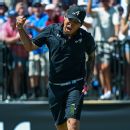

Morikawa’s Pebble Beach Breakthrough: More Than Just a Win
There’s a moment every golf writer dreams about covering—that instant when you witness not just a tournament victory, but a genuine turning point in a player’s career and life. I saw it Sunday at Pebble Beach, and it wasn’t the final putt that mattered most.
Sure, Collin Morikawa’s one-shot victory over Sepp Straka and Min Woo Lee is significant enough on its own. After 28 months without a win—45 starts since October 2023—Morikawa delivered when it counted, holing a 30-foot birdie putt on the 15th, following with a 6-iron to 8 feet, and navigating the theatrical final hole with ice in his veins while waiting nearly 20 minutes in cold Pacific wind.
But here’s what strikes me after three-and-a-half decades covering this tour: the real story is what Morikawa said afterward, and what he announced on the biggest stage available to him.
A Philosophical Shift That Changes Everything
In my experience caddying for Tom Lehman back in the day and watching hundreds of players navigate pressure moments, I’ve learned that the best performances come from players who’ve made peace with the outcome. Morikawa’s comment about his new approach—playing for joy rather than technique—tells me something fundamental has shifted in his mindset.
“There’s so much to life, there’s so much to enjoy,” he said.
That’s not typical PGA Tour vernacular. And when he chose to announce his wife’s pregnancy—their first child arriving this spring—in the immediate glow of his victory, it underscored something many tour insiders have whispered about for years: the mental burden of chasing perfection on the golf course can strangle the very talent it’s designed to maximize.
Morikawa finished at 22-under 266, tying the lowest winning total in 72 holes at Pebble Beach (matching Brandt Snedeker’s 2015 mark). That’s not luck. That’s not accident. The Cal alum clearly still has his considerable technical skills intact. What appears different is the filter through which he’s viewing those skills.
The Scheffler Factor and What It Reveals
Let’s talk about Scottie Scheffler for a moment, because his performance here was remarkable in its own right—and oddly instructive in understanding what Morikawa just accomplished.
Scheffler started the final round eight shots back. Eight. He shot 63, with three eagles, and became the first player in PGA Tour history to record three eagles in a round at Pebble Beach. He nearly completed what would have been the tournament’s greatest comeback.
“I had to do something special to give myself a chance. The back nine, I felt like I had to get to 21 or 22 (under). I played a bit more aggressive than I normally am. It was a fun day overall.”
Yet even Scheffler’s historic round fell just short. What does that tell you? In a tournament where six different players held a share of the lead at various points on Sunday, execution at the crucial moments became everything. Morikawa executed. Scheffler didn’t quite, despite one of the most impressive comebacks we’ll see this season.
Scheffler extends his streak to 18 consecutive top-10 finishes on the PGA Tour—an absolutely absurd run of consistency. But one detail stood out: a wedge shot on the 15th that hopped hard over the green, leading to a missed par putt. In a tournament where the margin was one shot, that’s the difference between hoisting the trophy and finishing fourth.
For Morikawa, it’s confirmation that his new mental approach is working.
The Field Was Legitimately Elite
One thing that deserves emphasis: this wasn’t a weak field where a streaky player caught lightning in a bottle. The 54-hole leader was Akshay Bhatia, who simply couldn’t maintain his position—a reality check for the young talent that happens more often than not in professional golf. The final leaderboard featured multiple world-class competitors, and Morikawa had to navigate through all of them, including a wait of 20 minutes on the 18th that would have unraveled most players.
“I tried to think about anything else other than golf. Thankfully, you had the nicest backdrop you could ask for, so that was very, very easy. For me, it was how do I stay loose, how do I stay warm and not just think about the shot.”
That answer alone tells you everything about his mental state. He walked to the ocean and back 10 times during the delay, managing anxiety not through obsessive swing thoughts, but through appreciation of his surroundings. That’s maturity.
What’s Next for Morikawa
Moving to No. 5 in the world rankings with his seventh PGA Tour victory, Morikawa has the opportunity to establish himself as a consistent major championship contender. He’s already won two majors—the 2020 PGA Championship and 2021 Open Championship. But the gap between his major success and his regular tour wins has been puzzling.
I think this Pebble Beach victory might be the psychological breakthrough that changes that calculus. When a player finds a way to quiet his own mind—to enjoy the competition rather than wage war against himself—everything else tends to follow. Add fatherhood into the equation, and you have someone whose priorities have been realigned toward what actually matters.
In my three-and-a-half decades watching this tour, some of the best golf I’ve seen has come from players who figured out how to love the game again after spending years trying to perfect it. Collin Morikawa just might be joining that club.
