

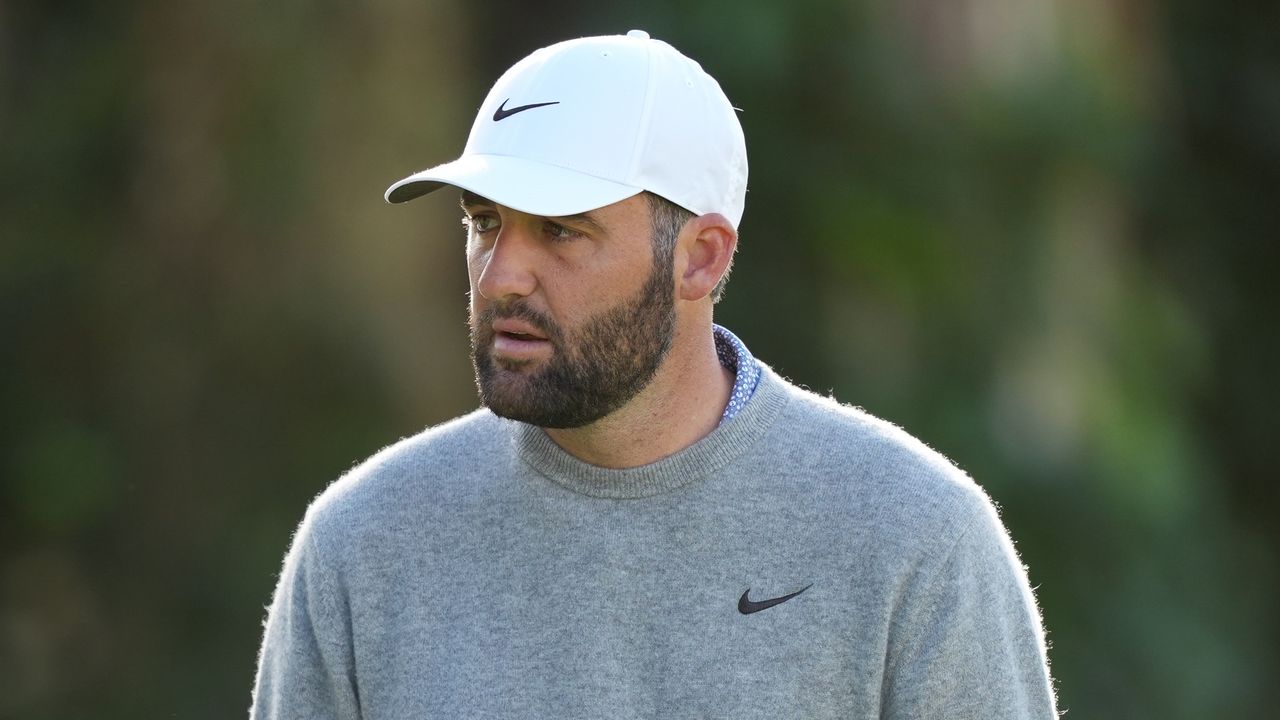

The Scottie Scheffler Slow-Start Mystery: Is Golf’s Dominant Force Finally Hitting a Wall?
I’ve been covering professional golf for 35 years, and I’ve seen enough talent come and go to know when something’s genuinely unusual. So when the World No. 1 finds himself at the bottom of a leaderboard—even in a rain-delayed, weathered-beaten first round—it’s worth paying attention.
That’s exactly where Scottie Scheffler found himself Thursday at the Genesis Invitational, and it’s prompted me to ask some harder questions about what might be happening with golf’s most dominant player right now.
The Numbers Tell a Story
Let’s start with the facts. After 10 holes at Riviera Country Club, Scheffler sat at five-over par—the worst 10-hole start of his entire PGA Tour career. He carded three bogeys and a double bogey in conditions that were admittedly brutal, but that’s the point: this is the guy who’s supposed to thrive in adversity.
| Scottie Scheffler’s Worst 10-Hole Starts on PGA Tour | Score | Context |
|---|---|---|
| Genesis Invitational (Today) at Riviera | +5 | World No. 1 player & 4-time major champion |
| 2014 Byron Nelson | +4 | As 17-year-old amateur |
What strikes me most is the context. This isn’t just a bad 10 holes in isolation. This is the third consecutive first round where Scheffler has struggled to establish rhythm. He shot 73 at TPC Scottsdale in Phoenix and 72 at Pebble Beach. Neither are disasters on their face, but for a player of his caliber—one who just snapped a 33-round streak of consecutive sub-par rounds—the pattern matters.
“Even if Scheffler can rescue the situation on Friday, it still marks three first rounds in a row for him, after also starting slowly at the WM Phoenix Open and AT&T Pebble Beach Pro-Am.”
In my experience caddying for Tom Lehman back in the day, I learned that trends like this usually signal something deeper than just poor weather or bad luck. Sometimes it’s mechanical. Sometimes it’s mental. And sometimes—though rarely with elite players—it’s the grind catching up with you.
Context Matters, But So Does the Pattern
Here’s where I want to be fair: the source article makes a crucial point that we can’t ignore.
“We also have to emphasize these are bad starts for Scheffler, given his insane level of production—as on the face of things shooting 73 at TPC Scottsdale and 72 at Pebble Beach aren’t exactly disasters.”
That’s absolutely true. In context of Scheffler’s standards, a 72 or 73 in tough conditions is more of a stumble than a crisis. The man has accumulated an absolutely staggering 18 consecutive top-10 finishes on the PGA Tour—the most since Billy Casper’s run of 17 in 1964-65. That’s transcendent consistency.
But here’s what keeps me thinking: even transcendent players don’t usually start slow three weeks in a row. The variance we’re seeing now—the basic errors, the frustration Scheffler showed in Phoenix after his 33-round streak ended—these are breadcrumbs. They suggest fatigue, either physical or mental, and possibly both.
The Recovery Is the Real Story
That said, let’s not lose sight of what actually matters. Scheffler has now finished T3 and T4 in both tournaments where he started slow. That’s the hallmark of a champion—the ability to absorb poor starts and still compete at the highest level. Most players would kill for a T4 finish; Scheffler treats it like a disappointment.
At Riviera, he’s facing a significant hole to climb. Rory McIlroy, making his 10th start at this event, carded a stunning 66 in brutal conditions, sitting atop the leaderboard with just one bogey. England’s Aaron Rai was threatening to go even lower at six-under after 16 holes. Jacob Bridgeman matched McIlroy’s opening salvo.
This is a field that’s playing well, and Scheffler will need to execute at his highest level to overcome a rough start. But here’s what I’ve learned over three decades: that’s actually when you want to see how a great player responds.
What This Really Means
The broader narrative here isn’t about Scottie Scheffler’s imminent decline—that would be absurd. It’s about the natural rhythm of professional golf and what happens when even the most dominant players run up against the law of diminishing energy.
I think what we’re witnessing is a player who’s played an enormous amount of golf at an extremely high level, and whose body and mind might be sending subtle signals that they need recalibration. Three slow first rounds in succession isn’t a red flag that screams “something’s wrong”—but it’s definitely worth monitoring.
The good news? Scheffler has shown he can respond when the heat’s on. The better news? A player this talented typically learns quickly. By the time we’re writing about round two, Friday might tell us whether this is a temporary blip or something more significant.
Either way, it’s worth watching closely.
