

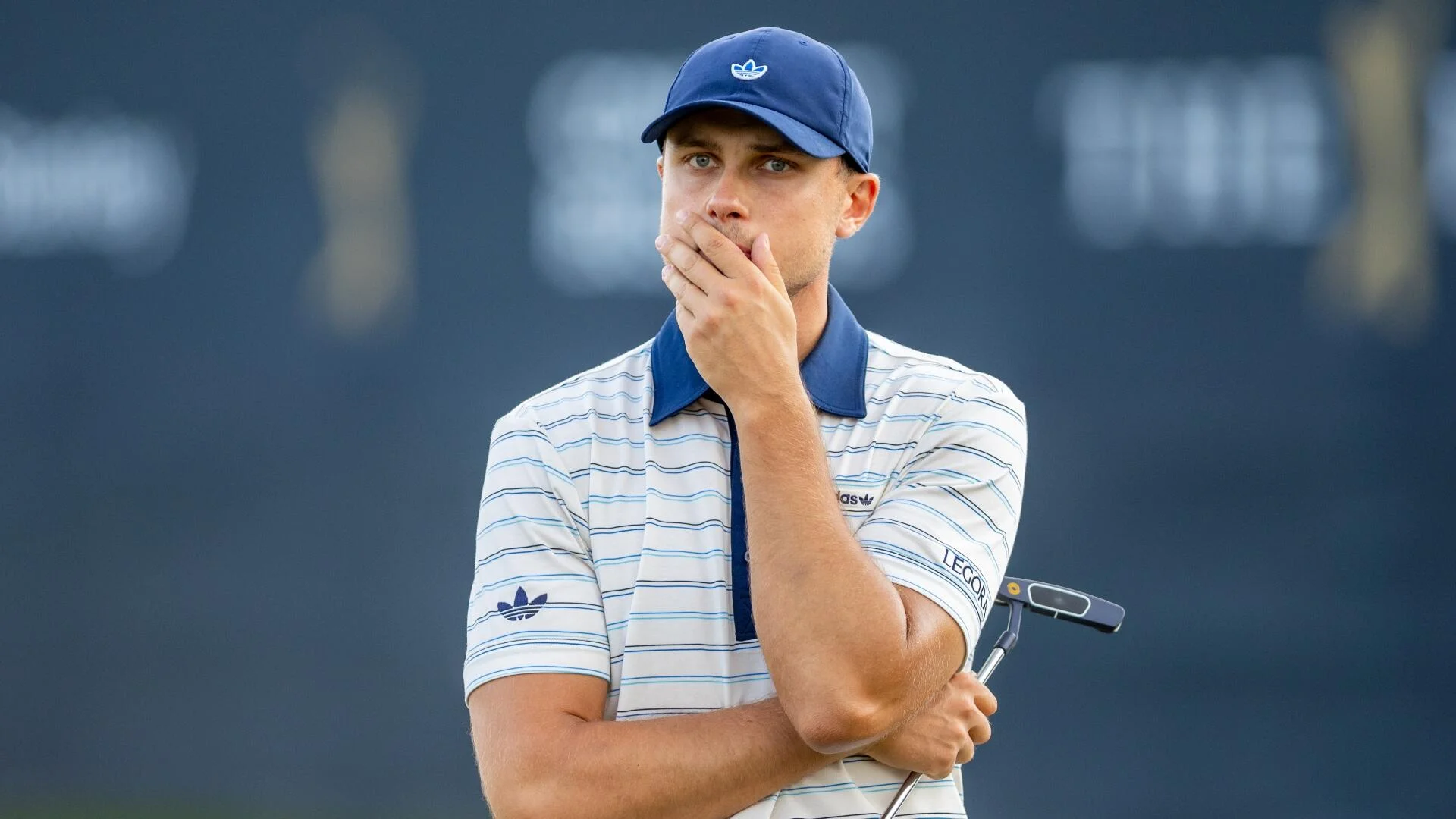

Ludvig Åberg had me convinced for about 64 holes at TPC Sawgrass last week that he was ready to win The Players Championship. And then, faster than you can say “snap hook,” he reminded me why even the most talented young players on this tour need a few more years in the oven.
Look, I’ve been around professional golf long enough to know that watching a player implode under pressure isn’t exactly breaking news. But what happened to Åberg on holes 11 and 12 Sunday tells us something important about where he stands in his development—and frankly, it’s a story we’re going to see play out several more times before he becomes the consistent winner his prodigious talent suggests he should be.
The Tale of Two Holes
Here’s what struck me watching those two holes unfold: They’re supposed to be among the easiest on Pete Dye’s masterpiece. A reachable par 5 followed by a drivable par 4. Both should be birdie opportunities for a guy swinging the club like Åberg has all week. Instead, they became the pivot point of the entire tournament.
The 7-wood into the water on 11? I can forgive that one. It was aggressive, yes, but it was the right kind of aggressive. Going for the green there is what you’re supposed to do when you’re leading. Even after the splash, he had a makeable par putt with a solid wedge approach. That’s acceptable risk management at a major championship-level event.
But then came 12, and this is where experience separates the good players from the great ones.
“Whenever I get in a stressful situation, I have to slow myself down because I get really fast. I start talking fast, I start breathing fast, and I kind of get, like, a little worked up like that.”
Åberg himself diagnosed his own problem perfectly on Saturday night. He knew exactly what was coming if he got rattled. He said the words. And then he proceeded to do the exact opposite 24 hours later by yanking driver on a hole where—and I can’t stress this enough—he already wasn’t in a position where he needed to press.
In my three decades covering this tour, I’ve seen this pattern repeat itself with young players who have extraordinary talent but haven’t yet developed the metacognitive ability to manage themselves in real time. They know what they need to do. They can articulate it brilliantly. But when the adrenaline spikes and things start moving quickly, the intellectual understanding hasn’t yet been hardwired into their nervous system.
The Putting Question That Matters Most
But here’s what really intrigues me about Åberg’s situation, and it’s something the casual observer might miss: The putting numbers are quietly screaming a truth that extends far beyond one tournament.
Åberg is 76th on the PGA Tour in strokes gained putting this season. Last year, he finished 67th. The year before that, 86th. When you’re sitting outside the top 75 in putting, you’re working with a psychological deficit that most fans don’t fully appreciate. You’re playing a different mental game than the elite putters.
“When a player doesn’t trust that they’ll make putts, they try to overcompensate by attacking every pin, taking aggressive lines off the tee to attempt short birdie putts.”
This is the real issue, and I think it’s worth sitting with for a moment. Åberg’s aggressive tendencies—which are his greatest strength when he’s on—are being amplified by a lack of confidence with the flat stick. He’s not pulling driver on 12 because he suddenly became reckless. He’s pulling driver because, deep down, he doesn’t quite trust himself to make enough 20-footers to close out wins by playing to the middle of the green.
It’s a vicious cycle, and breaking it requires either dramatic improvement in putting or the kind of maturity that comes with experience. Ideally, both.
Cameron Young as the Template
The good news? Cameron Young just showed us exactly how to escape from this trap. Young was worse than 145th in strokes gained putting in 2023 and 2024. He was a seven-time runner-up—sound familiar? And then something clicked. He finished 7th in putting last year, which unsurprisingly led directly to his breakthrough win at The Players.
Now that his putter is something he can lean on in big moments—he made the crucial 10-footer on 17 to tie the lead—he can afford to play with what I call “conservative aggression.” That’s the hallmark of every sustained winner in professional golf. You pick your spots. You’re not timid. But you’re not throwing darts either.
That’s the version of Ludvig Åberg that’s waiting on the other side of this learning curve.
The Timeline Question
People keep asking me: How long until Åberg breaks through and starts piling up wins? Could be a few weeks. Could be a couple years. Having caddied back in the ’90s and covered this tour ever since, I’ve learned that timelines for young talent are rarely predictable.
What I am confident about is this—it’s coming. The pathway is clear. The talent is undeniable. And Åberg, to his credit, is at least aware of his shortcomings and willing to learn from them. That’s more than I could say for some of the young guns I’ve covered over the years.
On Sunday at TPC Sawgrass, we didn’t see the arrival of Ludvig Åberg as a major championship winner. We saw a promising young player getting another hard lesson in the peculiar pressures of professional golf. Eventually, those lessons compound into wisdom. And when they do, watch out.
