

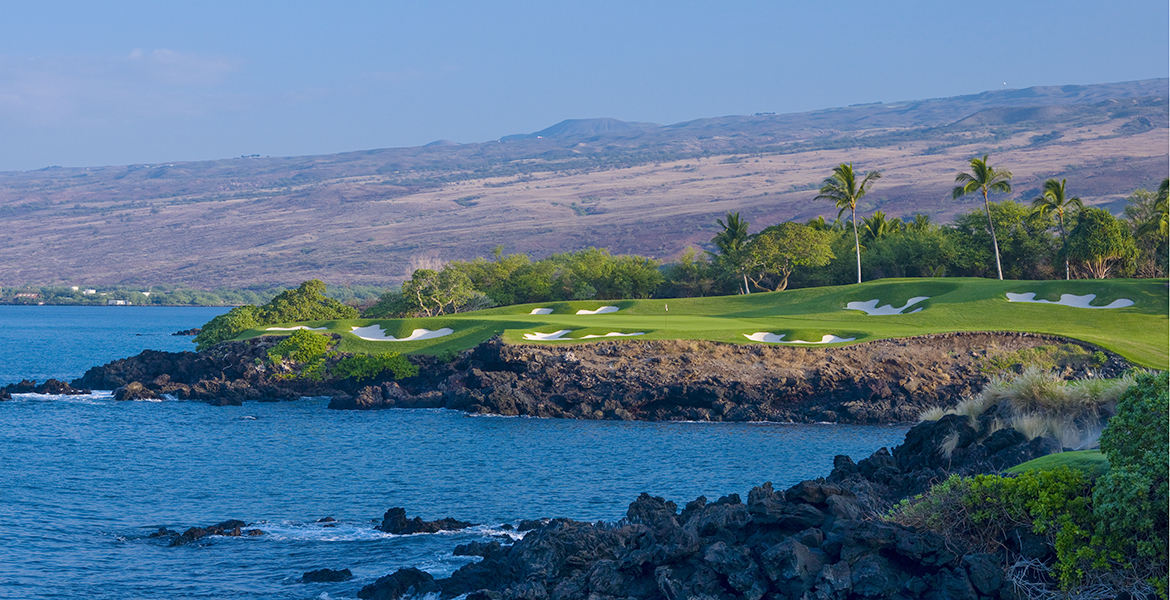

There are courses you play, and then there are courses that etch themselves onto your soul. Mauna Kea Golf Course, perched on the stunning Kohala Coast of the Big Island, undoubtedly belongs to the latter. As a golf architecture enthusiast who has walked the fairways of over 200 courses worldwide, I can tell you that this Hualalai masterpiece isn’t just a round of golf; it’s a testament to vision, resilience, and the sheer audacity of one of the game’s greatest designers.
I recall my first visit, stepping onto that volcanic landscape, the contrast between the deep, inky lava rock and the vibrant green of the fairways a startlingly beautiful tableau. It’s a land sculpted not just by nature’s ancient fury but by the genius of Robert Trent Jones Sr., a man famed for his “heroic” golf, where strategic hazards and bold carries define the challenge. But even for Trent Jones, Mauna Kea presented a unique canvas.
From Lava Flow to Lush Fairways: The Birth of a Legend
The story of Mauna Kea begins in 1960, a tale as dramatic as the Big Island’s volcanic origins. Laurance Rockefeller, a visionary developer, and Trent Jones Sr. were flying over the barren landscape when they spotted that perfect crescent beach. Yet, on the ground, the reality was stark – undulating, volcanic, seemingly uninhabitable for grass. Rockefeller, understandably, had his doubts. It was here that Trent Jones’s ingenuity shone brightest.
The source article recounts a pivotal moment often retold in golf circles:
“Dad picked up two lava stones and pummeled them together. They fractured. The pieces crumbled and fell to the ground.”
This simple act, according to his son Robert Trent “Bobby” Jones Jr., was the “aha” moment. Trent Jones Sr. had found his medium. He realized that with enough water, this seemingly hostile volcanic rock could be crushed into a fertile soil base. Together with construction superintendent Homer Flint, he engineered a ribbed roller that pulverized the lava into a fine red dust, mixing it with coral sand to create a weed-free foundation. It was an audacious feat of engineering and agronomy, transforming a lunar landscape into a verdant oasis.
The Jewel in the Crown: The Iconic 3rd
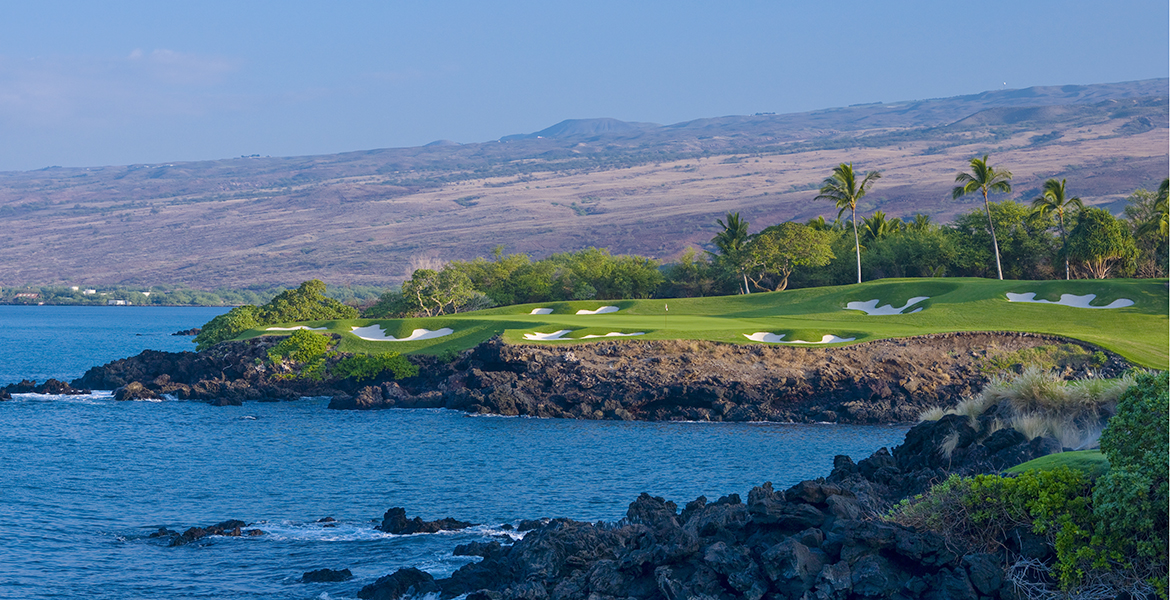
While the entire course is a masterclass in routing and thoughtful shot-making, one hole stands apart, transcending mere golf to become a global icon: the par-three 3rd. From the moment you step onto the back tee, set amidst ancient lava rock, the sheer scale of the challenge is breathtaking. It’s a full-blooded blast over the pounding Pacific surf to a gargantuan, kidney-shaped green far across a chasm of vibrant blue. At its original 250 yards, now often playing 272 yards, this is golf’s ultimate hero shot.
As Bobby Jones Jr. so aptly put it:
“My dad was into drama,” says Jones Jr. “When he saw the two rock outcroppings, he routed the golf course to get to that. Any architect would kill for that site. It’s one of the iconic holes in the game.”
And indeed, it is. I remember the salty breeze on my face, the rhythmic crash of waves echoing, and the almost impossible beauty of the turquoise water stretching to the horizon. It’s a shot that demands not just power, but precision, and a total commitment to the swing. The colossal green, ringed with bunkers, offers some relief for a slightly wayward shot, but anything short or too far left is swallowed by the ocean. It’s a hole that lives up to Trent Jones Sr.’s own description as his “gem among eighteen jewels.”
Trent Jones’s Design Philosophy on Display
Beyond the legendary 3rd, Mauna Kea showcases Trent Jones Sr.’s design principles beautifully. With 300 feet of elevation change at his disposal, he routed holes that climb and descend with the natural lava flows. You’ll find his characteristic “bend seven to the left, six to the right” approach, offering variety and strategic choice off the tee. Many of the greens are perched dramatically, often well-fortified by bunkers, demanding an aerial approach. This penal approach, often requiring extra club or two in the coastal winds, rewards bold, skillful play. Yet, he also integrated plenty of downhill holes, injecting a sense of fun and accessibility for all players.
The course opened in December 1964 with a “Big Three” event featuring Arnold Palmer, Jack Nicklaus, and Gary Player. The lore surrounding the 3rd hole from that exhibition, where Player allegedly couldn’t make the carry (before being moved forward), only added to its mystique. Player, much later, reflected on the course:
“Many of my fondest memories from Mauna Kea are of playing the beautiful par-three hole over the ocean,” said Player, 50 years later. “I had never seen anything like that before.”
That sentiment perfectly captures the essence of Mauna Kea. It was, and remains, an experience unparalleled. A more recent renovation by Robert Trent Jones II, his son, has enhanced the course, restoring views and ensuring its continued legacy, proving that good architecture endures.
Planning Your Visit to a Hawaiian Golf Paradise
Mauna Kea Golf Course is located on Kīholo Bay, within the Mauna Kea Resort on the Big Island of Hawaii. It is an integral part of the resort experience, meaning guests typically have preferred access. While public play is possible, it’s always advisable to book well in advance, especially during peak seasons. Before you go, understand that this is a true Trent Jones Sr. design – expect large, undulating greens, strategically placed bunkers, and carries that demand respect. The coastal breeze is almost always a factor, so club selection becomes paramount.
Playing Mauna Kea is more than just a round of golf; it’s a journey through a unique landscape, an appreciation of architectural ingenuity, and a profound connection to golf history. It’s a place where the grandeur of nature meets the artistry of design, leaving an indelible mark on every golfer fortunate enough to walk its hallowed fairways.
