


There are golf courses, and then there are golf courses that transcend the game itself, becoming indelible impressions etched in the memory forever. Mauna Kea on Hawaii’s Big Island is unequivocally one of the latter. As a golf architecture enthusiast who has been fortunate enough to walk over 200 courses worldwide, I can tell you that few places capture the imagination quite like the Mauna Kea Golf Course. It’s a testament not only to visionary design but to sheer audacious will, forging emerald fairways from barren lava rock against the backdrop of the Pacific’s endless blue.
My first visit to Mauna Kea was years ago, and the sheer audacity of its creation still astonishes me. To think that in 1960, a team looked at an undulating, volcanic wasteland and envisioned one of the world’s most iconic golf resorts is remarkable. Laurance Rockefeller, with his keen eye for development, and the maestro Robert Trent Jones, Senior, are the unlikely heroes of this tale. Picture it: a perfect crescent beach, a dream, quickly met with the harsh reality of volcanic stone. Rockefeller, understandably, had his doubts about building a course here. But golf architects, the truly great ones, see possibilities where others see obstacles. Trent Jones was one such architect, and his solution was as ingenious as it was simple.
“It depends on whether I can work with lava rock, if it can be crushed and used as a soil base to grow grass,” said Jones. “If it can, and there is enough water, I can build a golf course.”
This quote, from the source article, perfectly encapsulates the pioneering spirit of golf course construction in that era. It wasn’t about finding the perfect site; it was about *making* the perfect site. His son, Robert Trent “Bobby” Jones Jr., recounts the pivotal moment when his father picked up two lava stones, pummeled them together, and watched them crumble. “Yes, we can do it,” he declared. And just like that, the impossible began to take shape.
The construction itself is a legend. Jones and his superintendent, Homer Flint, invented a specially ribbed roller to crush the lava into a fine, talcum-powder-like dust. This was then mixed with coral sand from Kawaihae Harbor and spread almost a foot deep across the entire course. The result? As Jones himself noted in 1988: “When it sprouted, we got the cleanest grass you’ve ever seen. There were no weeds, because nothing had ever grown in the material before.” Imagine the sheer manual labor and the engineering challenge this presented. It’s a testament to the fact that great golf courses are often the result of overcoming immense natural hurdles, not merely finding pristine land.
The Iconic Third: A Masterpiece Unequaled
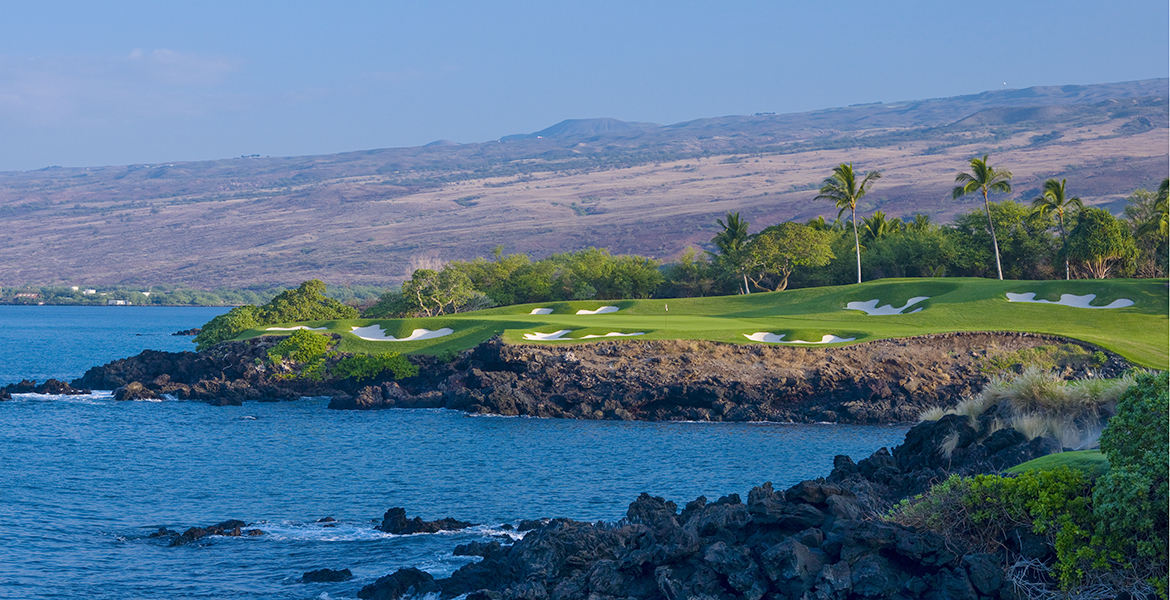
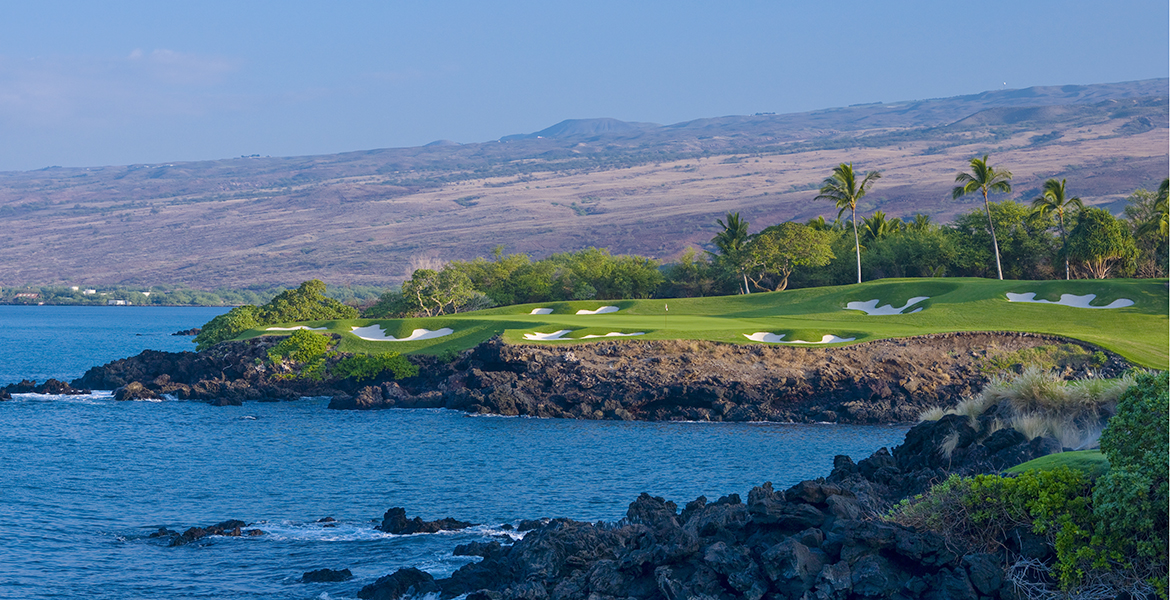
While the entire course is a marvel of routing and design, it is the par-three 3rd hole that catapulted Mauna Kea into the pantheon of golf’s greatest. From its dramatic, isolated tee box carved into 5,000-year-old lava rock, players face a shot of pure exhilaration: a 250-yard (originally) or 272-yard (today) carry over the pounding Pacific surf to a generous, kidney-shaped green. It’s a visual feast, a shot demanding courage and precision, and an architect’s dream come to life.
“My dad was into drama,” says Jones Jr. “When he saw the two rock outcroppings, he routed the golf course to get to that. Any architect would kill for that site. It’s one of the iconic holes in the game.”
This insight from Bobby Jones Jr. perfectly elucidates the appeal. Architects like Alister MacKenzie or Tom Doak often talk about working with the natural contours of the land, finding holes rather than imposing them. Here, Trent Jones did both – he ingeniously transformed the land, but he also recognized the dramatic potential of those two volcanic promontories. It’s theatre, pure and simple, and it works flawlessly. The vastness of the ocean, the vivid greens of the turf, and the dark, rugged lava create a striking contrast that is unforgettable.
The strategy of the 3rd is deceptively simple: hit the green. But the coastal breezes, the daunting carry, and the sheer visual intimidation make it a stern test. The kidney shape of the green, well-fortified by bunkers, means even a successful carry demands accuracy to avoid a long, breaking putt. The aerial approach is not just an option here; it’s a necessity. This hole isn’t just pretty; it’s a strategically sound par-3 that punishes anything less than a well-struck shot.
Beyond the Third: A Course of Strategic Brilliance
But Mauna Kea is far more than just its famous third hole. Trent Jones leveraged the “300 feet of elevation change” at his disposal to craft a routing that flows beautifully up and down the volcanic landscape. He understood the art of balance: bending seven holes to the left and six to the right, ensuring diverse shot shapes were required. Eight greens were perched atop hills, many well-bunkered, demanding precise aerial approaches – a signature of Trent Jones’s philosophy. This design ethos encourages strong, confident play and challenges golfers of all skill levels.
What I particularly appreciate about Trent Jones’s work here, and indeed a hallmark of his best designs, is the thoughtful balance between challenge and enjoyment. He built courses for the pros, evident in Mauna Kea hosting the “Big Three” event with Palmer, Nicklaus, and Player shortly after its opening in December 1964. But he also crafted holes that, as the article notes, “let anyone in on the fun.” The downhill holes, for instance, provide a sense of reward and exhilaration, offering spectacular views alongside a more manageable shot. It’s exactly this kind of thoughtful routing, blending dramatic, difficult holes with strategic yet accessible ones, that makes a course truly enduring.
Planning Your Mauna Kea Experience
Mauna Kea Golf Course is located on the Kohala Coast of the Big Island, Hawaii. It’s an absolute must-play for any golf aficionado visiting the islands. Public play is available, typically through staying at the resort or booking tee times directly. My advice for anyone planning a trip: play in the morning. Not only are the conditions often calmer, but the rising sun paints the ocean and lava fields in an otherworldly glow that simply has to be experienced.
When you stand on that 3rd tee, take a deep breath. Feel the ocean spray, hear the waves crash, and understand that you are about to hit a golf shot on a piece of land that was once deemed unplayable. It’s more than just golf; it’s a connection to a remarkable feat of human ingenuity and a celebration of golf’s enduring allure over even the most formidable landscapes.
Mauna Kea isn’t just a golf course; it’s a pilgrimage for those who appreciate the blend of nature’s raw beauty and an architect’s masterful touch. It remains, without question, one of Earth’s most spectacular golfing experiences.
