


The Blade Putter Reckoning: Why Four Tour Stars Are Holding the Line—For Now
The Genesis Invitational this week gave us a quiet equipment narrative on the surface, but beneath that calm exterior, there’s a genuine philosophical reckoning happening on the PGA Tour. And it centers on something you wouldn’t expect to dominate golf conversation in 2026: old-fashioned blade putters.
Look, I’ve been around this game long enough to recognize when a trend is becoming unavoidable. Maverick McNealy switching from his beloved Toulon blade to a Spider Tour X mallet felt like watching a final domino tip over. McNealy carried those blades through his entire Stanford career and into his pro years—that’s not casual equipment loyalty. That’s identity. Yet even he surrendered this week.
With McNealy’s move, we’re now down to just four players in the OWGR top 25 using blade putters: Hideki Matsuyama, Alex Noren, Patrick Reed, and Ludvig Aberg. Four. Let that sink in for a moment. I’ve covered 15 Masters Tournaments, and I remember when blade putters were the default choice for serious competitors. The notion that we’d reach a point where you could count the top-25 blade users on one hand seemed impossible ten years ago.
Yet here we are.
"It’s all I’ve ever known." — Ludvig Aberg, on his continued use of a blade putter
What strikes me most about Aberg’s answer isn’t stubborn nostalgia—it’s the uncomfortable truth hiding beneath those five words. Aberg makes a subtle distinction that reveals why the blade is becoming extinct at the highest level: he’s not claiming blades are better. He’s simply saying he doesn’t know anything else. There’s a difference, and it’s important.
Having caddied for Tom Lehman back in the ’90s, I watched firsthand how equipment philosophy shaped professional golf. Tom was meticulous about feel and control, willing to sacrifice forgiveness for that sense of command. That mindset dominated the era. But the tour has evolved. Modern putters with toe hang, wider soles, and advanced insert technology don’t just offer forgiveness—they offer consistency. And consistency, at the tour level, beats the illusion of control every time.
The real intrigue, though, isn’t in who’s leaving blades. It’s in how they’re leaving them. Consider Rory McIlroy’s recent comments this week:
"I’ve made enough bad strokes with the Spider where the ball still went in the hole from inside six feet… I practice with a blade at home because I think when you practice with a blade a little bit and then you go back to the Spider, it feels just that little bit easier." — Rory McIlroy
That’s a brilliant insight from one of the game’s best practitioners. Rory’s found the sweet spot—he’s harnessed the mallet’s forgiveness while maintaining the touch that blades develop. And apparently, Aberg picked up on this strategy, as he was spotted testing a Scotty Cameron prototype mallet at Riviera. The blade isn’t dead; it’s just becoming a training tool.
Kikuyu Grass and the Wedge Reckoning
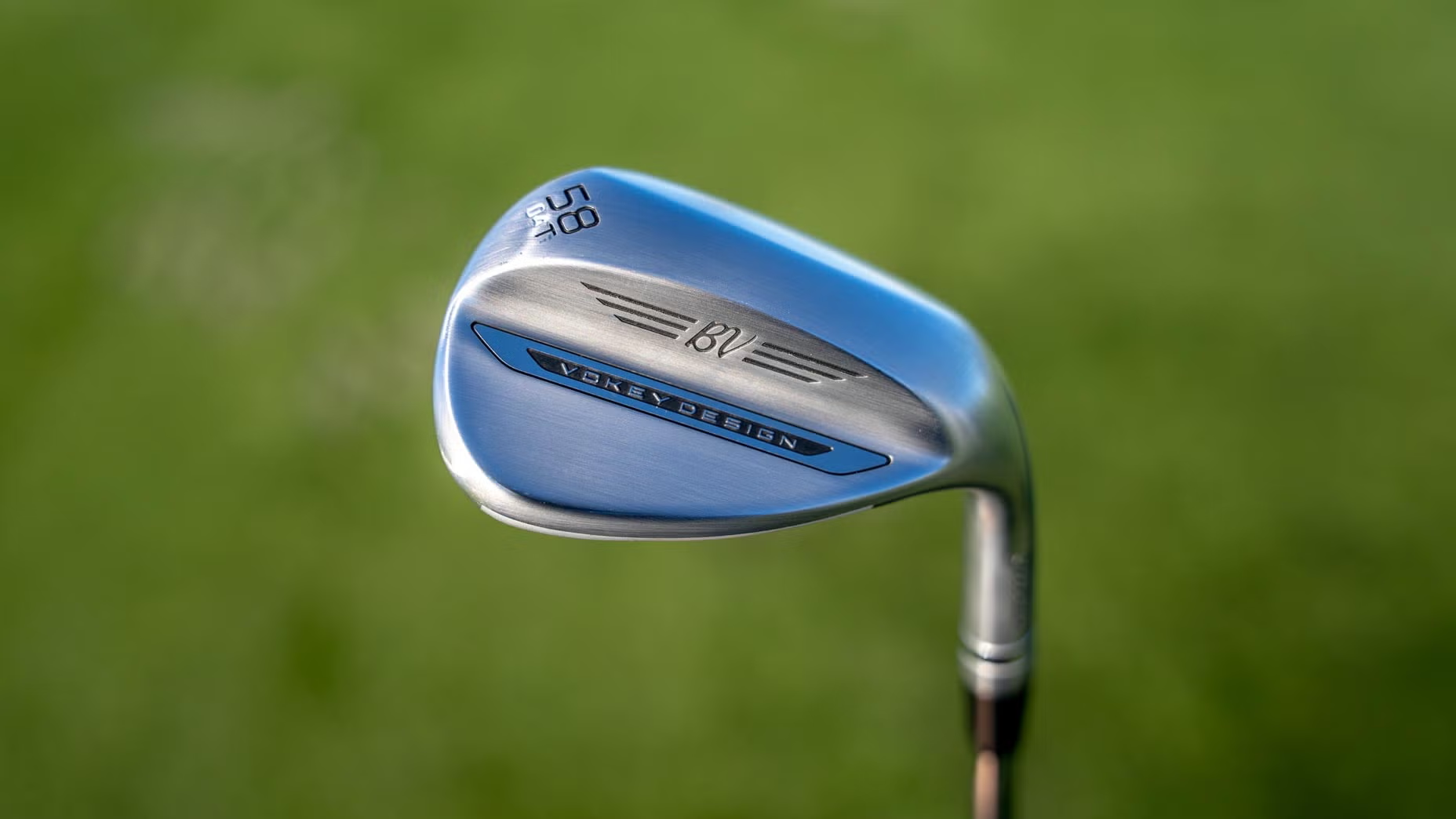
While the putter conversation dominated social media, there was equally fascinating technical chess happening with wedges this week. The wet Kikuyu grass at Riviera created conditions that only appear twice annually on the PGA Tour, and the Vokey team’s analysis of how to navigate it reveals something important about modern tour golf: marginal gains now require boutique expertise.
"Kikuyu grass and a little bit of added moisture can make golf really tricky. You’re not only adding this water in this poor weather that will influence spin, but you’re also moving strikes around the face because of that added moisture." — Aaron Dill, Vokey Tour Representative
The challenge Dill describes is elegant in its complexity. The stiff, crosshatching growth pattern of Kikuyu grass sits the ball up unnaturally high, especially when moisture is involved. On tour, that’s a problem. These players need to strike the ball on specific grooves—ideally numbers 2 through 5—to generate the lower launch and higher spin they demand around greens. Teed-up lies push strikes higher, and that cascades into everything: less speed, less spin, higher launch. Disaster.
The solution required subtle sole adjustments. Most players gravitated toward testing wider options without fully committing. Only Marco Penge made an actual switch, moving from a narrow .04T-grind to a K*-grind. And yes, he opened with a strong round—though correlation isn’t causation in a single event.
What fascinated me was how differently this played out compared to driver fitting. Wedge adjustments are delicate, calculated decisions. Driver changes are sometimes dramatic swings between polar opposite settings. In my experience, that’s where you see the real technical expertise separate from marketing noise. The Vokey team’s framework—nudging T-grind players toward M-grinds, then potentially to wider K* options if spin became elusive—represents tour-level problem-solving.
The Spider’s Quiet Conquest
One final observation: TaylorMade’s Spider putter line continues its methodical conquest of the tour. When Scottie Scheffler switched to the Spider Tour X, it was headline news. Now? McNealy’s switch barely registered. That’s how completely the mallet has normalized at the highest level.
The equipment landscape is shifting in real time, and while it might seem like just another week of marginal tweaks, what we’re really watching is the professionalization of every decision on tour. Blades aren’t disappearing because they’re bad—they’re disappearing because mallets are measurably consistent, and in modern professional golf, consistency beats everything.
Even tradition.
