


TGL’s First Full Season Proves the Format Works—But Questions Remain About Tour Sustainability
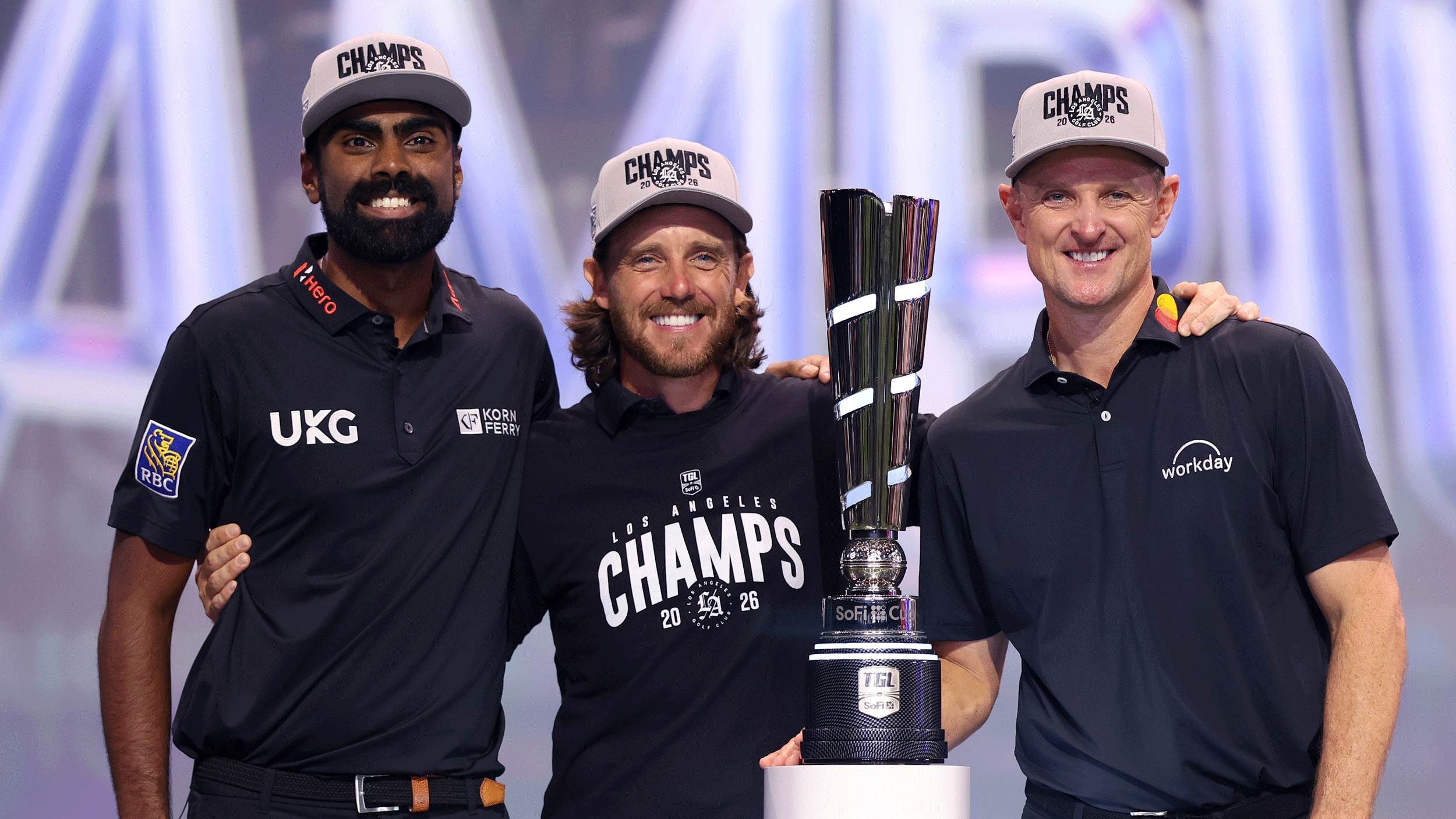
Los Angeles Golf Club’s dominant 2-0 sweep over Jupiter Links in the TGL Finals tells us something important that goes beyond simulator golf: this format is legitimately compelling, and the sport’s power players believe in it enough to show up and compete hard.
Having spent 35 years around professional golf—from caddying for Tom Lehman through countless Masters and beyond—I’ve watched this game resist change like a five-handicapper resists a swing coach. The fact that TGL completed its first full season without the usual hand-wringing about “gimmick golf” or “not real competition” speaks volumes.
But here’s what strikes me most about LA’s championship run: this wasn’t some lightning-in-a-bottle story. These guys were dominant all season, losing only two matches with a squad that included Tommy Fleetwood, Justin Rose, Sahith Theegala, and Collin Morikawa. That’s a four-player roster that could compete in any format, anywhere. They came in as the No. 2 seed behind Rory McIlroy’s Boston Common, then methodically dismantled Atlanta Drive in the semis before “comfortably closed out the best-of-three-match Finals thanks to a gutsy 6-5 win in match one on Monday followed by a remarkable 9-2 success on Tuesday.”
That 9-2 drubbing on Tuesday? That’s not simulator theater. That’s domination.
The Tiger Factor—And What It Reveals
Now, about that Jupiter Links roster. They brought in Tiger Woods for match two—a move that screams desperation and also reveals something fascinating about TGL’s current standing in professional golf. Here’s a 15-time major champion being deployed like a relief pitcher in the Finals because his team needed a spark.
Look, I respect Tiger’s competitive fire as much as anyone. But “even the 15-time Major winner could not help the No.4 seed turn things around.” The fact that LA’s team responded by reeling off three consecutive eagles—including after Tiger missed a three-foot putt on the seventh—tells me the gap between these teams was just too large.
What I found more interesting than Tiger’s participation was the prize money attached to it. Jupiter Links took home $4.5 million as runners-up, which breaks down to $1.125 million per player. That’s not chump change, but consider the full picture:
| Position | Team (Players) | Prize Money (Per Golfer) |
|---|---|---|
| 1st | Los Angeles (Tommy Fleetwood, Justin Rose, Sahith Theegala, Collin Morikawa) | $2.25 million |
| 2nd | Jupiter Links (Tiger Woods, Max Homa, Kevin Kisner, Tom Kim) | $1.125 million |
| 3rd | Boston Common (Rory McIlroy, Keegan Bradley, Hideki Matsuyama, Adam Scott) | $562,500 |
| 4th | Atlanta Drive (Billy Horschel, Justin Thomas, Patrick Cantlay, Lucas Glover) | $500,000 |
| 5th | The Bay (Ludvig Aberg, Wyndham Clark, Min Woo Lee, Shane Lowry) | $437,500 |
| 6th | New York (Rickie Fowler, Xander Schauffele, Cameron Young, Matt fitzpatrick) | $375,000 |
Even sixth place is collecting $375,000 per player. That’s a real incentive structure.
What This Means for the Broader Tour
In my three decades covering professional golf, I’ve learned that formats succeed when three things happen: genuine competition, compelling viewing, and meaningful stakes. TGL appears to have all three.
But here’s the tension I see: TGL is explicitly positioned as a complement to the PGA Tour, not a replacement. The simulator format, the team structure, the league-style presentation—it’s all designed to be different enough to attract viewers who might not tune in for stroke play at Torrey Pines. And the fact that a player like Rory McIlroy is buying in, that top 40 players showed up to compete, suggests the ecosystem is finding equilibrium.
That said, I think the more important story isn’t who won TGL this year. It’s that the format didn’t collapse under its own novelty. Six teams completed a full season. Matches were competitive. Boston Common’s squad—featuring McIlroy, Keegan Bradley, Hideki Matsuyama, and Adam Scott—finished third despite being the regular-season No. 1 seed, which tells me parity exists and upsets happen. That’s healthy for any league.
The counterargument, which I hear in the clubhouse, goes something like this: Aren’t we fragmenting professional golf into too many formats? LIV, the PGA Tour, DP World Tour, now TGL? In my experience, players can handle multiple formats as long as the money and exposure justify the time commitment. TGL requires a limited time investment compared to tour events, and the per-player prize money is substantial.
The Real Test Ahead
What matters next is ratings and sustaining interest beyond Year One. LA’s victory was convincing. Their consistency all season was real. But does a general sports audience care deeply about simulator golf between now and the Masters?
I think it does, provided the presentation stays sharp and the competition remains genuine. Having caddied and covered this game for so long, I can tell you that fans ultimately want to see great players competing for real stakes. TGL delivers that—just in an unconventional venue.
Los Angeles Golf Club earned their $2.25 million per player. They were the best team all season and closed it out with authority. That’s not a story about gimmicks. That’s a story about professional excellence in a new format.
Whether TGL becomes a permanent part of the golf calendar depends on whether it can repeat this level of engagement. Based on year one, I’d say the odds are better than I expected.
