

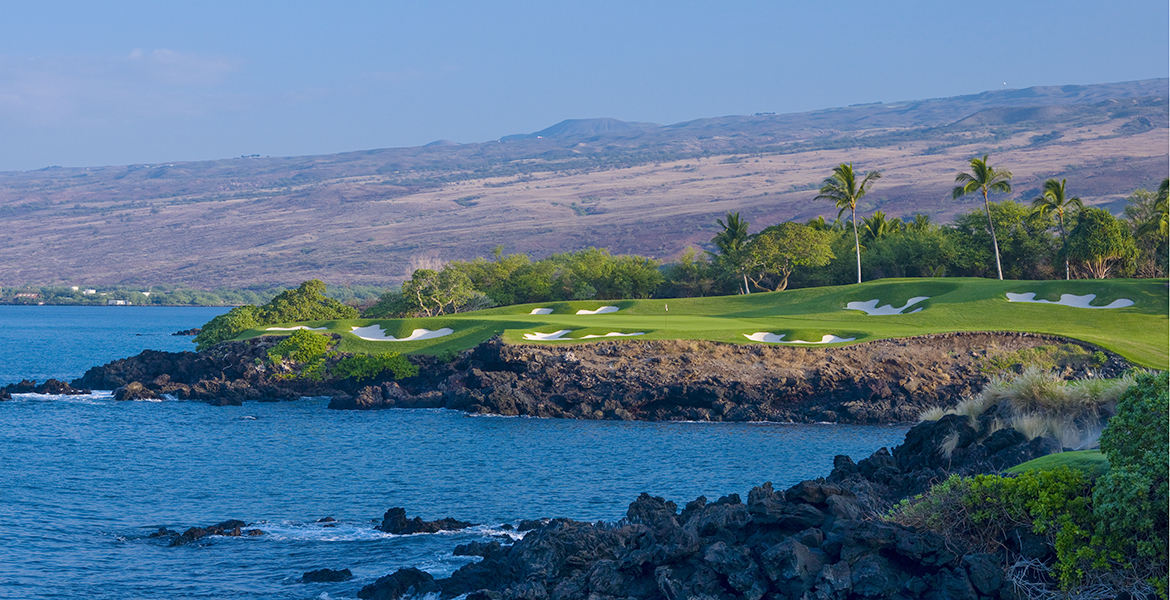

The Big Island of Hawaii stirs something primal in a golfer’s soul – a raw encounter with nature’s grandeur, shaped by eons of volcanic might. And nowhere is this more profoundly felt than at Mauna Kea Golf Course, a Robert Trent Jones Sr. masterpiece etched into the stark, beautiful canvas of cooled lava. I’ve been fortunate enough to walk fairways across continents, from the heaving links of the British Isles to the pine-studded tracks of the American South. Yet, Mauna Kea possesses a singular allure, a testament to audacious vision and the triumph of design over seemingly impossible terrain.
My first glimpse of Mauna Kea wasn’t from the air, like Laurance Rockefeller’s fateful flight, but from the ground, driving up the resort’s winding entrance. The rich, verdant fairways cut a striking contrast against the dark, jagged lava fields and the azure Pacific. It’s hard to imagine that this golf oasis was once considered an insurmountable challenge, a barren expanse of volcanic rock. The story of its creation, particularly the audacious engineering feats, is as compelling as any legendary match.
Picture this: a powerful visionary in Rockefeller, and the era’s preeminent architect, Jones Sr., surveying a landscape that practically screamed “no golf here!” It was a leap of faith, a true “aha” moment for Hawaiian golf, spurred by a rudimentary, yet brilliant, test.
“Dad picked up two lava stones and pummeled them together. They fractured. The pieces crumbled and fell to the ground.”
Bobby Jones Jr. recounts this pivotal moment, where his father’s pragmatism unlocked a dream. That simple act proved that the seemingly unyielding lava could be transformed. And transform it they did, inventing a ribbed roller to crush the volcanic rock into a talcum-fine red dust, mixing it with coral sand, and laying the foundation for arguably the cleanest, weed-free turf in golf history.
The Architecture: Drama and Strategic Genius
Trent Jones Sr. was a master of “heroic” architecture, and Mauna Kea is a textbook example. He believed in providing a clear challenge, options for the bold, and rewards for the well-executed shot. With 300 feet of elevation changes at his disposal, he artfully draped holes across the rolling lava flows. You feel the strategic rhythm woven into the routing: seven holes bending left, six bending right, creating a constant demand for shot shaping. Eight greens are perched, often well-bunkered, demanding precise aerial approaches – a design hallmark that truly shines in a place where the wind is a constant, unpredictable companion.
But let’s be honest, while the entire course is a triumph, it’s the par-three 3rd hole that forever etched Mauna Kea into the pantheon of golf. Jones Sr. himself called it his “gem among eighteen jewels,” a fitting descriptor for a hole that has launched a thousand postcards and countless golf fantasies.
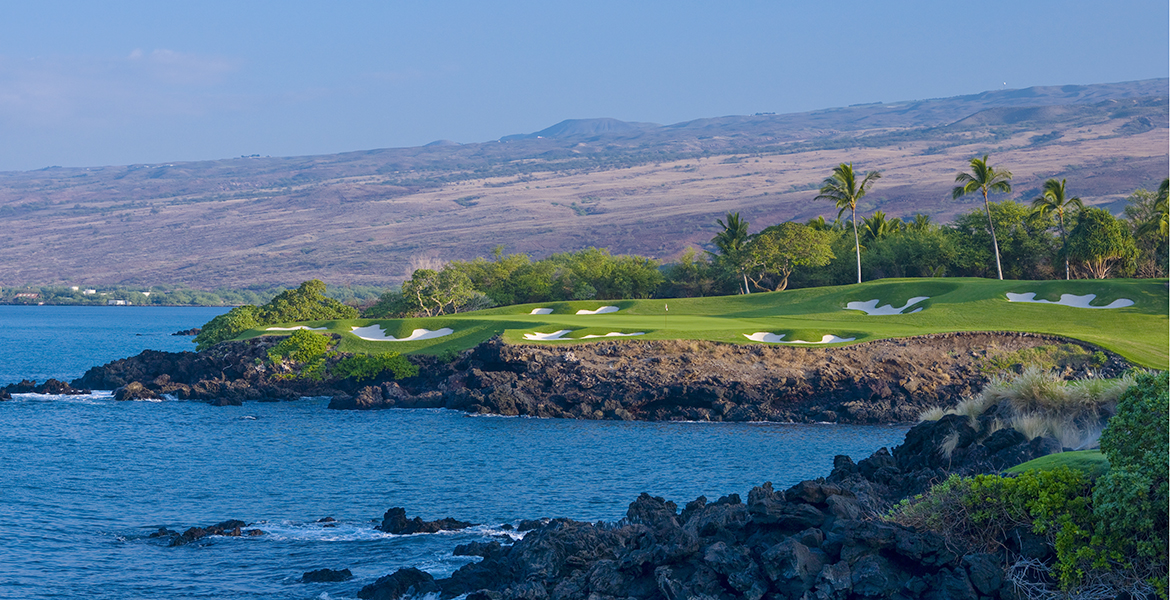
Standing on that original back tee, carved into 5,000-year-old lava rock, staring across the frothing Pacific toward a gargantuan, kidney-shaped green, is an experience that transcends golf. The carry, originally 250 yards, now stretching to 272, is a visceral challenge. The salt spray on your lips, the roar of the surf below, the wind whipping at your hat – it’s pure, unadulterated drama. As Bobby Jones Jr. so aptly put it:
“My dad was into drama. When he saw the two rock outcroppings, he routed the golf course to get to that. Any architect would kill for that site. It’s one of the iconic holes in the game.”
This isn’t just a long par-three; it’s a masterclass in risk-reward. The green, generously sized, offers a safe landing for a well-struck shot, but anything short, offline, or misjudged by the omnipresent wind is swallowed by the ocean or the deep bunkers guarding its flanks. It’s a hole that forces you to commit, to trust your swing, and to embrace the spectacle.
A Legacy Forged in Lava
The opening of Mauna Kea in December 1964 was heralded by golf royalty: Arnold Palmer, Jack Nicklaus, and Gary Player facing off in a “Big Three” event. The edited match, airing nationwide, cemented Mauna Kea’s legend, particularly the buzz around the 3rd hole. Imagine the awe these legends must have felt, standing where we stand today, gazing out at that impossible shot. Player himself, years later, confessed:
“Many of my fondest memories from Mauna Kea are of playing the beautiful par-three hole over the ocean. I had never seen anything like that before.”
And indeed, no one had. Mauna Kea wasn’t just a golf course; it was an architectural pioneering venture, a statement that golf could embrace, rather than merely tame, the most challenging natural landscapes.
Playing the Dream
For those considering a pilgrimage to this Hawaiian gem, Mauna Kea remains as accessible as it is iconic. It’s located on the Kohala Coast of the Big Island, part of the exquisite Mauna Kea Resort. Guests of the hotel enjoy preferential tee times, though it’s open to the public. Be sure to book in advance, especially during peak season. The conditions are typically immaculate, a testament to the continued dedication to Jones Sr.’s original vision, even after a sensitive renovation by Robert Trent Jones II that enhanced vistas without sacrificing the original drama.
Prepare for wind; it’s a constant factor and beautifully integrated into the strategic demands of the course. While the 3rd hole garners all the fame, the entire round is a journey through diverse demands. You’ll encounter downhill tee shots that stretch for miles, uphill approaches that test your club selection, and greens that subtly repel the timid. Embrace the grandeur, let the ocean breeze be your caddie, and marvel at a course that truly is in a league of its own, a testament to pure, unadulterated architectural brilliance carved from the raw power of the earth.
