


When Bad Luck Meets Bad Timing: What the Phoenix Open Chair Incident Really Tells Us About Professional Golf
I’ve been covering professional golf for 35 years, and I’ve seen just about every way a tournament can be decided—the dramatic putt, the clutch iron shot, the opponent’s collapse. But I’ll be honest: I’ve never quite seen anything like what happened at TPC Scottsdale last week. And what strikes me most isn’t the mishap itself—it’s what it reveals about where we are as a sport.
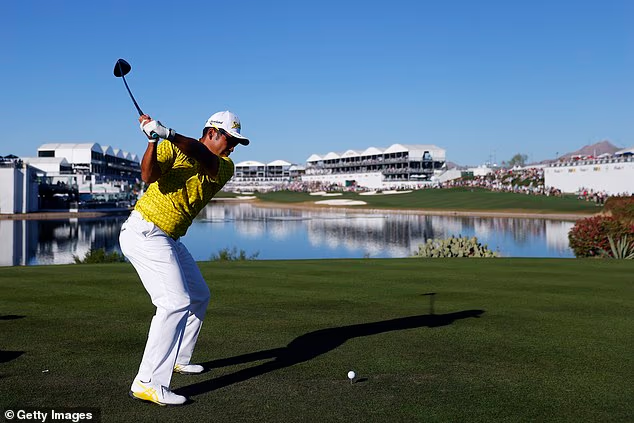
For those who missed it, Hideki Matsuyama’s playoff loss to Chris Gotterup at the WM Phoenix Open came down to a moment that no amount of skill, preparation, or mental fortitude could have prevented. As Matsuyama addressed his tee shot on the 19th hole playoff, a security guard stationed near the tee box dropped a chair. The metallic clang interrupted his swing at the worst possible moment.
“Just as he started his backswing, a loud metallic clang rang out near the tee box. Matsuyama managed to stop his swing just in time, but it caused onlookers to whip their heads around to see what happened.”
Now, here’s the thing that professional golfers deal with constantly—distractions. Fans coughing, cameras clicking, even the occasional heckler. Most of the time, the best players in the world simply tune it out. They’ve trained their minds to block out noise and focus on the shot. But there’s a difference between ambient crowd noise and a loud, unexpected metallic crash at the exact moment your club is moving. That’s not a distraction; that’s a violation of the reasonable expectation of play.
What happened next is where the real story lies. After composing himself, Matsuyama took his second attempt at the shot—and found the water. Gotterup, meanwhile, remained unfazed and sank a 27-foot birdie putt to clinch his fourth PGA Tour victory and a $1.7 million payday.
The Cascading Effect of One Moment
In my years as a caddie for Tom Lehman back in the ’90s, I learned something fundamental about tournament golf: momentum is real, but so is mental recovery. The question I keep asking myself is whether Matsuyama’s second shot was truly affected by the guard’s mistake, or whether the psychological wound had already done the damage.
“After composing himself and swinging again, Matsuyama pulled his tee shot to the left—careening off a pole and into the water.”
Think about what just happened to him. You’re tied for one of the biggest wins of the year. You’ve fought off Scottie Scheffler and Michael Thorbjornsen. You’re one good tee shot away from possibly claiming your second major-caliber victory. Then, in an instant, something completely beyond your control disrupts your focus. Yes, Matsuyama had to take another swing. But can we really separate that second attempt from what came before it?
I don’t think so. And neither should the PGA Tour.
The Broader Picture: Security, Standards, and the Tour’s Responsibility
What troubles me more than the incident itself is what it says about operational standards on tour. The PGA Tour has spent decades—rightfully so—professionalizing every aspect of tournament golf. We’ve got rules officials positioned strategically around courses, caddies schooled in etiquette and procedure, galleries managed with precision. Yet somehow, a security guard can still drop a chair during the most critical moment of a major playoff.
This isn’t about assigning blame to an individual. Security personnel work grueling hours in challenging conditions. I’m sure that guard felt absolutely terrible about what happened. But here’s what matters: the tour’s infrastructure should be designed to prevent such moments from occurring in the first place, especially during playoff situations.
In my three decades covering the tour, I’ve watched the sport evolve dramatically. We’ve introduced the playoff format itself, refined television coverage, enhanced fan experience. But we haven’t adequately addressed the intersection of crowd management and player protection during the highest-stakes moments.
The Stats That Tell the Story
Let’s look at Matsuyama’s recent track record. A former Masters champion, he hadn’t recorded a victory since The Sentry at Kapalua in January 2025—a full calendar year drought in a sport where consistency matters. This loss marks his second playoff defeat, his first since falling to Abraham Ancer at the WGC-Fedex St Jude Invitational back in 2021. Across his career, Matsuyama carries a 4-2 playoff record, including two Phoenix Open victories in 2016 and 2017.
The numbers suggest a player capable of performing under pressure. A player who has won playoffs before. A player who was playing his best golf when it mattered most.
Gotterup, on the other hand, is clearly on the rise. His fourth career PGA Tour victory, his second of the 2026 season following his Sony Open triumph in Hawaii, suggests a young player hitting his stride. There’s nothing controversial about his victory itself—the guy made a 27-foot birdie putt when it counted. That’s championship golf.
Moving Forward
What I appreciate about the PGA Tour is its commitment to continuous improvement. Yes, this incident happened. Yes, it cost Matsuyama millions of dollars and a significant tournament victory. But the tour will learn from it. Security protocols will be reviewed and tightened. Standards will be refined.
That’s not me being optimistic—that’s me speaking from experience. I’ve watched this tour adapt and improve for 35 years. This is an organization that cares about the integrity of competition.
For Matsuyama, the immediate disappointment will sting. But his resume speaks for itself, and there will be other opportunities. For Gotterup, the path forward is clear: continue the momentum and prove this victory was the beginning of something special, not a one-off.
As for that security guard? Let’s hope they got a cup of coffee after their shift and didn’t dwell too much on what happened. We’ve all made mistakes under pressure. Theirs just happened to have a $1.7 million audience.
