

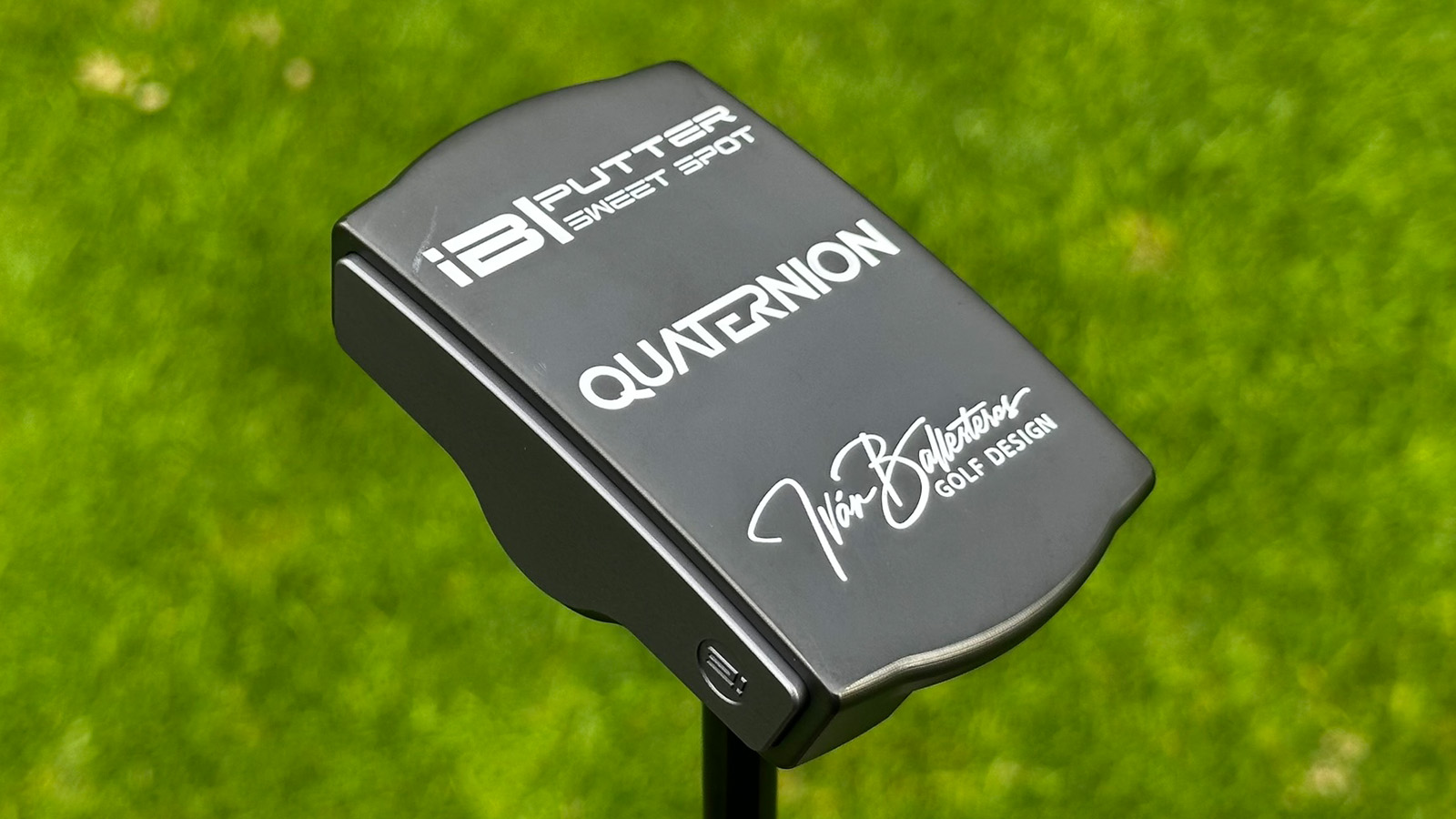

Alright, let’s talk putters. Specifically, the IB Sweet Spot Quaternion. I’ve seen my share of “revolutionary” putter designs come across my desk at The Daily Duffer, and most of them end up being more gimmick than game-changer. But when the original IB Sweet Spot putter landed, it genuinely piqued my interest. Not because it promised magic, but because it promised something far more valuable: a brutal, unforgiving lesson in striking the ball dead center.
My first experience with the original IB Sweet Spot was eye-opening. It was a miniscule mallet, barely bigger than a golf ball itself. There was no hiding a mishit. The data on the launch monitor was instant and stark – any deviation from the sweet spot led to a dramatic drop-off in ball speed and inconsistent roll. It wasn’t designed for forgiveness; it was designed for feedback.
“It forces you to lock in on your stroke and concentrate purely on finding the middle of the face to get a solid roll.”
And it did exactly that. For me, and for the handful of golfers I introduced it to during fittings, it was a potent training tool. So, when the IB Sweet Spot Quaternion arrived, I was eager to get it on the green and dissect its performance.
IB Sweet Spot Quaternion Putter
(Image credit: Future)
Design and First Impressions: A Step Into The Void?
The Quaternion definitely looks different. The article notes it “evolves into something that looks like it belongs in space,” and I can’t disagree. It’s certainly visually striking, and while aesthetics are subjective, the compact head design is its most defining characteristic. Much like the original, this putter screams “precision required.”
The immediate observation, confirmed by my time with it, is the sheer lack of mass compared to modern high-MOI mallets. What does that mean for you? Less mass means less resistance to twisting on off-center strikes. While the design aims for zero torque mechanically, in practical terms, a mishit is going to lose more energy and deviate more offline than with a larger, perimeter-weighted putter. The marketing speaks to its “zero-torque DNA,” and structurally, a perfectly symmetrical, center-shafted design does minimize torque, but the laws of physics around mass and MOI still apply. This is where the rubber meets the road between theoretical design and on-green performance.
I found the alignment aids to be well-executed, particularly on shorter putts. They offer a strong visual confirmation of your line, which is critical when a smaller head can make aiming feel less stable. However, and this mirrors the reviewer’s sentiment,
“when hitting putts from range, I’d be lying if I said I didn’t think I was going to miss the ball a couple of times.”
That’s the mental game at play when you’re looking down at such a compact footprint. Confidence is paramount in putting, and for many, a putter that looks like it demands perfection can be intimidating.
(Image credit: Future)
Performance: Feedback Over Forgiveness
On the putting green, connected to my Quintic Ball Roll system, the Quaternion delivered a fascinating dataset. When struck perfectly from the center, the ball speed consistency was excellent. The crisp, responsive feel translated to a pure roll with minimal skid, assuming ideal impact. The “zero torque through impact” claim holds true for perfectly struck putts, where the center of percussion aligns with the center of gravity. This stability at impact for ideal strikes is genuinely impressive for a putter of its size.
However, the moment you deviate, even slightly, the data tells a different story. Off-center strikes, particularly heel or toe hits, showed a noticeable drop in ball speed and an increase in side spin – far more pronounced than what I’d see from a high-MOI mallet like a Scotty Cameron Phantom X or even a bladed putter with significant perimeter weighting. The initial reviewer notes,
“the performance was very much a mixed bag. It actually feels nice off the face, offering a crisp, responsive pop that provides excellent feedback on strike quality.”
This is precisely it. The feedback is fantastic – you *know* immediately when you’ve missed the sweet spot. But that feedback comes at the cost of forgiveness that most golfers, even very good ones, rely on.
IB Sweet Spot Quaternion Putter at address
(Image credit: Future)
The Milling Question: A Missed Opportunity?
One detail that immediately jumped out to me, and which the article also highlights, is the lack of face milling.
“But it is interesting how there is no milling on this face to help with the roll or improve sound.”
This is a critical point in modern putter design. Face milling or inserts (like those from Odyssey, PXG, or Scotty Cameron) are not just for aesthetics; they are engineered to control skid, promote immediate forward roll, and optimize feel and sound. The data consistently shows putters with specific face technologies generate a more consistent launch and roll profile, even on putts struck slightly off-center.
The Quaternion relies entirely on a perfectly square impact and pendulum stroke. While its design does promote this, omitting face technology feels like leaving performance on the table. A precisely engineered mill pattern could have mitigated some of the speed loss and directional inconsistency on minor mishits, without compromising the fundamental “sweet spot” philosophy. This isn’t marketing fluff; it’s tangible performance benefit seen across countless launch monitor sessions.
The face of the IB Sweet Spot Quaternion Putter
(Image credit: Future)
Who Is This Putter For?
This is where the rubber meets the road. After testing it extensively on the launch monitor and on various green speeds, I’ve concluded that the Quaternion is not for everyone. In fact, it’s for a very specific type of golfer:
- The dedicated practice enthusiast: If you love working on your stroke and crave instant, undeniable feedback, this is an excellent training aid. The small face, coupled with its zero-torque properties for perfect strikes, really does force you to engage your core putting mechanics.
- The low-handicap golfer with an ultra-consistent stroke: If your stroke is already so good that you rarely miss the sweet spot, the Quaternion could offer a uniquely stable and tactile experience. For these players, the “zero torque” aspect minimizes face rotation through impact, potentially leading to a fractionally straighter roll on perfectly weighted putts. Emphasis on “perfectly weighted.”
- The “brave few willing to embrace the zero-torque revolution”: The reviewer summed it up well. It’s an investment for someone genuinely committed to the philosophy.
For the majority of golfers – say, anyone above a 10 handicap – I’d be hesitant to put this in their bag as their primary gamer. My fitting experience tells me that most amateur golfers benefit significantly from the stability and forgiveness offered by higher MOI putters. The slight deviations that are inevitable even for good players are far more punishing with the Quaternion. The lack of milling also means less consistent roll on imperfect strikes.
The leather grip on the IB Sweet Spot Quaternion Putter
(Image credit: Future)
The Price Point: Value Proposition
At £349, it’s a significant investment. For that money, you can get a top-of-the-line putter from any major brand, complete with advanced face technology, high MOI designs, and proven performance on tour and in fittings. The Quaternion is undoubtedly a niche product. If you’re buying it solely as a primary gamer hoping for instant improvement without putting in the work, you’ll likely be disappointed. If you view it as a high-end training aid that can occasionally double as a gamer on days when your stroke feels dialed in, the value proposition changes.
Ultimately, the IB Sweet Spot Quaternion takes the core philosophy of its predecessor – forcing pure strikes – and attempts to package it into a more “playable” design. It’s an objectively well-made, physics-driven piece of equipment. My data shows it delivers on its promise of minimizing face rotation on perfect strikes. But the reality is that “perfect strikes” are rare for most golfers, and the lack of forgiveness on off-center hits, coupled with the absence of modern face technology, makes it a highly specialized tool. It might be a potent secret weapon for the dedicated purist, but for most, there are more forgiving, equally effective options available for less, or comparable money, that offer broader appeal and more consistent performance across the board.
