

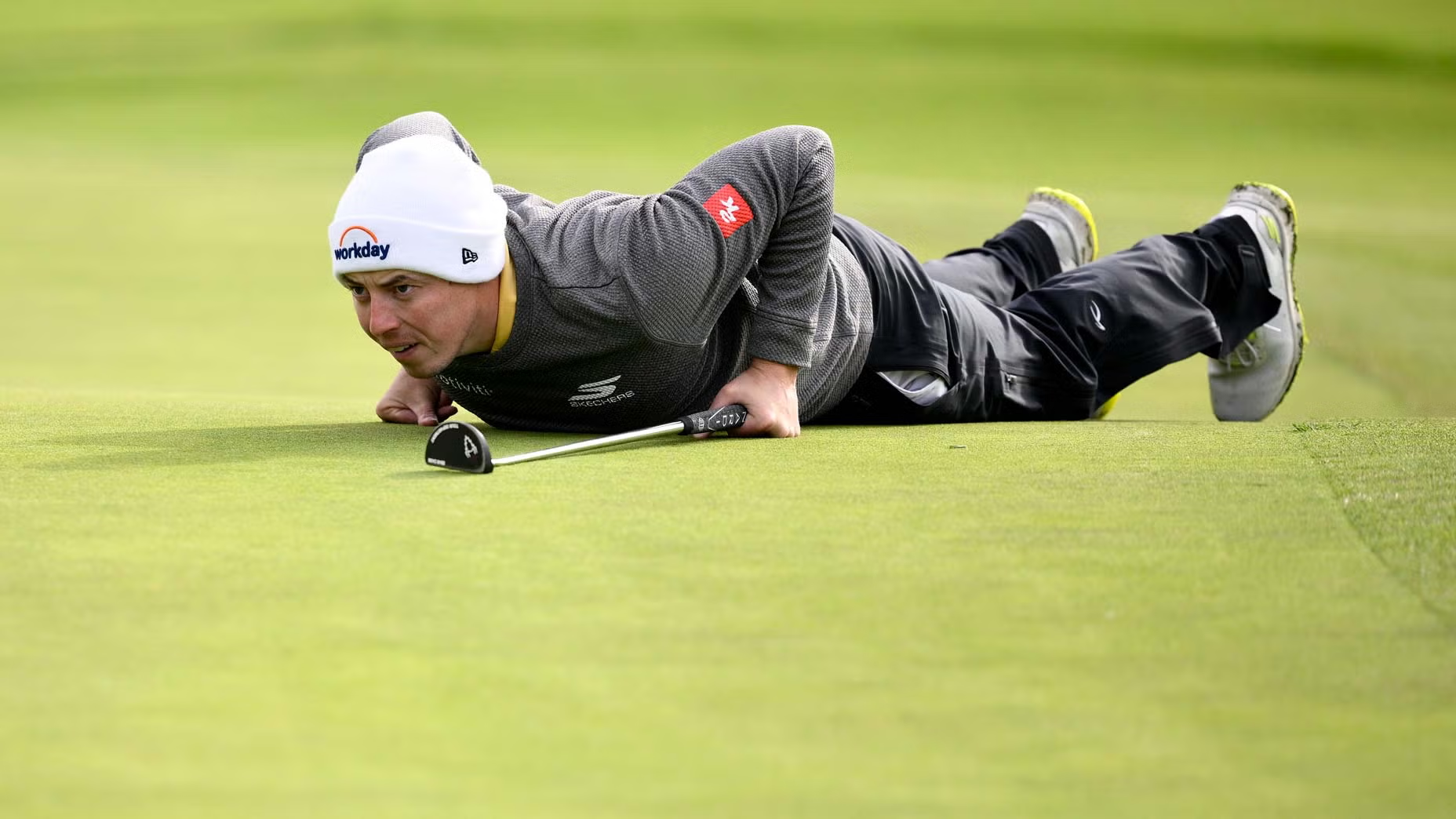

Riviera’s Poa Annua Puzzle: When Perfect Greens Become the Perfect Villain
I’ve walked these grounds at Riviera Country Club more times than I care to count—fifteen Masters under my belt doesn’t prepare you for how deceptive a coastal California course can be in February. But watching Xander Schauffele miss a two-foot-seven par putt on 16 this week reminded me of something I learned decades ago as Tom Lehman’s caddie: sometimes the best-maintained golf course in America becomes your worst enemy, not because it’s poorly conditioned, but because it’s too well-conditioned.
What we’re witnessing here isn’t a putting crisis born of neglect. It’s the opposite problem entirely—a crisis born of perfection colliding with nature, and it’s telling us something important about how we’ve engineered professional golf.
The Data Doesn’t Lie
Let’s start with the numbers, because they paint a vivid picture. Over the last five years at Riviera, professionals three-putt more regularly and make fewer putts from every distance compared to tour averages. The gap is significant:
- 4-8 feet: Tour average 69.2% | Riviera 65.6%
- Outside 25 feet: Tour three-putt average 8.9% | Riviera 11%+
That’s not a rounding error. That’s a structural problem. And here’s what strikes me as the real story: despite these putting woes, we’re still seeing historically low scoring. Jacob Bridgeman’s 19-under through three rounds would’ve been unimaginable a decade ago. So the course is giving with one hand (generous approach shot opportunities) while taking with the other (maddening putting surfaces).
When Poa Annua Becomes Public Enemy Number One
I’ll be honest—I don’t envy the agronomists who maintain Riviera’s greens. Poa annua is a beautiful, fine-textured grass that looks immaculate on television. It also has a mind of its own.
“The greens here have so much pitch, and as the day goes on, the greens continue to hold speed and they stay fast and they continue to get bumpier and bumpier just with the nature of poa annua … the greens are getting softer and they’re fast, which I think is a really good challenge. It’s kind of underrated how hard that is.”
That’s Scottie Scheffler talking, and he’s being diplomatic. What he’s really describing is a phenomenon I’ve seen haunting poa courses for years—the “waffle-iron effect” where afternoon play becomes progressively bumpier despite immaculate conditioning. Add in this week’s rain, which has softened the surfaces while paradoxically keeping them fast, and you’ve got a putting puzzle that even the best in the world can’t solve consistently.
Rory McIlroy’s analysis was more pointed. After missing a four-footer on 17, he described the exact bind that makes poa so treacherous:
“They’re hard because you don’t want to hit [putts] too hard obviously, and then the softer you hit them, the more break they’re going to take early. There’s a lot of double breakers here, so my putt on 16 today was a great example. I had to hit it really soft. It was left to right early but the last half of the putt was right to left, but it went so far right early because I hit it so soft, it never had a chance to come back. It’s, yeah, it’s tough.”
That’s a professional golfer describing an essentially unwinnable scenario. Too soft and the early break carries the ball offline. Too firm and you roll through the break entirely. It’s the putting equivalent of threading a needle in the dark.
The Character Test
What fascinates me most is how differently players have responded. Jacob Bridgeman, the tournament leader and—remarkably—the statistical putting leader despite these conditions, has figured something out that most haven’t. His comment is worth parsing carefully:
“In the past I’ve really struggled on poa. For whatever reason, I didn’t like it, didn’t really know what to do. I think I’ve accepted now that some of them are going to bump out. Like mine on the last hole, I hit a good putt, it just bumped left and it didn’t go in. I think in the past I would get kind of frustrated with that and that would kind of inch over into my stroke and play.”
Bridgeman’s discovered what took me years to learn as a caddie: acceptance is half the battle. You can’t control whether a poa green has a spike mark or an imperceptible undulation that deflects your three-footer. You can only control whether you let it destroy your confidence. He’s made mid-round adjustments, trusted his process, and refused to let the surface defeat his mindset. That’s not lucky. That’s championship-caliber golf.
The Bigger Picture
In my thirty-five years covering this tour, I’ve noticed we’ve swung the pendulum pretty far in both directions—from courses that were too firm and fast in the ’90s to courses that are now, in some cases, almost too friendly to approach play while punishing anything remotely resembling a miss on the greens. Riviera this week is the clearest example I’ve seen of that tension.
The good news? These are still the best putters in the world, and they’re still making plenty of putts. The low scoring proves it. The better news is that Riviera’s challenge isn’t a flaw—it’s a feature. It’s separating those who can manage their emotions and accept the variables from those who can’t. That’s golf at its most honest.
Just ask Xander. That two-footer probably stings less today than his response to it will define his tournament tomorrow.
