

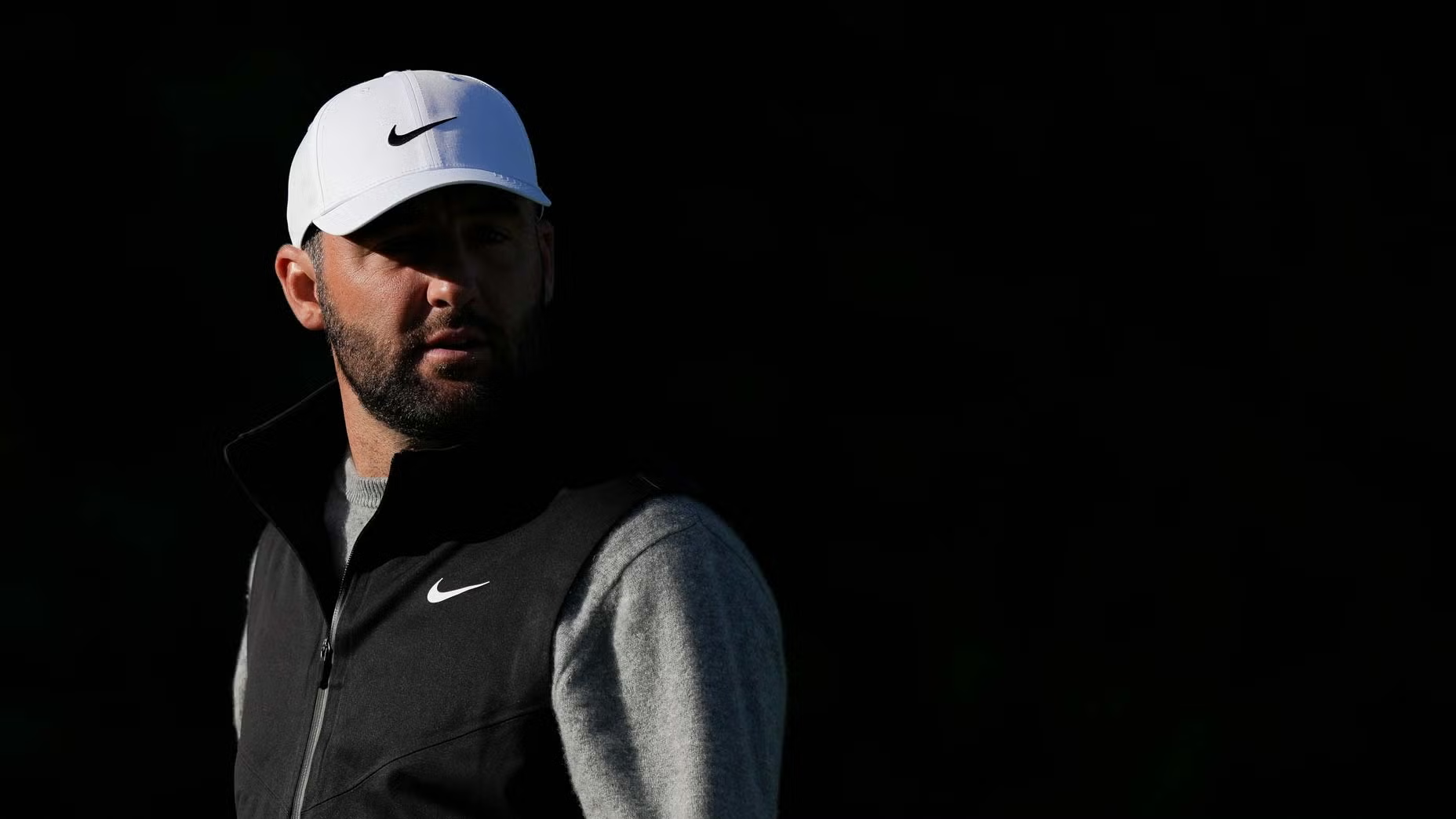

The Scheffler Paradox: Why Last Place Has Never Looked So Good
By James "Jimmy" Caldwell, Senior Tour Correspondent
I’ve been covering professional golf since the late ’80s, and I’ve learned that there’s rarely a straight line from point A to point B in this game. But what unfolded at Riviera this week might be the most instructive non-victory I’ve witnessed in years—and that includes plenty of dramatic comebacks.
Here’s what struck me watching Scottie Scheffler claw his way from dead last to making the cut: we’re watching the emergence of a player so fundamentally sound that even his struggles are becoming a form of mastery.
Let me explain what I mean.
The Thursday Problem That Isn’t Really a Problem
When I arrived at Riviera early Friday morning—bundled up like the rest of the hardy souls willing to brave 42-degree weather—I came with the same question everyone else was asking: What the hell is Scottie Scheffler doing in last place? It seemed antithetical to everything we know about the World No. 1.
But here’s where experience matters. In my three decades around this tour, I’ve learned that Thursday struggles, when followed by the right player, are often just noise. The real story isn’t that Scheffler shot 74 in round one. The real story is what came next.
"I may not be, like, the flashiest player, but I feel like my mind has always been my greatest tool, and I just try to use that to my advantage."
That quote, from his Tuesday presser, is the throughline for everything that happened over the next 36 hours.
A Pattern Worth Watching
What actually concerns me—in a fascinating way—is that this has become a pattern. Starting the WM Phoenix Open with a 73. Opening Pebble Beach with a 72. Now a 74 at Riviera. Three consecutive tournaments where Scheffler has dug himself into a hole on Friday morning, only to storm back with rounds of 65-67-64 at Scottsdale and 66-67-63 at Pebble Beach.
The man finished one shot out of a playoff at both events.
I’ve caddied alongside some of the best, and I’ve covered others who dominated their eras. But this particular skill set—the ability to systematically dismantle a golf course once you’ve decided it’s time—is reminiscent of what we saw from Tiger in his prime. It’s not about never making mistakes. It’s about responding to mistakes with a clarity that most players simply don’t possess.
When Scheffler dropped his driver on the eighth tee Friday afternoon, clearly apoplectic after another left miss, I thought we might be witnessing the unraveling. Instead, we witnessed what happens when frustration becomes fuel. According to my notes, he played the next eight holes in two under par—essentially perfect golf.
The Streak Nobody Talks About
Here’s the statistic that should be getting more attention: Scheffler hasn’t missed a cut since summer 2022. In an era where cut-making has gotten easier with no-cut events and smaller fields, that’s still remarkable. But what’s even more impressive is his streak of 19 consecutive finishes of T8 or better.
Think about that. Nineteen consecutive top-eight finishes. That’s not luck. That’s not flash. That’s a commitment to commitment—to borrow a phrase from Tiger’s playbook.
"He stormed his way to the eighth tee and collapsed into a chair in frustration. Then he fired his tee shot well left, repeating a left miss he battled all day. As the ball soared off line, Scheffler dropped his driver on follow-through, apoplectic. That’s a Scheffler hallmark: he’s so used to things going right that he can’t believe it when they don’t."
What strikes me about that moment is how honest the frustration is. Scheffler isn’t performing for the cameras. He genuinely expects better from himself because he knows he’s capable of it. That’s the mindset that separates the good from the great.
The Riviera Riddle
I’ll be candid: I didn’t expect him to make the cut Friday evening. Twelve shots off the lead with 36 holes to play—even for a player of Scheffler’s caliber—seemed like a mountain too steep. But Scheffler himself said it best after the round:
"I don’t know, this place and I have a weird relationship. I feel like I can play so well out here and I just haven’t yet."
Here’s an interesting parallel. Riviera was Tiger’s white whale. The best golfer of a generation never won the Genesis/Northern Trust event at this course, despite countless opportunities. Scheffler’s struggles here—relative to his dominance elsewhere—suggest a humility about the game that’s actually refreshing. He’s not making excuses, but he’s also honest about not having figured out every puzzle yet.
That’s the mark of a player who understands there’s always something more to learn.
Why This Matters
In 35 years of covering this tour, I’ve learned that comebacks are easy to romanticize. But what we’re actually watching with Scheffler isn’t about drama or narrative. It’s about process. It’s about a player so committed to his own standards that even a missed cut would apparently be unacceptable—not for rankings or money, but because it would violate his own code.
That fist pump when his seven-footer caught the cup on 18? That wasn’t relief at making the cut in a 72-man field. That was a man greeting the baseline—the bare minimum he’s set for himself.
The question for the weekend isn’t whether Scheffler can win. The question is whether we’re prepared to appreciate a player whose weaknesses are becoming his greatest teaching tool. Every Thursday stumble, every Friday resurrection, every Saturday charge—it’s all becoming part of a larger mastery that we might be taking for granted.
Having watched Tom Lehman grind for decades, having caddied for him during his best years, I know what sustained excellence looks like. Scheffler isn’t flashy. But he’s relentless. And in my experience, relentless always wins in the end.
