


Mastering Billy Horschel’s Golf Swing: 6 Key Elements You Can Learn
Billy Horschel’s career in professional golf is a study in contrasts. Known for his sharp wardrobe and precise swing, he is equally infamous for his passionate reactions on the course. This article dives into the six crucial components of Horschel’s swing, drawing insights that any golfer can implement to improve their game.
A Brief Career Overview
Billy Horschel first made waves in the golf world as a standout amateur, helping the U.S. clinch the 2007 Walker Cup, and earning four All-American honors as a star at the University of Florida. His transition to professional golf in 2009 was promising; he gained his PGA Tour card the same year but faced setbacks due to a wrist injury in 2010. However, after two additional attempts at Q-School, Horschel’s career took off in 2013.
He achieved his first victory at the Zurich Classic of New Orleans that year, showcasing a spectacular six-birdie final round. Horschel dominated the 2014 season, winning the prestigious FedEx Cup, which included notable victories at both the BMW Championship and the Tour Championship.
After a quieter decade, Horschel made a significant comeback in 2024 with two wins—one on the PGA Tour and another on the DP World Tour. He also had a near-miss at the Open at Royal Troon. Today, he continues to deliver impressive top-10 finishes, highlighting a renewed sense of consistency and resilience.
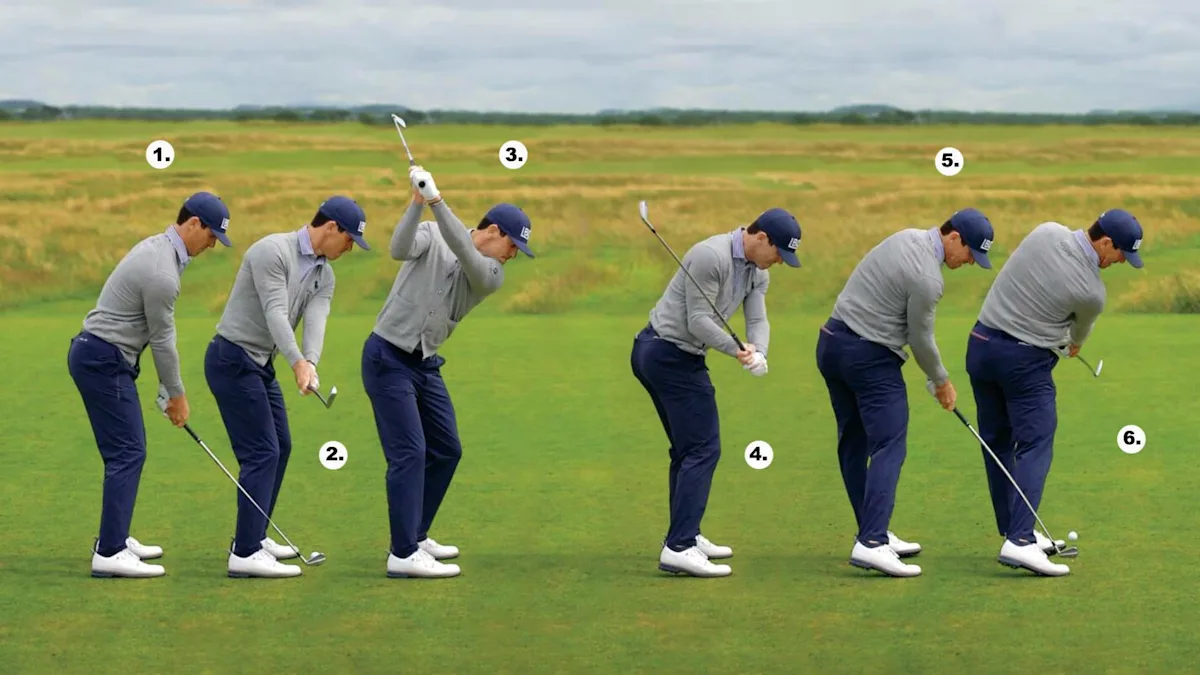
Below, we break down the six critical positions in Horschel’s swing that golfers of all skill levels can learn from.
1. Address
Professional golfers stand much closer to the ball than recreational players. Horschel maintains an optimal distance—close but not overcrowded. His posture features a slight rear-end extension, avoiding an overly straightened back, which sets the foundation for a solid swing.
2. Takeaway
Notice the toe of Horschel’s club pointing skyward during his takeaway—this classic technique helps him soften his trail arm and shoulder, enhancing his body turn. This foundational move allows for a free-flowing swing initiation.
3. Top of the Backswing
Billy’s backswing is compact and efficient. He avoids an overly loose or lengthy motion; his lead wrist remains flat, allowing for a powerful position. Observing the buttons on his sweater pointing away from the target reveals a significant torso turn, essential for generating club speed.
4. Downswing
Horschel skillfully pushes off his trail foot while keeping his chest closed, opening his hips as he begins the downswing. He maintains the shaft’s position between his arms, reminiscent of legends like Jack Nicklaus and David Toms. This is ideal for golfers who struggle with attempting to over-shallow the shaft.
5. Impact Position
At impact, Horschel demonstrates a harmonious balance between a relatively high and forward trail shoulder. He consistently works on this aspect, managing his tendency to retain side bend long after making contact with the ball—critical for optimal striking.
6. Release
In the release phase, Horschel exhibits impressive control over the clubface by positioning his trail arm beneath his lead arm. This technique prevents the clubface from closing too quickly or remaining too open during the follow-through, ensuring a more consistent strike.
Horschel’s swing is a testament to the combination of technical skill and mental prowess. Interested in refining your own swing? Consider focusing on these six key components that have driven his success.
Brian Manzella, a GOLF Top 100 Teacher, shares these insights while instructing at English Turn Golf & Country Club in New Orleans, Louisiana.
Incorporating these principles into your practice can lead to notable improvements in your golf game, mirroring the precision and effectiveness indicative of Billy Horschel’s swing.
