


Tiger’s Masters Hint Signals Something Bigger Than a Comeback
Look, I’ve been around this game long enough to know when Tiger Woods is being coy versus when he’s genuinely signaling intent. And after 35 years covering professional golf—including my time as caddie for Tom Lehman back in the day—I can tell you that his recent comments about Augusta aren’t just feel-good fodder for the sports pages. They’re a calculated message wrapped in careful language, and what he’s really saying deserves your attention.
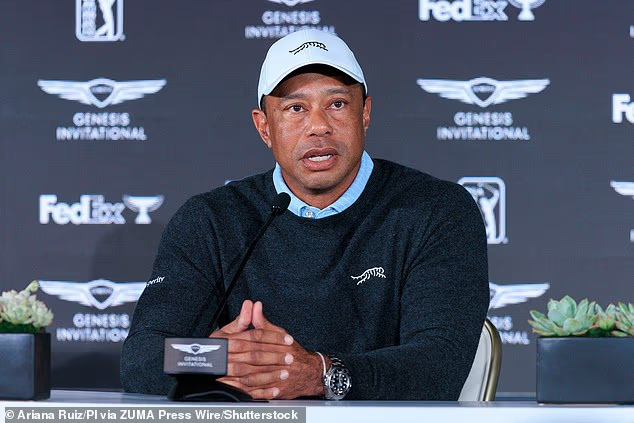
When asked point-blank whether a Masters appearance is off the table, Woods gave perhaps the most loaded single-word answer in recent golf history:
“No.”
That’s not a man ruling out the possibility. That’s a man keeping every door open while his medical team still figures out which ones he can actually walk through.
The New Reality of Tiger at 50
Let’s be honest about the elephant in the room: Tiger Woods just turned 50 years old. He’s had seven back surgeries. He suffered a torn Achilles last March. By any reasonable measure, the odds of seeing him compete at the Masters—let alone perform at the level his legacy demands—seem astronomically low.
But here’s what I think gets lost in the doom-scrolling about his health: Woods isn’t talking about winning. He’s talking about playing. And more specifically, he’s talking about reimagining what his competitive future might look like on different platforms.
His comments about the Champions Tour are particularly telling.
“That’s something that, as I said, I won’t do out here on this tour because I don’t believe in it. But on the Champions Tour, that’s certainly that opportunity.”
Woods is referring to the cart rule—something he’s philosophically opposed to on the PGA Tour—but that he’d be willing to use on the senior circuit. This isn’t resignation. This is pragmatism from a competitor who still wants to compete, just under modified rules.
In my three decades covering the tour, I’ve watched plenty of great players struggle with the identity crisis that comes with aging out of peak competition. Most handle it poorly. Woods seems to be handling it differently—accepting the reality of his body while refusing to accept the narrative that he’s finished.
The Ryder Cup Captain Question
Then there’s the Ryder Cup captain situation for 2027 in Ireland. Woods said the right things about wanting to do justice to Team USA, but read between the lines here.
“I’m trying to figure out what we’re trying to do with our tour… That’s been driving me hours upon hours every day.”
This tells me Woods is deeply invested in the future direction of professional golf—specifically the ongoing integration of PGA Tour, LIV, and whatever other structures are being negotiated. A Ryder Cup captaincy for Tiger isn’t just ceremonial; it’s an anchor point in a rapidly shifting landscape. Whether he can balance that responsibility with his physical limitations remains unclear, but his willingness to even consider it suggests he sees himself as having a role in golf’s future beyond just the occasional tournament appearance.
What This Means for Augusta
Here’s what strikes me most about all this: If Tiger does play the Masters in April, it won’t be the dominant performance we’ve become accustomed to seeing from him. That era is genuinely over. But a missed cut? A respectable showing as a 50-year-old playing his first official event since Royal Troon in 2024? That would be one of the more remarkable stories in recent golf history.
And let’s not overlook the timing. Rory McIlroy arrives at Augusta as the defending champion, having won his first green jacket last year. The narrative writes itself: the old guard (Tiger, potentially) testing the waters against the new generation. The Masters doesn’t need Tiger to make the cut to have one of its most compelling storylines in years.
Realistic Expectations
I want to be clear: I’m not predicting Tiger wins the Masters or even competes seriously for 72 holes. His own words confirm that:
“My body has been through a lot. Each and every day I keep trying, I keep progressing, trying to get it to a level that I can play at the highest level.”
That’s not the language of a man planning to hoist another Claret Jug. It’s the language of someone managing expectations while refusing to surrender hope entirely.
What matters here is the broader picture. Professional golf’s biggest draw—a man who redefined what’s possible in sports recovery—isn’t ready to disappear from the game entirely. He’s exploring new frameworks for competition, new platforms, and new ways to remain relevant. Whether that’s Augusta, the Champions Tour, or a captaincy role, Woods is signaling that retirement, in the traditional sense, isn’t his endgame.
That’s actually pretty encouraging news for a sport that needs its icons as much as its icons need the game.
