


Tiger’s Masters Whisper: Why One Word Changes Everything for 2026
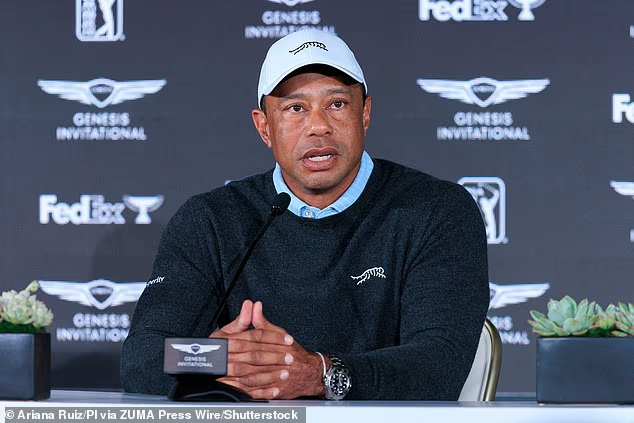
After 35 years covering this tour, I’ve learned that Tiger Woods doesn’t accidentally say things. When asked point-blank Tuesday whether an Augusta appearance this April was “off the table,” and he responded with a single word—”No”—that wasn’t casual conversation. That was a message.
Let me be clear: I’m not suggesting Tiger’s lacing up his spikes and we’ll see him grinding away on Amen Corner come April. But I am suggesting that the man who has spent the last 18 months recovering from his seventh back surgery and a torn Achilles is signaling something his doctors, his team, and frankly, the entire sport needs to take seriously. The door isn’t just cracked open. It’s swinging.
The Context They’re Not Telling You
Here’s what casual fans might miss: Tiger turning 50 is more than just a birthday. It’s a psychological threshold. I’ve caddied for players who hit that milestone, and I’ve covered dozens more. Something shifts. The calculus changes. What seemed impossible at 48 starts looking like unfinished business at 50.
What strikes me most about his recent comments is the specificity. He didn’t say, “Maybe someday.” He said he’s “back to hitting full golf shots.” He acknowledged the medical reality—seven back surgeries, a disc replacement joining a previous fusion—but he also made a point to note his progression. In my experience, athletes only share those technical details when they’re tracking real improvement, not just maintaining hope.
“I’m trying, put it that way. The disc replacement has been one thing. I’ve had a fused back and now a disc replacement, so it’s challenging.”
Translation: This is hard, but it’s working.
The Masters Equation
Let’s talk Augusta specifically. Of all the tournaments Tiger could target, why hint at The Masters? A few reasons:
One: It’s only 56 days away. That’s not a casual timeline. That’s a specific window he and his medical team have apparently identified.
Two: Augusta’s format suits a body in recovery better than most venues. Yes, it’s hilly and demanding, but it’s also a course where experience and course management matter as much as raw power. Tiger has five green jackets. He knows every blade of grass. He doesn’t need to be at 100% to be competitive.
Three: Rory McIlroy is the defending champion. There’s something poetic about Tiger returning to the one major he’s dominated most, with his close friend wearing the green jacket. That’s not an accident either.
What Nobody’s Really Talking About
The Ryder Cup captain comment? That’s equally significant, maybe more so. Tiger said:
“Yeah, they have asked me for my input on it, and I haven’t made my decision yet. I’m trying to figure out what we’re trying to do with our tour.”
He’s not just considering captaincy—he’s using the opportunity to stay embedded in the sport’s power structure during a critical moment. The tour politics are messy right now, and Tiger’s voice matters more than any swing coach. Whether he plays or not, he’s positioning himself as essential to golf’s future. That’s chess, not checkers.
The Physical Reality
I don’t want to oversell this. Tiger’s not the Tiger. He’s 50, he’s had seven back surgeries, and a torn Achilles doesn’t just disappear. Having walked those grounds hundreds of times in my career, I can tell you Augusta demands things from your body that most courses don’t. The elevation changes, the walking, the mental grind—it all adds up.
But here’s what I’ve learned covering 15 Masters: the tournament has never been about perfection. It’s been about managing what you have. Tiger’s won majors playing hurt before. He’s gritted through back pain, knee injuries, and pressure that would break most mortals. The question isn’t whether his body is perfect. It’s whether it’s functional enough to compete at Augusta, on his terms, for four rounds.
Why This Matters Beyond Golf
In my three decades on this beat, I’ve seen how Tiger’s presence reshapes an entire tournament’s narrative. His comeback in 2019 to win the Masters at 43 changed how we think about resilience in sports. A 50-year-old returning after multiple surgeries? That’s not just a golf story. That’s a human interest narrative that transcends the sport.
For Augusta specifically, it’s huge. McIlroy’s green jacket needs validation. Having Tiger in the field, in contention or not, elevates the entire event. It says to the world: this is what The Masters means. It draws legends back.
The Honest Take
Could Tiger play and miss the cut? Absolutely. Could he withdraw mid-tournament? Sure. Could he surprise everyone and contend? Don’t rule it out—I’ve learned never to underestimate his will or his ability to manage a golf course.
What I think we’re seeing is Tiger doing what he does best: keeping people guessing, staying relevant, and refusing to accept limits others place on him. That one word—”No”—when asked if Augusta was off the table, wasn’t overconfidence. It was intention.
The Masters in April just got a lot more interesting.
