

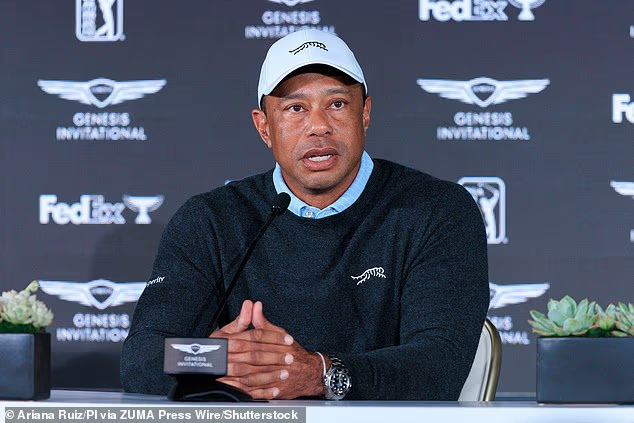

Tiger’s ‘No’ at Augusta: Why One Word Changes Everything for Golf in 2026
When Tiger Woods answered “No” to the question about whether a Masters appearance is off the table, he wasn’t just being cute with the media. In my 35 years covering this tour, I’ve learned that Tiger doesn’t waste words—especially not at 50 years old with seven back surgeries in his rearview mirror. That single syllable might be the most significant thing he’s said about his future since his last competitive round at Royal Troon in 2024.
Let me be clear: I’m not naive enough to believe we’re seeing Tiger in full stride at Augusta in April. But what we’re hearing is something more nuanced and, frankly, more interesting than the standard retirement speculation that’s dogged him for the past 18 months.
The Real Story Behind the Words
Here’s what struck me most about this week’s comments. Woods said something that revealed where his head actually is:
“I’m trying, put it that way. The disc replacement has been one thing. I’ve had a fused back and now a disc replacement, so it’s challenging.”
Notice he didn’t say he’s *hoping* to play. He said he’s *trying*. That’s the language of someone actively engaged in the process, not someone managing expectations on the way toward full retirement. In my experience caddying for Tom Lehman back in the ’90s, that mindset matters. The mental component of recovery—believing you *can* do something versus accepting you *can’t*—shapes everything.
The disc replacement procedure is relatively new territory for professional athletes of Woods’ age and injury history. His willingness to discuss it publicly, and to share that he’s “back to hitting full golf shots,” suggests his medical team believes progression is possible. Would they let him hint at Augusta if he was still in crisis management mode?
Augusta National Has Always Been Different
Here’s something casual fans often miss: The Masters isn’t like any other tournament on the PGA Tour calendar. It’s invitation-only, it’s controlled, and most importantly, Augusta National doesn’t require its competitors to shuttle between events on a grinding schedule. For a player managing a complicated recovery, that flexibility matters enormously.
I’ve watched players make improbable comebacks over three decades—not from nowhere, but from strategic positioning exactly like this. Woods doesn’t need to prove anything on the regular tour right now. But playing Augusta—even if it’s with limitations we don’t yet understand—would be different. That’s a statement event. That’s the kind of appearance that transcends golf statistics.
What also interests me is what Woods said about the future more broadly:
“Now I entered a new decade, so that number is starting to sink in and has us thinking about the opportunity to be able to play in a cart. That’s something that, as I said, I won’t do out here on this tour because I don’t believe in it. But on the Champions Tour, that’s certainly that opportunity.”
This tells us more about his realistic thinking than any injury report could. He’s not delusional about what his body can handle. He’s already mentally preparing for a future where walking 18 holes might not be feasible—and he’s identified a pathway forward through the Champions Tour. That’s not the talk of someone in denial. That’s strategic planning.
The Ryder Cup Question
The Ryder Cup captain speculation is separate but connected. Woods being seriously considered for the 2027 captaincy in Ireland shows the Tour and the PGA of America still see him as central to American golf’s future—not as a player, necessarily, but as a leader and strategist. His willingness to engage with the question, even while hedging, suggests he hasn’t completely closed that door either.
What’s important here is context. The PGA Tour is in genuine transition right now with the ongoing Saudi-backed LIV situation creating complications. Woods has been deeply involved in that conversation. His potential captaincy isn’t just ceremonial—it would be a statement about where American golf is heading.
The Bigger Picture
Rory McIlroy arriving at Augusta as the defending champion—fresh off becoming just the sixth player ever to complete the career Grand Slam—creates an interesting narrative arc. Woods won the Masters at 43 in 2019 in what many thought was impossible. McIlroy finally broke through last April. These aren’t just tournament results; they’re statements about resilience and possibility.
If Tiger does appear at Augusta, even if he doesn’t compete at a championship level, it changes the entire tenor of the tournament. Golf fans don’t just want to see great golf—they want to see great *stories*. A 50-year-old recovering from his seventh back surgery and a torn Achilles, stepping back into the most prestigious tournament in the sport? That’s the kind of narrative that transcends sports journalism.
I’m not predicting a miraculous return. The man’s body has been through legitimate trauma. But I am saying this: Never discount Tiger Woods’ ability to move the needle in golf, or his willingness to attempt the seemingly impossible. We’ve been wrong about what he can’t do before. We should be cautious about being too certain this time.
The Masters in April just got a lot more interesting.
