

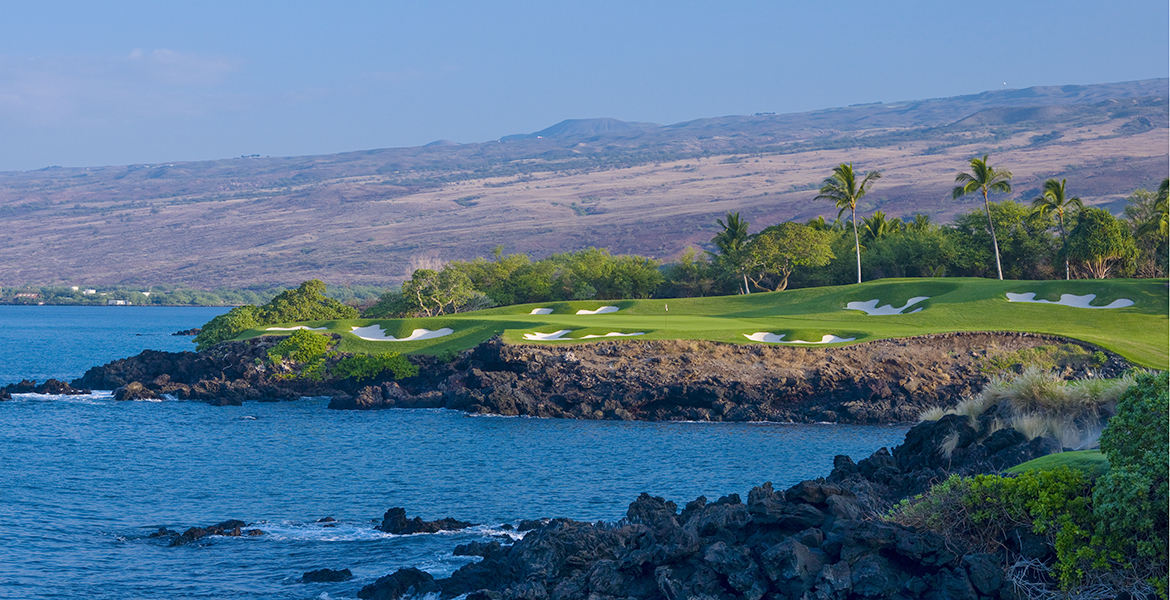

There are courses you play, and then there are courses that play you – courses that etch themselves into your very golfing soul. Mauna Kea Golf Course on Hawaii’s Big Island is unequivocally in the latter category. For me, a pilgrim who has trodden the fairways of over 200 courses across the globe, few places capture the raw, untamed beauty of their surroundings quite like this Robert Trent Jones Sr. masterpiece. It’s a testament to vision, grit, and the audacious belief that golf could not just exist but thrive in the most unlikely of places.
From Lava to Links: A Vision Forged in Fire
Imagine, if you will, the Big Island in 1960. A volcanic landscape, rugged and stark, where the land meets the sea. Laurance Rockefeller, the visionary behind Mauna Kea as a resort, surveyed the undulating, barren terrain. What he saw was a challenge; what Robert Trent Jones Sr. saw was a canvas. This wasn’t merely about laying out 18 holes; it was about inventing a new paradigm for golf course construction.
The very foundation of Mauna Kea’s existence is legendary. Rockefeller, eyeing the volcanic rock-strewn land, doubted a course was even feasible. Jones, ever the pragmatist with a grand vision, knew that the earth itself held the key.
“It depends on whether I can work with lava rock, if it can be crushed and used as a soil base to grow grass,” said Jones. “If it can, and there is enough water, I can build a golf course.”
His son, Robert Trent “Bobby” Jones Jr., recounts the pivotal moment:
“Dad picked up two lava stones and pummeled them together. They fractured. The pieces crumbled and fell to the ground.”
And with that simple, dramatic act, the fate of Hawaiian golf was sealed. Jones, with construction superintendent Homer Flint, even invented a specially ribbed roller to crush the lava into a fine red dust. This “talcum powder”-like material, mixed with coral sand from Kawaihae Harbor, became the very soil structure. The result? As Jones Sr. himself proudly noted, “the cleanest grass you’ve ever seen. There were no weeds, because nothing had ever grown in the material before.” This wasn’t just construction; it was an act of creation, turning desolation into verdant fairways.
The Iconic 3rd: A Symphony of Ocean and Open Air
While the entire course is a masterclass in routing and dramatic elevation changes – Jones used the 300 feet of natural undulation to full effect, bending holes left and right, placing eight greens atop strategic hills – it’s the par-three 3rd hole that truly elevates Mauna Kea into the pantheon of the world’s greatest courses. It’s a signature hole not just for Hawaii, but for golf itself.
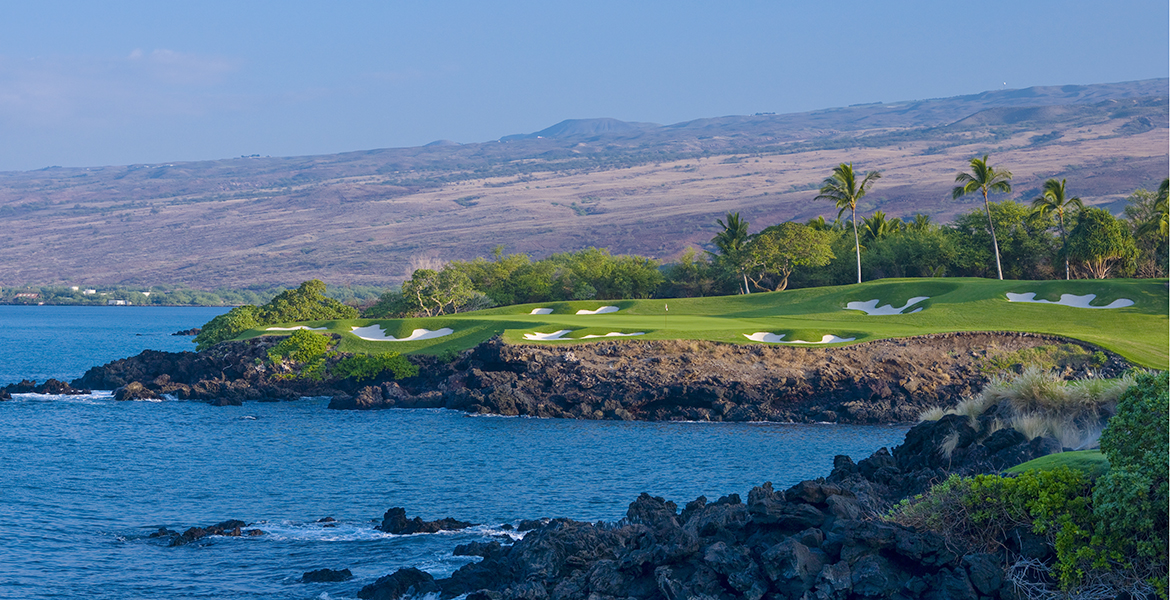
Standing on that isolated tee box, carved into 5,000-year-old lava rock, staring across the vast expanse of pounding Pacific surf to a kidney-shaped green cradled by bunkers, is an experience that transcends mere golf. The wind, ever-present, whispers tales of the ocean and the land. From the original back tee of 250 yards (now 272 yards, a testament to modern equipment), this hole demands commitment, courage, and a healthy dose of awe.
Jones was into drama, as Bobby Jr. noted, and the 3rd hole is pure theatrical brilliance. It is strategic, visually overwhelming, and demands precise shot-making. The aerial approach is not merely suggested but mandated, often requiring an extra club or two to account for the ocean breeze. Its iconic status was cemented almost immediately. Imagine Arnold Palmer, Jack Nicklaus, and Gary Player standing on that very tee during the “Big Three” event in 1964. Player, who famously struggled with the carry, later remarked, “Many of my fondest memories from Mauna Kea are of playing the beautiful par-three hole over the ocean. I had never seen anything like that before.” And indeed, none of us had.
A Masterclass in Routing and Strategy
Beyond the undeniable spectacle of the 3rd, Mauna Kea offers a strategic challenge throughout. Jones’s philosophy of “heroic golf” is evident. The course continually asks questions, presenting wide fairways that invite the drive but then demand precise approaches to well-guarded greens. Perched green complexes, fortified by bunkers, ensure that the aerial attack, common in Jones’s designs, is often the most rewarding route.
What I particularly appreciate about Mauna Kea is how it balances strategic rigor with playability for all. While skilled players relish the shot-making challenges – the need to shape shots, control trajectory in the wind – there are also plenty of downhill holes that offer a sense of exhilaration and reward for the less powerful golfer. It’s a clever design that acknowledges its challenging canvas while remaining enjoyable.
Playing Mauna Kea: What to Expect
Mauna Kea is located on the Kohala Coast of the Big Island, part of the Mauna Kea Resort. Yes, you can absolutely play it, and it’s an experience I highly recommend. It opened in December 1964 and has been delighting golfers ever since. Before you go, understand that this is Hawaiian resort golf perfected. The views are utterly breathtaking, from the deep blue Pacific to the dramatic volcanic landscape. The recent renovation by Robert Trent Jones II has only enhanced these elements, restoring original views and ensuring the course remains immaculate.
When you stand on these fairways, feeling the warmth of the sun and the whisper of the trade winds, you’re not just playing a round of golf; you’re stepping into history. You’re walking where a true architectural pioneer – Robert Trent Jones Sr. – dared to dream big, literally smashing rocks to build what many consider Hawaii’s greatest golf course. It’s a testament to vision, resilience, and the enduring allure of golf played on nature’s most dramatic stage. Every golfer owes it to themselves to experience this masterpiece at least once.
