


Ah, the Golden Age of golf course design in America. A time, roughly between 1915 and 1935, when visionaries like Donald Ross, A.W. Tillinghast, and Alister MacKenzie were shaping not just landscapes, but the very soul of the game. I’ve had the immense fortune to walk the fairways of over 200 courses worldwide, and there’s a certain magic, a timeless quality, that emanates from those Golden Age layouts. They weren’t about brute force or forced carries; they were about strategic brilliance, seamless integration into the natural environment, and a profound respect for the ground game.
The architects of this era understood how to challenge without punishing, to reward thoughtful play, and to create courses that felt as if they had always been there, born from the very land itself. Today, many of these masterpieces remain hallowed grounds, largely inaccessible to the everyday golfer. But thankfully, some shining examples have opened their gates to the public. And one such marvel, a course that exemplifies the strategic genius of its creator, is Pasatiempo.
Pasatiempo: MacKenzie’s Californian Gem
Venturing to Santa Cruz, California, you’ll discover Pasatiempo, a 1929 creation by the legendary Dr. Alister MacKenzie. From the moment you step onto the property, you understand you’re treading on sacred ground. The views alone are worth the trip, with glimpses of the Pacific Ocean dancing in the distance as rolling terrain unfolds before you. This isn’t a course that intimidates with sheer length; its relatively modest 6,495 yards, now playing to a par of 70, might deceive the uninitiated. But quickly, you realize MacKenzie’s brilliance lies in his cunning, not in overwhelming yardage.
“Par has been shaved from 74 to 70 since Dr. Alister MacKenzie’s finest public access course first opened, yet it seldom takes a beating, even at the hands of Ben Hogan, Byron Nelson, or Tiger Woods—none of whom has bettered 67 on the 6,495-yard layout.”
This quote speaks volumes. When legends struggle to break par, you know you’re facing a masterful design. MacKenzie, a true artist of deception, sculpted greens that are famously quick and canted, demanding precision with every approach. Miss in the wrong spot, and you’ll find yourself contemplating escape routes from collection areas that feel like magnets for errant shots. The fairways, often slender and hemmed in by mature trees, force strategic decision-making off the tee. It’s not about blasting it as far as you can; it’s about finding the ideal angle for your next shot, setting yourself up for success on the devilish greens.

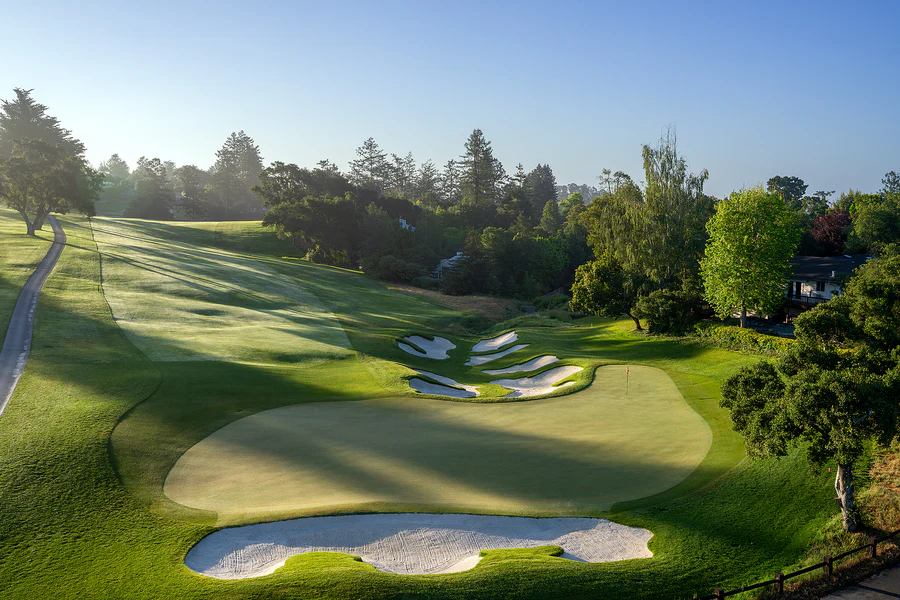
I distinctly remember the 16th hole, a par-3 that stands as one of MacKenzie’s most iconic creations. From an elevated tee, you’re looking down onto a multi-tiered green protected by a deep, cavernous front bunker. The undulations and slopes are severe, making two-putting a significant accomplishment. It’s a hole that lives in your mind long after the round, a perfect microcosm of MacKenzie’s philosophy: challenge the player mentally and strategically, forcing intelligent choices over brute strength.
A Restoration that Honors History
One of the true joys of playing a Golden Age course like Pasatiempo is experiencing its historical authenticity. Architect Jim Urbina’s recent restoration efforts have been lauded for bringing back much of the MacKenzie magic that may have been lost over time.
“A recent Jim Urbina restoration has put back much of the MacKenzie magic.”
This is crucial. Good restoration isn’t about redesigning; it’s about rediscovering the original intent, uncovering the strategic layers the architect embedded in the land. At Pasatiempo, this means reestablishing MacKenzie’s distinctive bunkering – often deep, artfully sculpted, and placed to influence play without simply penalizing every miss. It also means understanding the nuances of how the land was meant to flow, how the greens were originally shaped to repel or accept shots based on the player’s approach.
I find it fascinating how MacKenzie, even without modern equipment and agronomy, understood the subtle manipulations of terrain and perception that could create infinitely varied challenges. The barrancas crisscrossing the course, for instance, aren’t just hazards; they are integral to the strategy, forcing layups or daring carries depending on your risk tolerance.
The Golden Age Legacy: accessible Brilliance
Pasatiempo stands as a testament to the enduring genius of the Golden Age of Golf Course Architecture. While many of its contemporaries might be behind velvet ropes for private club members, Pasatiempo offers a rare and precious opportunity for public access.
“Few of these celebrated layouts are accessible to the public—but several are.”
This distinction is vital for golf architecture enthusiasts like myself. Being able to experience the subtle brilliance of MacKenzie’s work firsthand, to navigate his strategic challenges, and to simply marvel at the harmony between land and design, is an invaluable experience. It’s a journey into the mind of a master, a chance to understand firsthand why this era produced so many enduring masterpieces.
So, if you appreciate the artistry of intelligent design, the thrill of strategic play, and the beauty of a course that feels steeped in history, make the pilgrimage to Pasatiempo. You won’t just play a round of golf; you’ll immerse yourself in a living piece of golf’s Golden Age, an experience that will undoubtedly refine your appreciation for the game and its architectural heritage.
