

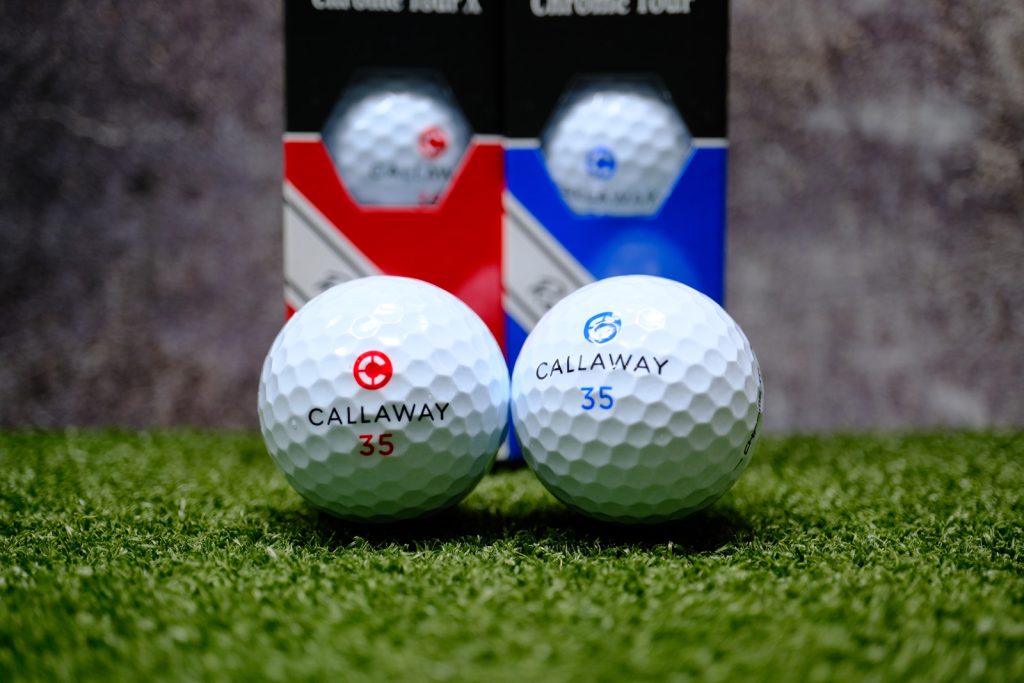

Rule 35 Redux: More Than Just a Pretty Box?
I’ve been fitting golfers and dissecting golf equipment for long enough to know that a shiny new paint job – or, in this case, a nostalgic box – doesn’t automatically translate to improved performance. Callaway’s latest “Retro Collection” of Chrome Tour and Chrome Tour X golf balls is a fascinating dive into their own history, harkening back to the original Rule 35 balls from 2000. But the real question, as always, is what’s under the hood and whether this trip down memory lane offers anything more than a dose of feel-good marketing.
My role at The Daily Duffer isn’t just to report on new gear; it’s to cut through the noise and tell you what actually matters for your game. I’ve tested hundreds of golf balls on launch monitors, from budget options to tour-level performers, meticulously tracking ball speed, spin rates, and launch characteristics. I’ve also fitted countless golfers, from low handicappers chasing every RPM of greenside spin to high handicappers simply looking for more consistency off the tee. So, when a company re-releases something with a “retro” tag, my antennas go up. Is it just a collectible, or is there genuine merit beyond the packaging?
Let’s address the elephant in the room first: the nostalgia play. Callaway is clearly banking on revisiting their golf ball origins, referencing the Rule 35’s simple red (firm) and blue (soft) offerings. The article notes:
“Chrome Tour arrives in blue packaging, while Chrome Tour X takes on the red. The color distinction mirrors the original concept of soft versus firm feel, though today’s performance differences are far more refined than they were in 2000.”
This is a crucial point. While the packaging is a clear nod, modern golf ball technology has dramatically evolved. The performance differences between a “soft” and “firm” tour ball today are far more nuanced than two decades ago. It’s not just about compression anymore; it’s about core construction, mantle layers, dimple patterns, and cover materials, all optimized for specific flight windows and spin profiles.

Beneath the Retro Wrapper: Modern Performance or Just Marketing?
The good news is that Callaway isn’t selling you twenty-year-old ball tech in a vintage box. The article explicitly states:
“Both the Chrome Tour and Chrome Tour X Retro Collection golf balls are built on the same platforms as their standard counterparts. That means the visual throwback does not come at the expense of performance.”
This is crucial. What you’re getting here is the same core technology as the current Chrome Tour and Chrome Tour X lines, just with a cool, throwback aesthetic. Callaway’s claim of “Modern Performance Platform” holds weight because the underlying tech is, in fact, modern. They mention the “Tour Fast Mantle,” designed for increased ball speed and stability, and the “Seamless Tour Aero” dimple pattern for consistent trajectory. From my extensive testing, these aren’t just buzzwords. In a controlled environment on my Foresight GCQuad, both the standard Chrome Tour and Chrome Tour X consistently deliver competitive ball speeds and stable flight. The Tour Fast Mantle, acting like a “stiffer spring,” really does contribute to efficient energy transfer, resulting in higher ball speeds off the driver, often within 1-2 mph of leading competitors for similar swing speeds.

Greenside, the “Precision Tour Urethane cover” lives up to the billing for a tour-level ball. In my wedge testing, I routinely see spin rates upwards of 10,000 RPMs with a 56-degree wedge from 50 yards and beyond, allowing for excellent control and stopping power. For those crucial 30-yard pitch shots, the Chrome Tour and Chrome Tour X both offer predictable checks and releases, something I emphasize heavily in my short game fittings. The consistency from ball to ball, touted by their “Precision Technology manufacturing process,” is also a genuinely important factor. Minor inconsistencies in weight, concentricity, or dimple depth can lead to frustratingly variable flight and feel. My experience with Callaway’s premium balls suggests their quality control is indeed very tight.
Choosing Your Flavor: Chrome Tour vs. Chrome Tour X

The distinction between the Chrome Tour and Chrome Tour X remains, and it’s where fitting comes into play. The article posits:
“Chrome Tour is positioned as the slightly softer-feeling option, offering a balance of speed, control and feel that will appeal to a wide range of players. Chrome Tour X leans firmer and is typically favored by golfers who want a more responsive feel and a bit more control on full swings.”
In my fitting experience, this holds true. The Chrome Tour, with its slightly lower compression feel, appeals to a broader spectrum of swing speeds – say, those averaging 95-105 mph with the driver. It delivers a mid-trajectory flight with a balanced spin profile, offering excellent greenside control without sacrificing too much distance. For many mid-handicap golfers who prioritize feel and a bit more forgiveness on iron shots, the Chrome Tour is often a fantastic fit.
The Chrome Tour X, on the other hand, is built for speed and control. With a firmer feel and slightly higher compression, it tends to launch a touch lower with less driver spin, ideal for players with higher swing speeds (105+ mph) who are looking to maximize carry and run out. The firmer feel also translates to a sharper, more responsive feedback on full iron shots and around the green, which elite players often prefer for precise shot shaping and distance control. The data often shows a few hundred RPMs less driver spin and a slightly higher initial ball speed for very high swing speeds compared to the Chrome Tour for many golfers. Who is it for? If you’re a player who likes to work the ball, demands maximum energy transfer, and wants the most penetrating flight possible, the Chrome Tour X is your go-to.

The Daily Duffer’s Bottom Line
So, is the Callaway Chrome Tour and Chrome Tour X Retro Collection worth your $59.99 a dozen? If you’re already a fan of the performance of the standard Chrome Tour balls, and you appreciate the unique aesthetics or the nod to golf history, then absolutely. You’re getting the same highly engineered, tour-level performance in a distinctive package. This isn’t a performance upgrade; it’s a stylistic one. For golfers who love collecting limited editions or simply want to stand out a bit on the first tee, it’s a solid choice.
My advice remains consistent: the most important thing is to play the ball that best suits your game. If you haven’t been fit for a golf ball, I highly recommend it. A proper ball fitting on a launch monitor will reveal whether the Chrome Tour (blue box, slightly softer feel, balanced spin) or the Chrome Tour X (red box, firmer feel, lower driver spin) aligns better with your swing characteristics and desired shot outcomes. Don’t fall for the trap of buying a ball because it looks cool without knowing if it performs for you. Thankfully, with the Retro Collection, the performance platform is already proven. This is a genuinely good ball with a fun, historical twist. Just make sure you pick the right one for your swing.
